

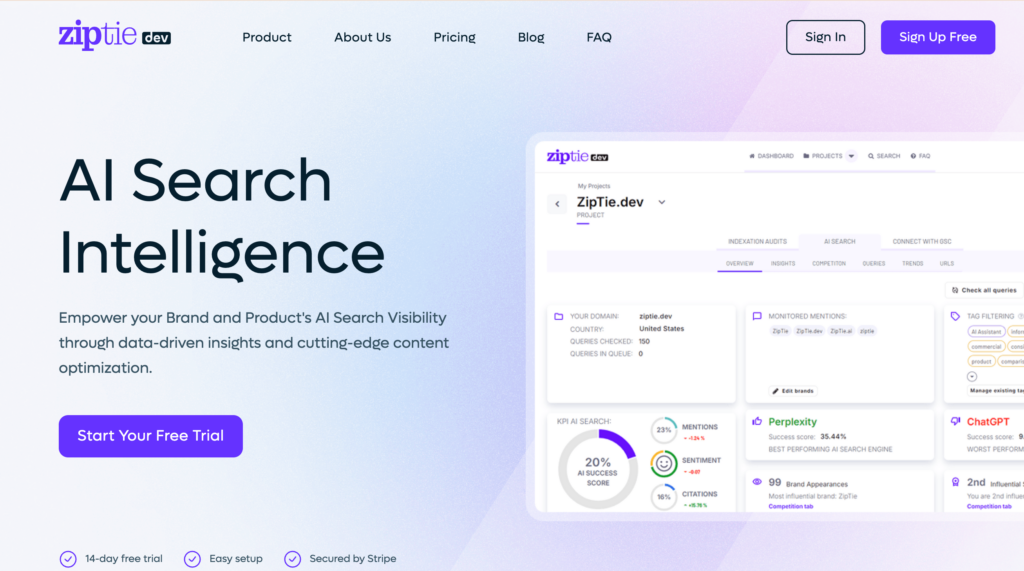
The digital marketing world is currently undergoing its most significant transformation since the invention of the search engine. As we navigate through 2026, the traditional “blue link” search results are being replaced by AI-driven responses. From Google’s Search Generative Experience (SGE) to Perplexity and OpenAI’s SearchGPT, the way users find information has fundamentally shifted. In this new landscape, traditional SEO tools are often blind to how AI models perceive and cite brands. This article offers An In-Depth Guide to the ZipTie AI Search Performance Tool, a specialized AI search performance tool designed to provide visibility into this “black box” of generative search.
For brands and SEO professionals, the challenge is no longer just ranking #1 on a SERP; it is about becoming the “source of truth” that an AI model chooses to synthesize into its answer. ZipTie has emerged as a critical piece of infrastructure in this transition. It allows marketers to track their “Share of Model” and understand the specific triggers that lead an AI to recommend one product over another. This article provides a comprehensive exploration of ZipTie, its technical mechanics, and how it is redefining search performance in an AI-first era.
ZipTie is a performance monitoring and diagnostic platform specifically built for the Generative AI Search era. Unlike legacy tools that focus on keyword rankings and backlink profiles, ZipTie scans AI search engines to see if a brand is mentioned, how it is described, and which specific pages are being used as citations. It is essentially an “audit” tool for the AI’s memory.
The tool operates on the principle of AI Search Optimization (ASO)—a discipline that focuses on influencing Large Language Models (LLMs). Because AI models don’t just “crawl” the web in the traditional sense but rather “ingest” and “summarize” it, ZipTie identifies the content clusters that are most likely to be picked up by an AI’s Retrieval-Augmented Generation (RAG) process. By using ZipTie, companies can move away from guessing and start using data to see which parts of their website are “AI-friendly.”
To understand ZipTie’s value, one must understand how AI search works. When a user asks a question, the AI performs a real-time search, pulls the most relevant snippets, and rewrites them into a cohesive paragraph. ZipTie automates this process at scale. It queries these engines thousands of times across various locations and devices to provide a statistically significant map of a brand’s visibility.
One of the most powerful features of ZipTie is its ability to identify “Information Gain.” AI models prefer content that adds something new to the conversation rather than just repeating what is already on Wikipedia. ZipTie’s algorithms analyze the responses to see what specific unique value propositions (UVPs) are triggering citations. This allows content teams to stop writing “fluff” and start producing the data-rich, authoritative content that LLMs crave. Statistics from early 2026 users suggest that brands using ZipTie to refine their content strategy see a 40% increase in AI citation frequency within the first quarter of implementation.
In traditional SEO, we track Click-Through Rate (CTR) and Position. In ZipTie, the metrics are more nuanced. The tool introduces the concept of Share of Citations. If an AI search engine provides an answer with four links, and one of them is yours, you have a 25% share for that specific query. ZipTie aggregates this data across thousands of keywords to give a macro view of market dominance in AI search.
Another vital metric is Pixel Real Estate. Because AI summaries often take up the entire “above the fold” section of a mobile screen, ZipTie calculates how much of the user’s screen is dedicated to information about your brand versus your competitors. This is a much more accurate predictor of brand awareness in 2026 than old-school impressions. By focusing on these metrics, ZipTie helps businesses justify their marketing spend in an environment where organic traffic from search engines is generally declining, but “brand influence” via AI is rising.
A prominent mid-sized electronics retailer recently faced a 30% drop in organic traffic following a major Google AI update. Using ZipTie, they discovered that while they still ranked #1 for many product terms, the AI summary at the top of the page was citing their competitors for “Best Value” and “Best Warranty” comparisons. The AI was effectively steering users away before they ever saw the organic links.
By using ZipTie’s Competitive Audit, the retailer identified that their warranty information was buried in a PDF that the AI wasn’t properly indexing. They moved that data to a structured FAQ section and used ZipTie to monitor the results. Within three weeks, ZipTie showed that the AI began citing the retailer in the “Best Warranty” summaries. This led to a 12% recovery in total conversions, proving that winning the AI summary is often more important than winning the traditional ranking.
Content creation in 2026 is less about keywords and more about “Entities” and “Relationships.” ZipTie helps content creators understand the “semantic web” through the lens of an AI. For example, if you are a travel agency, ZipTie can show you that for the query “best time to visit Japan,” the AI is currently prioritizing sites that mention “local festival schedules” and “humidity indices.”
This allows for Strategic Content Engineering. Instead of writing a general guide, you can use ZipTie to find the “content gaps” that the AI is currently struggling to fill. When you provide the missing piece of the puzzle, the AI is much more likely to reward you with a prominent citation. ZipTie essentially provides a “cheat sheet” for what the AI feels is missing from its current knowledge base. This proactive approach turns SEO into a data-driven science of providing high-utility information units.
One of the biggest risks of the AI era is the “hallucination”—when an AI search engine makes up false information about a company. This could range from incorrect pricing to claiming a product has features it doesn’t. ZipTie acts as a Brand Safety Guardrail by constantly monitoring what AI models are saying about you.
If ZipTie detects a recurring falsehood in AI summaries, it allows the brand to take immediate action. This usually involves updating the source material that the AI is using or utilizing “Search Engine Relations” tactics to correct the record. In a world where an AI’s word is often taken as gospel by the user, having a tool that alerts you to “AI-driven misinformation” is a critical requirement for any PR or legal team. This shift moves brand management from “monitoring mentions” to “monitoring interpretations.”
As we look toward 2027, the developers of ZipTie are moving into Predictive Analytics. This involves simulating future AI model updates to see how a brand’s visibility might change before the update even rolls out. By analyzing the training data patterns of new models like GPT-5 or the latest Gemini iterations, ZipTie aims to give marketers a “early warning system.”
This predictive capability will allow brands to pivot their strategy months in advance. Imagine knowing that a future AI update will place more weight on “video transcripts” than “text blogs.” Brands using ZipTie would already have their video strategy in place while their competitors are still trying to figure out why their traffic vanished. This “first-mover advantage” is what separates the winners from the losers in the hyper-competitive 2026 market. The tool is evolving from a dashboard of “what is happening” to a compass for “what will happen.”
ZipTie is not meant to replace your entire marketing stack; it is meant to enhance it. It integrates with traditional SEO tools like Ahrefs or Semrush, providing the “AI layer” that those tools lack. For example, you can use Semrush to find high-volume keywords and then use ZipTie to see how those keywords are actually being handled by AI search engines.
Furthermore, ZipTie data can be fed into a CRM or a Business Intelligence (BI) tool. This allows executives to see a direct correlation between “AI Visibility” and “Revenue.” When the CEO asks, “Why are we investing in AI search?” the marketing team can point to a ZipTie report showing that 60% of their new leads came from an AI citation that they specifically optimized for. This level of attribution is the holy grail of digital marketing, and ZipTie makes it possible in an increasingly fragmented digital world.
The rise of AI search has made traditional SEO strategies insufficient. To survive in 2026, brands must understand how AI models synthesize information and choose their sources. The ZipTie AI Search Performance Tool provides the necessary data to navigate this shift, offering insights into citations, share of model, and brand reputation within LLMs.
As search engines continue to evolve into “answer engines,” tools like ZipTie will become as fundamental to marketing as Google Analytics was in the 2010s. The brands that master AI search today will be the household names of tomorrow.