

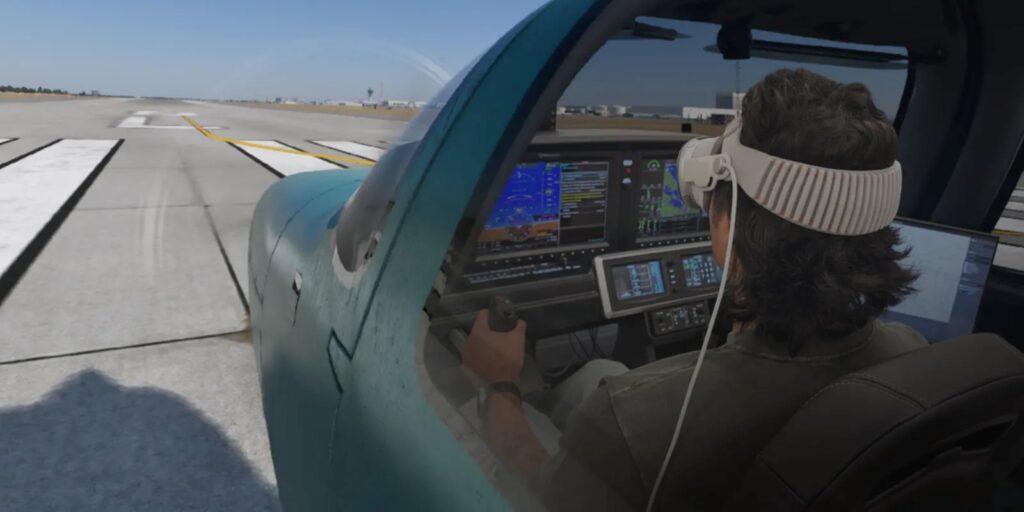
The world of spatial computing and virtual reality just got a big upgrade. Apple Vision Pro now supports Nvidia CloudXR 6.0, bringing powerful cloud VR streaming capabilities to Apple’s high-end mixed reality headset.
This development opens the door for a new type of immersive experience. Instead of relying entirely on the headset’s local hardware, users can stream high-performance VR applications from powerful cloud servers.
For developers, gamers, and enterprise users, this integration could significantly expand what the Apple Vision Pro is capable of. With Nvidia CloudXR 6.0, demanding VR workloads can now run remotely while the headset acts as the display and interaction device.
The result is smoother performance, access to complex simulations, and the ability to run advanced VR experiences that would normally require expensive local hardware.
Nvidia CloudXR is a platform designed to stream virtual reality and augmented reality content from powerful servers to devices such as VR headsets, tablets, and even smartphones.
With CloudXR 6.0, Nvidia improved several key aspects of the platform, including:
Instead of rendering VR graphics directly on the headset, the processing happens in the cloud on high-end GPUs. The final image is then streamed to the user’s device in real time.
This approach allows devices like the Apple Vision Pro to access experiences that would normally require a gaming PC or workstation.
The addition of CloudXR 6.0 support for Apple Vision Pro is significant for several reasons.
Apple’s headset is designed as a powerful spatial computing device, but even it has limits when running extremely demanding VR applications.
Cloud streaming solves this problem.
With CloudXR, Vision Pro users can access:
These experiences can run on powerful servers equipped with Nvidia GPUs, delivering much more processing power than the headset alone.
Streaming VR from the cloud means developers don’t have to worry as much about the headset’s internal processing limits.
The heavy work happens remotely, allowing more complex graphics and physics simulations.
Support for CloudXR could encourage more developers to create VR experiences specifically designed for the Apple Vision Pro.
This may help accelerate the growth of the platform.
Cloud VR streaming is similar to cloud gaming, but it requires even lower latency and higher visual quality.
Here is how the process works.
A powerful server equipped with Nvidia GPUs runs the VR application.
The server renders the VR environment in real time.
The rendered frames are compressed and streamed to the Vision Pro headset.
Head movements, hand gestures, and controller inputs are sent back to the server instantly.
This loop happens continuously, creating a smooth VR experience that feels almost like the application is running locally.
The latest version of Nvidia’s platform introduces several improvements that make cloud VR more practical.
Low latency is critical in VR. Even small delays can cause discomfort.
CloudXR 6.0 includes networking optimizations designed to keep motion-to-photon latency extremely low.
Better compression technology allows high-resolution visuals to be streamed without overwhelming network bandwidth.
This is especially important for headsets like the Vision Pro that feature high-resolution displays.
CloudXR now supports a wide range of devices, making it easier for developers to deploy VR experiences across multiple platforms.
Adding Apple Vision Pro to the list is a major step.
Many companies use VR for training, design, and simulation.
CloudXR 6.0 includes tools that help organizations deploy cloud VR systems across multiple locations.
The combination of Apple Vision Pro and Nvidia CloudXR 6.0 could unlock several powerful use cases.
Companies can use cloud-powered VR to train employees in complex tasks such as:
Because the applications run on servers, organizations can scale training programs more easily.
Architects and engineers often work with extremely detailed 3D models.
Cloud VR allows these models to be rendered on powerful GPUs while designers explore them through the Vision Pro headset.
Researchers working with complex data sets can use cloud VR to visualize information in immersive environments.
This can help with fields like:
Although the Vision Pro is not primarily marketed as a gaming headset, CloudXR could open the door to high-end VR gaming experiences streamed directly from the cloud.
While cloud VR streaming offers exciting possibilities, it also comes with challenges.
High-quality VR streaming requires fast and stable internet connections.
Poor networks can cause lag, which can break immersion.
Running powerful GPU servers is expensive. Companies offering cloud VR services must maintain large data centers.
Even with advanced optimization, streaming VR from distant servers can introduce delays.
This means cloud VR works best when servers are located relatively close to users.
The integration of Nvidia CloudXR 6.0 with Apple Vision Pro reflects a broader shift in how immersive technologies are evolving.
Instead of relying entirely on local hardware, many future VR and AR systems may depend on cloud-based processing.
This approach offers several advantages:
As network technologies like 5G and next-generation Wi-Fi continue to improve, cloud VR could become much more common.
The addition of Nvidia CloudXR 6.0 support for Apple Vision Pro marks an important milestone for cloud-powered immersive computing.
By enabling cloud VR streaming, the integration allows Vision Pro users to access powerful virtual experiences that go far beyond the headset’s built-in hardware capabilities.
For developers, enterprises, and VR enthusiasts, this technology could unlock new types of applications ranging from industrial simulations to immersive design tools.
While challenges like network latency still exist, the partnership between Apple and Nvidia signals a future where spatial computing devices rely more heavily on cloud infrastructure.
As the technology evolves, cloud VR may become a key part of how people interact with virtual worlds.