

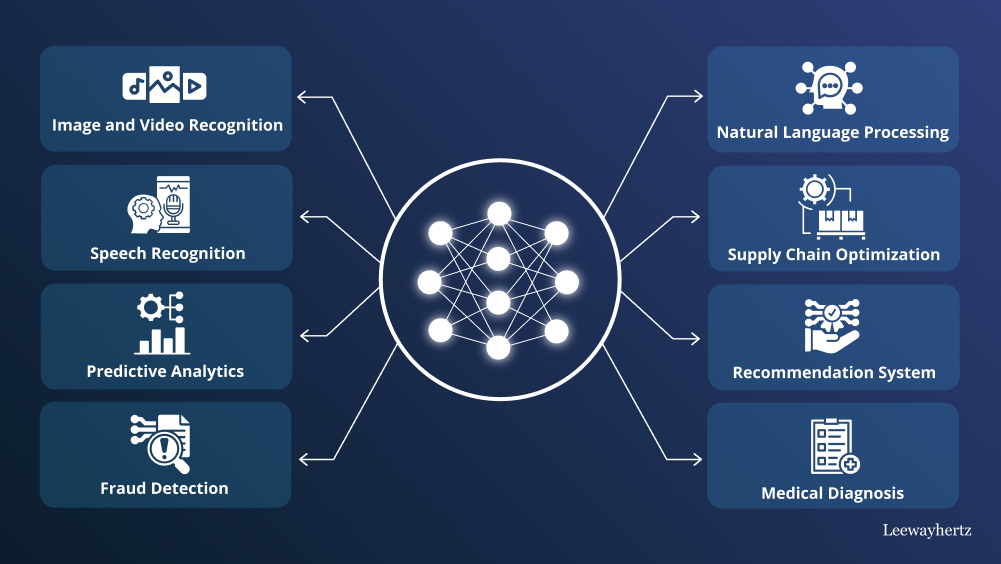
In the fast-moving digital landscape of 2026, image recognition has moved from a novelty to a fundamental utility. The rise of deep learning techniques for image recognition systems has transformed what machines can see and understand. Whether it is a self-driving car identifying a pedestrian in a rainstorm or a medical AI spotting a microscopic tumor, deep learning is the engine behind these “superhuman” capabilities. Unlike traditional computer vision, which relied on hand-coded features, deep learning allows machines to learn representations directly from raw pixel data.
The explosion of visual data—with billions of images uploaded daily to social media and surveillance networks—has provided the “fuel” for these algorithms. Concurrently, advancements in GPU and NPU (Neural Processing Unit) hardware have provided the “engine.” Today, deep learning techniques for image recognition have achieved accuracies exceeding 99% on standardized benchmarks like ImageNet, fundamentally altering sectors ranging from retail to national security.
The Convolutional Neural Network (CNN) remains the bedrock of image recognition. Inspired by the human visual cortex, CNNs use a mathematical operation called “convolution” to scan an image for patterns. In the early layers, the network identifies simple edges and colors. As the data moves deeper, these are combined into textures, then parts of objects, and finally, the objects themselves.
In 2026, CNN architectures have become incredibly efficient. We have moved far beyond the early days of AlexNet (2012). Modern iterations like EfficientNet-V3 use “compound scaling” to balance network depth, width, and resolution. This ensures that high-accuracy recognition can run on mobile devices without draining the battery. CNNs are particularly prized for their “spatial invariance,” meaning they can recognize a cat whether it is in the top-left corner or the bottom-right of a frame.
While CNNs dominated for a decade, the “Vision Transformer” (ViT) has emerged as a powerful challenger in recent years. Borrowing from the “Attention” mechanisms that power Large Language Models like Gemini, ViT treats an image as a sequence of patches, similar to words in a sentence. This allows the model to understand “global context”—the relationship between a hat on a person’s head and the shoes on their feet—much more effectively than a standard CNN.
By 2026, “Hybrid Models” that combine CNNs and Transformers have become the industry standard for complex tasks. These models use CNNs for quick, local feature detection and Transformers for high-level reasoning. Research indicates that while CNNs are better for smaller datasets, Transformers scale significantly better with “Big Data.” On massive datasets of 100 million+ images, ViT-based systems often outperform traditional networks by several percentage points in top-1 accuracy.
One of the most practical techniques in modern deep learning is “Transfer Learning.” It is rarely efficient to train a model from scratch. Instead, engineers take a “Pre-trained Model”—one that has already learned to recognize millions of general objects—and “fine-tune” it on a specific task, such as identifying defects in semiconductor wafers.
In 2026, libraries of pre-trained models are highly specialized. A developer in the agricultural sector might download a model pre-trained on “Earth Observation Data” (satellite imagery) rather than general photos. This reduces the required training data by up to 90% and slashes carbon emissions associated with AI training. Statistics show that 85% of commercial image recognition systems now utilize some form of transfer learning, making high-end AI accessible to small startups.
A major hurdle in image recognition is the “Data Gap.” If you want to recognize a rare disease, you might only have ten photos of it. Deep learning requires thousands. Generative Adversarial Networks (GANs) solve this by creating “Synthetic Data.” One part of the AI (the Generator) creates fake images, while the other (the Discriminator) tries to spot the fakes. Through this competition, the AI learns to create incredibly realistic training samples.
By 2026, GANs are used to create “Edge Case” scenarios for autonomous vehicles. It is dangerous to drive a car into a crowd to get training data; instead, GANs generate thousands of photorealistic variations of pedestrians in low-light, snow, or fog. This “Data Augmentation” ensures that recognition systems are robust against rare but critical events. Synthetic data has grown so sophisticated that some models are now trained on 70% “fake” data with no loss in real-world performance.
The impact of deep learning is perhaps most profound in healthcare. In 2025, a landmark study showed that a “Multi-Stage CNN” could identify skin cancer with 15% higher accuracy than a board of twenty dermatologists. The system doesn’t just look at the mole; it analyzes skin texture, symmetry, and even subtle vascular patterns invisible to the human eye.
In 2026, these systems have moved to the “Edge”—meaning they run directly on handheld ultrasound probes in rural clinics. By automating the “triage” process, image recognition allows doctors to focus on the most urgent cases. However, this has introduced the “Black Box” challenge: doctors need to know why an AI flagged an image. This has led to the rise of “Explainable AI” (XAI), which generates heatmaps showing exactly which pixels led to a specific diagnosis.
Image recognition is often about more than just saying “this is a car.” It involves “Object Detection” (where is the car?) and “Instance Segmentation” (which pixels belong to the car?). Techniques like YOLOv10 (You Only Look Once) have revolutionized real-time processing. YOLO processes the entire image in a single pass, making it fast enough to run at 120 frames per second on modern hardware.
In the industrial world of 2026, segmentation is used for “Robotic Bin Picking.” A robot in a warehouse must recognize a specific item among a jumble of thousands. Deep learning allows the robot to “see” the specific orientation of a product and calculate the perfect grip point. This level of precision has increased warehouse automation efficiency by 40% over the last three years. The ability to distinguish between overlapping objects is the current “gold standard” of the industry.
[Image showing an adversarial example: Panda + Noise = Gibbon]
As image recognition becomes more powerful, its flaws become more dangerous. “Algorithmic Bias” remains a critical issue; if a model is trained mostly on images of people from one demographic, its accuracy for others drops significantly. In 2026, new regulations require “Bias Audits” for any image recognition system used in public sectors like law enforcement or hiring.
Another rising threat is the “Adversarial Attack.” By adding a tiny amount of invisible “noise” to an image, a malicious actor can trick an AI. For example, a stop sign with a specific, nearly invisible sticker might be read by a self-driving car as a “Speed Limit 65” sign. Researchers are currently in an “arms race,” developing “Adversarial Training” techniques to make neural networks more resilient to these digital illusions. Privacy also remains a top concern, leading to the development of “Federated Learning,” where AI models are trained on user devices without the actual photos ever leaving the phone.
The next frontier in 2026 is “Self-Supervised Learning.” Currently, most AI requires humans to “label” images (e.g., “this is a dog”). Self-supervised models learn by playing “hide and seek” with the data—hiding a part of an image and trying to predict what goes there. This allows models to learn from the trillions of unlabeled images on the internet, moving us closer to how a human child learns by simply observing the world.
Furthermore, “Neuro-Symbolic AI” is gaining traction. This approach combines the pattern recognition of deep learning with the logical reasoning of traditional “if-then” programming. If a deep learning model sees a “flying car,” the symbolic logic layer can flag it as a potential error based on the laws of physics. This hybrid approach promises to make image recognition not just faster and more accurate, but more “sensible” and trustworthy.
Deep learning has fundamentally changed how machines interact with the visual world. From the foundational power of CNNs to the contextual intelligence of Vision Transformers, we have moved from simple pattern matching to a complex understanding of scenes. The integration of Transfer Learning and Synthetic Data has democratized this power, allowing every industry to benefit from high-fidelity vision.
Key Takeaways:
In 2026, image recognition is no longer a separate “feature”—it is a core sensory input for the digital age. As we move toward more autonomous systems, the techniques discussed here will be the difference between a tool that merely “looks” and a system that truly “sees.” The evolution of deep learning ensures that the machine’s eyes are becoming as sharp, and perhaps more insightful, than our own.