

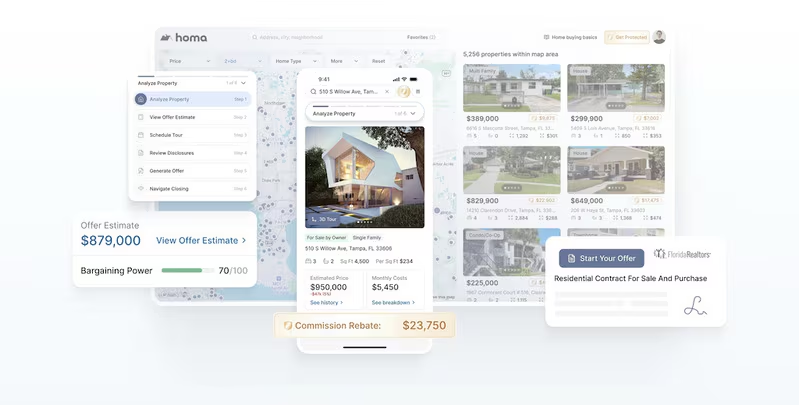
The real estate industry is no longer just about location, location, location. Today, it’s also about data, automation, and artificial intelligence. From virtual tours to price predictions, AI-powered real estate platforms are changing how people buy, sell, and invest in property. What once took weeks of work can now be done in minutes with the help of smart algorithms.
In this article, we’ll explore what AI-powered real estate platforms are, how they work, their key benefits, and why they’re becoming essential for agents, buyers, investors, and developers around the world.
AI-powered real estate platforms are digital property platforms that use artificial intelligence and machine learning to automate tasks, analyze large amounts of data, and provide smarter insights. These platforms go beyond simple property listings. They can:
Predict property prices
Recommend suitable homes for buyers
Analyze investment risks
Automate customer support
Detect market trends in real time
Popular platforms like Zillow, Redfin, and Compass already use AI to improve search accuracy, pricing tools, and user experience.
In simple terms, AI turns raw real estate data into practical, easy-to-understand decisions.
AI in real estate is powered by a mix of big data, machine learning models, and predictive analytics. These systems analyze millions of data points, such as:
Property prices
Buyer behavior
Mortgage rates
Neighborhood safety
Infrastructure development
Market demand
From there, the AI learns patterns and makes predictions. For example, when you search for a home, the platform doesn’t just show random listings. It learns your preferences—budget, location, property size—and keeps improving recommendations over time.
Some platforms even use computer vision to analyze property photos and detect features like pools, garden sizes, and renovation quality automatically.
AI helps users find homes faster and more accurately. Instead of scrolling through hundreds of listings, the platform only shows properties that match your behavior and needs. This saves time and reduces frustration for buyers.
AI can estimate property values instantly based on recent sales, market trends, location, and property condition. Tools like “instant home value” remove guesswork for sellers and help buyers avoid overpaying.
Many platforms now offer AI-driven virtual tours, allowing users to walk through properties from their phones or laptops. This feature became extremely popular after the pandemic and is now a standard tool in digital real estate.
AI chatbots provide 24/7 customer service, answering questions about pricing, availability, financing, and scheduling viewings. This reduces workload for agents and improves customer experience.
AI can predict whether prices in a certain area will go up or down. Investors use this feature to identify the best locations for future profit and avoid risky markets.
With AI-generated insights, users no longer rely on guesswork. Price trends, demand levels, and investment predictions are available instantly.
Humans can make mistakes when analyzing data. AI reduces errors by processing massive amounts of information with high precision.
Each user gets a customized experience based on search behavior, budget, location, and preferences. The more you use the platform, the smarter it becomes.
AI platforms make property data more transparent. Buyers can compare prices fairly, while sellers can price their homes based on real market value.
For agents and developers, AI helps target the right buyers, recommend the right properties, and close deals faster.
AI-powered platforms are also transforming property investment and mortgage financing. Investors now rely on AI to:
Calculate ROI accurately
Analyze rental demand
Predict long-term price growth
Identify undervalued properties
On the finance side, banks and fintech companies use AI to assess credit risk, approve loans faster, and reduce fraud. This creates a smoother experience for homebuyers applying for mortgages.
Major tech companies like OpenAI, Google, and Amazon indirectly support real estate AI through cloud computing, data processing, and machine learning tools.
These technologies power the engines behind modern real estate platforms, making AI faster, more scalable, and more affordable for businesses of all sizes.
Despite its benefits, AI in real estate is not without challenges.
AI platforms collect sensitive data related to finances, location, and personal preferences. Without proper security, this data can be misused.
If AI is trained on biased data, it can produce biased results, especially in property pricing or loan approvals.
Some users may rely too much on AI estimates without checking real-world conditions. Human judgment is still essential in property decisions.
Building and maintaining AI systems requires significant investment in technology and skilled professionals.
AI doesn’t just help with pricing and search—it also changes how properties are marketed:
Personalized ads based on user behavior
Automated email marketing for property alerts
Smart lead scoring for agents
AI-generated listing descriptions
Social media targeting based on buyer intent
This makes marketing more efficient and reduces wasted advertising budgets.
The use of AI in real estate is growing rapidly in countries like the United States, the UK, China, Singapore, and Australia. Even in developing markets, proptech startups are using AI to digitize traditional real estate processes.
In Southeast Asia, including Indonesia, AI-powered property platforms are helping buyers compare prices, check legal status, and explore properties without visiting them in person.
The future of AI-powered real estate platforms looks even more exciting. In the next few years, we can expect:
Fully automated buying and selling processes
Voice-based property search
AI-driven smart contracts with blockchain
Advanced fraud detection
Integration with smart city systems
Hyper-accurate price forecasting
Eventually, buying a home may become as simple as chatting with an AI assistant and approving a digital contract.
AI-powered real estate platforms are no longer a futuristic concept—they are already shaping how the property industry works today. From instant property valuations and virtual tours to predictive analytics and automated marketing, AI is making real estate faster, smarter, and more transparent.
For buyers, it means better decisions and less stress. For sellers and agents, it means faster deals and higher efficiency. And for investors, it means smarter strategies with lower risk.
The real estate world is changing fast, and AI is leading the transformation. Those who adapt early will have a major advantage in the digital property era.