

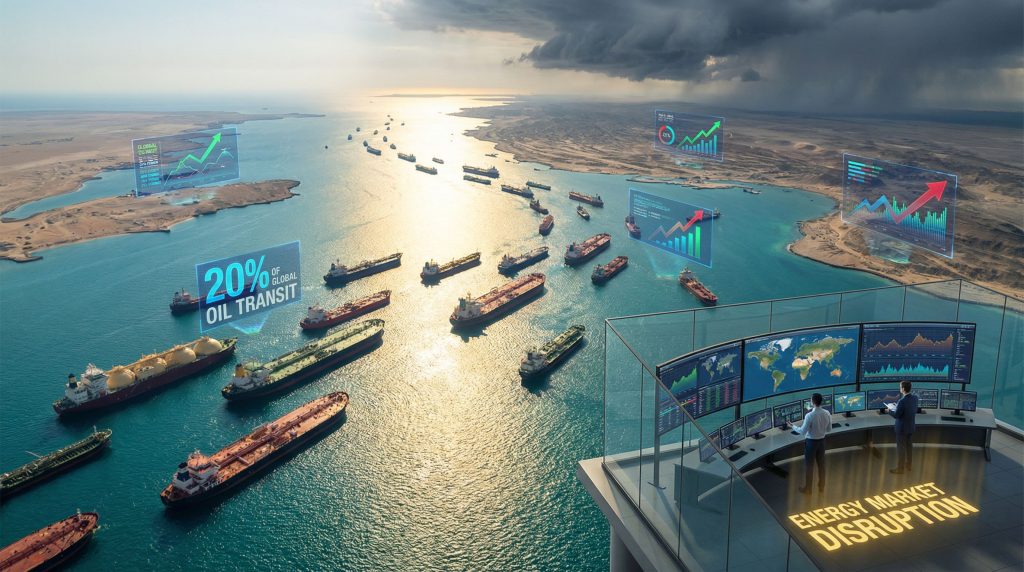
As we navigate the complexities of 2026, the specter of the “oil crisis” has evolved from a historical ghost of the 1970s into a recurring modern challenge. How the Oil Crisis Reshapes Global Transportation and Industry is a topic of significant relevance today. Whether driven by geopolitical tension, supply chain bottlenecks, or the natural depletion of easily accessible reserves, a spike in oil prices sends a shockwave through the global economy. Oil is not just a fuel; it is the lifeblood of modern civilization, serving as the primary energy source for moving goods and the essential feedstock for thousands of industrial products.
When the flow of oil is restricted or its cost skyrockets, the “multiplier effect” takes hold. Transportation costs rise, which in turn increases the price of every physical good delivered to a consumer. Simultaneously, heavy industries—from plastics to pharmaceuticals—face surging input costs. This article explores the deep-seated structural impacts of oil crises on the world’s most vital sectors and examines how these shocks are accelerating a permanent shift toward alternative energy paradigms.
Transportation accounts for approximately 60% of global oil consumption. It is the sector most immediately and visibly affected by an oil crisis. From the family car to the massive container ships crossing the Pacific, the reliance on petroleum-based fuels (gasoline, diesel, and jet fuel) creates a direct link between the price at the pump and the health of the global economy.
In 2026, the “Diesel Squeeze” has become a particularly acute problem for the trucking industry. Unlike passenger vehicles, which are rapidly electrifying, heavy-duty long-haul trucking remains tethered to diesel. When fuel prices rise by 50%, the operating margins of logistics companies disappear. Statistical data from recent market shifts indicates that for every 10% increase in crude oil prices, the cost of ground freight logistics increases by roughly 3%, a cost that is almost always passed down to the end consumer, fueling general inflation.
While transportation burns oil for energy, the industrial sector uses it for both energy and material. The petrochemical industry is perhaps the most vulnerable. Crude oil is the raw material for ethylene and propylene, the building blocks of the modern world. Everything from the insulation in your walls to the polyester in your clothes and the plastic in your medical devices originates from a barrel of oil.
During an oil crisis, industrial manufacturers face a “double whammy.” First, the energy required to run massive furnaces and chemical reactors becomes more expensive. Second, the raw material itself costs more. This creates a supply-side shock. In 2025, during a period of restricted supply, the cost of synthetic rubber and high-density polyethylene (HDPE) rose by 40% in six months, causing a slowdown in the automotive and packaging industries globally.
One of the most significant “silver linings” of an oil crisis is the accelerated adoption of Electric Vehicles (EVs). When gasoline prices stay high for an extended period, the “total cost of ownership” (TCO) for EVs becomes significantly more attractive to the average consumer. In 2026, we are seeing a “tipping point” where the psychological fear of oil volatility is outweighing “range anxiety.”
A case study of the 2022-2023 energy shock in Europe showed that EV registrations jumped by 28% in regions where fuel prices exceeded $2 per liter. Manufacturers are responding by diverting investment away from Internal Combustion Engines (ICE) and toward battery technology. However, the industrial challenge remains: the machines that build the EVs and the ships that transport them still largely run on the very oil the world is trying to escape. This “transition paradox” highlights the difficulty of decoupling from petroleum.
The era of “hyper-globalization”—where a product might cross the ocean three times during manufacturing—was built on the back of cheap, reliable oil. An oil crisis makes long-distance supply chains prohibitively expensive. In 2026, “Near-Shoring” has become the dominant strategy for industrial giants. Companies are moving manufacturing closer to the end consumer to reduce the “oil-miles” embedded in their products.
For example, North American companies that previously relied on East Asian manufacturing are increasingly moving operations to Mexico. This shift is not just about labor costs anymore; it is about energy security. By reducing the physical distance a product must travel, companies insulate themselves from the volatility of international bunker fuel prices and shipping surcharges. This is fundamentally altering the industrial geography of the planet, favoring regional trade blocs over globalized ones.
Heavy industries like steel and aluminum production are among the most energy-intensive on earth. While many of these plants run on electricity or natural gas, an oil crisis often drives up the price of all energy sources through a process called “inter-fuel substitution.” When oil is expensive, demand for natural gas and coal increases, driving up the entire energy complex.
In 2026, industrial leaders are responding with “Circular Metallurgy.” This involves recycling existing metals at a much higher rate, as recycling aluminum requires 95% less energy than producing it from virgin ore. During an oil crisis, the “scrap value” of industrial materials becomes a key economic indicator. This shift is turning industrial waste into a strategic resource, reducing the sector’s overall exposure to the volatile price of a barrel of crude.
An oil crisis is never just an economic event; it is a geopolitical one. Nations that are net importers of oil face massive trade deficits and currency devaluation during a crisis. This has led to a new era of “Industrial Sovereignty.” Governments in 2026 are increasingly treating energy and transportation as matters of national security, providing massive subsidies for domestic battery manufacturing and renewable energy.
The “Inflation Reduction Act” in the US and similar “Green Deals” in the EU are direct responses to the vulnerability exposed by energy shocks. By subsidizing the transition away from oil, these nations are attempting to “de-risk” their entire industrial bases. However, this leads to new dependencies—specifically on the rare earth minerals required for magnets and batteries. The “Oil Crisis” of today is effectively the “Mineral Crisis” of tomorrow, as industry trades one finite resource for another.
The impact of an oil crisis eventually filters down to the individual worker. In the transportation sector, independent owner-operator truckers are often the first to go bankrupt when diesel prices spike. In the industrial sector, high energy costs can lead to “curtailment”—the temporary shutting down of factories to save money—which results in furloughs and lost wages for millions.
Furthermore, the rising cost of transportation affects the “commuter economy.” In 2026, companies are seeing a renewed demand for remote work whenever oil prices spike, as the cost of driving to a physical office becomes a de facto pay cut for employees. This is creating a “dual-speed” workforce: those in digital industries who can pivot away from oil-based costs, and those in physical industries (manufacturing, logistics) who remain vulnerable to every tick of the commodity clock.
The impact of an oil crisis on transportation and industry is profound and permanent. While short-term spikes lead to immediate pain at the pump and in the grocery aisle, the long-term effect is a fundamental restructuring of how we move and make things. The transportation sector is moving toward a multi-modal, electrified future, while the industrial sector is embracing circularity and “near-shoring” to shorten its exposure to global volatility.
Key Takeaways:
Ultimately, the oil crises of the 2020s are serving as the final “push” for the global economy to enter a post-petroleum era. While the transition is fraught with economic friction and industrial challenges, the result will be a global system that is more resilient, more localized, and significantly less dependent on the volatile price of a single carbon-based commodity. The “Crude Awakening” is leadng us toward a more sustainable industrial dawn.