

The Strait of Hormuz is often called the world’s most important oil artery. Located between Oman and Iran, it is a narrow strip of water just 21 miles wide. Yet, it serves as the main exit for most of the oil and natural gas (LNG) produced in the Middle East. As we look at the world in 2026, any trouble in this small area remains the biggest threat to the global economy. The impact of Strait of Hormuz disruption on energy markets is a key concern for policymakers and investors alike.
If this path is blocked, the shock would be felt everywhere. It would shake financial markets, cause prices to jump, and force countries to change how they trade. History shows that even the threat of closing the Strait can send oil prices spinning. This article looks at what would happen to our money, our fuel, and our safety if this vital route were ever disrupted.
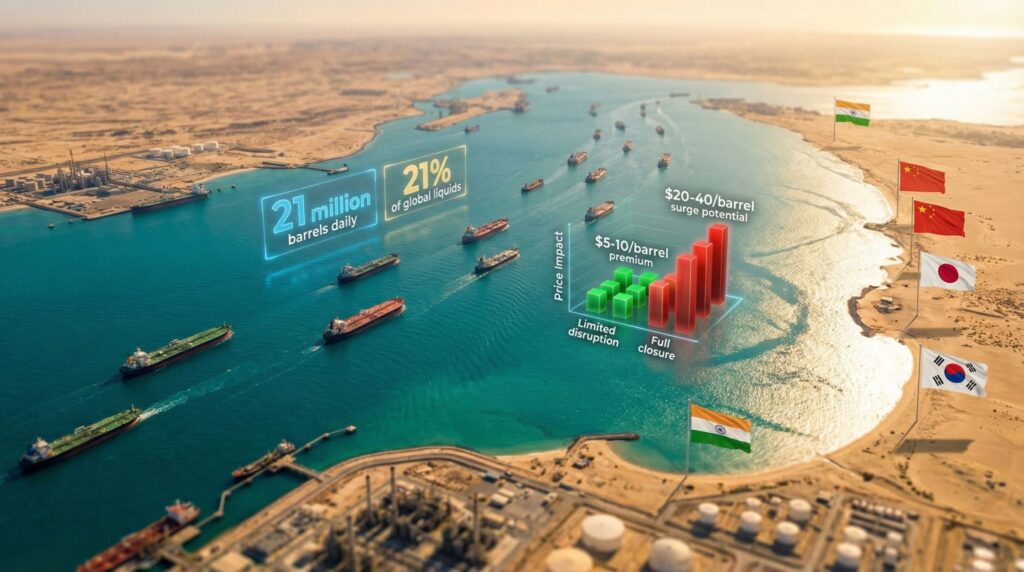
To see the danger, you have to look at the massive amount of energy moving through these waters. By early 2026, the Strait handles about 21 million barrels of oil every single day. That is roughly 21% of all the oil used in the world.
It isn’t just about oil; it is also about gas. Qatar, a top seller of Liquefied Natural Gas (LNG), uses this route to send power to Europe and Asia. If the Strait closed, gas prices would skyrocket, causing a crisis even worse than the one seen in 2022. In our modern world, a physical block in the Strait is like cutting the power cord to the global economy.
The Strait of Hormuz is more than a waterway; it is a tool for power. Iran controls the northern coast and has often threatened to close the Strait when facing international pressure. In 2026, as old alliances change, the value of controlling this “chokepoint” is higher than ever.
Experts often worry about “gray zone” activities. This means instead of a full war, nations might seize tankers or use drones and sea mines to cause trouble. Each time something like this happens, the price of oil goes up. Traders add a “risk fee” to every barrel because they aren’t sure if the next shipment will arrive safely.
When energy stops flowing through Hormuz, prices go up fast. But the real damage happens next. Energy is needed to make almost everything. When it costs more to fuel ships, trucks, and planes, the price of everything from fruit to phones goes up too.
In a worst-case scenario, oil could hit $200 a barrel. This would lead to “stagflation”—a mix of high prices and a failing economy. Central banks would be stuck. They would want to raise interest rates to stop inflation, but they would also want to lower them to help businesses survive. For many people, this means losing jobs while life gets much more expensive.
A common question is: “Why can’t we just use pipes?” While there are some pipelines, they aren’t big enough to move all the oil that currently goes by ship. Saudi Arabia and the UAE have pipes that bypass the Strait, but they have limits.
Currently, these pipes can only move about 7 million barrels a day. That leaves a massive gap of 14 million barrels with nowhere to go. Also, these pipes can be attacked or broken. For gas (LNG), there is no other way out at all. If the ships cannot sail through Hormuz, the gas simply stays in the ground.
To see what could happen, we look back at the Iran-Iraq War in the 1980s. During the “Tanker War,” both sides attacked oil ships to hurt each other’s money. Over 500 ships were hit, and the U.S. Navy had to step in to protect them.
That war taught us two things. First, the world can survive if there is extra oil elsewhere (like from the North Sea). Second, keeping the Strait open is very expensive and hard. In 2026, the stakes are higher. Our “just-in-time” world is much more fragile today, and we trade much more than we did forty years ago.
While a Hormuz crisis hurts everyone, it is a nightmare for Asia. China, Japan, South Korea, and India are the world’s biggest buyers of Gulf oil. For them, Hormuz is the first door they must pass, with the Strait of Malacca being the second.
China has spent billions on new roads and pipes across Asia to avoid these sea routes. However, by 2026, these land paths still only carry a small amount of what they need. A block in Hormuz would lead to power cuts in Asian cities. This would stop factories from making the electronics and cars that the rest of the world relies on.
If oil stops flowing, the world uses its “Strategic Petroleum Reserve” (SPR). These are massive piles of oil kept for emergencies. Most big countries keep enough oil to last for at least 90 days.
But there is a catch. Many countries used up part of their reserves in 2022 to keep prices low. In a 2026 crisis, seeing these reserves drop quickly might actually make people panic more. Also, these reserves can only replace the oil; they cannot fix the mess of thousands of ships being stuck in the wrong place.
A crisis in the Strait hits more than just oil prices. Because oil is so important, its price is tied to millions of investments and retirement funds. If oil prices explode, investors might get scared and sell their stocks to cover their losses.
In 2026, computer trading means this panic would spread in seconds. We could see a “flash crash” where the value of the stock market drops instantly. Poorer countries that owe money in U.S. dollars would find it impossible to pay their debts, potentially leading to a global wave of bankruptcies.
The constant threat of trouble in the Strait is a big reason why countries are moving to green energy. For many, switching to wind, solar, or nuclear power isn’t just about the climate—it’s about safety. Every bit of power made at home is power that doesn’t depend on a ship passing through a dangerous area.
By 2026, more people are using electric cars. However, big factories, planes, and ships still need oil. This means that even as we use more green energy, the oil we do use is even more important for keeping the world moving. The Strait of Hormuz is just as vital today as it was decades ago.
Finally, there is the cost of preventing a crisis. Nations spend billions of dollars every year to keep navies in the region. This “safety tax” is part of the cost of our reliance on Middle Eastern oil, even if we don’t see it at the gas station.
In 2026, the military risks are new. Drones and advanced missiles mean that keeping the Strait open is harder than ever. A simple mistake by any side could start a war that closes the Strait for months. The cost of such a war would be impossible to measure, both in lives and in money.
The Strait of Hormuz is the “weakest link” in our global energy chain. As we have seen, a block there would lead to:
In 2026, the world is trying to be more prepared. But the truth remains: the stability of those 21 miles of water is the foundation of our global economy.