

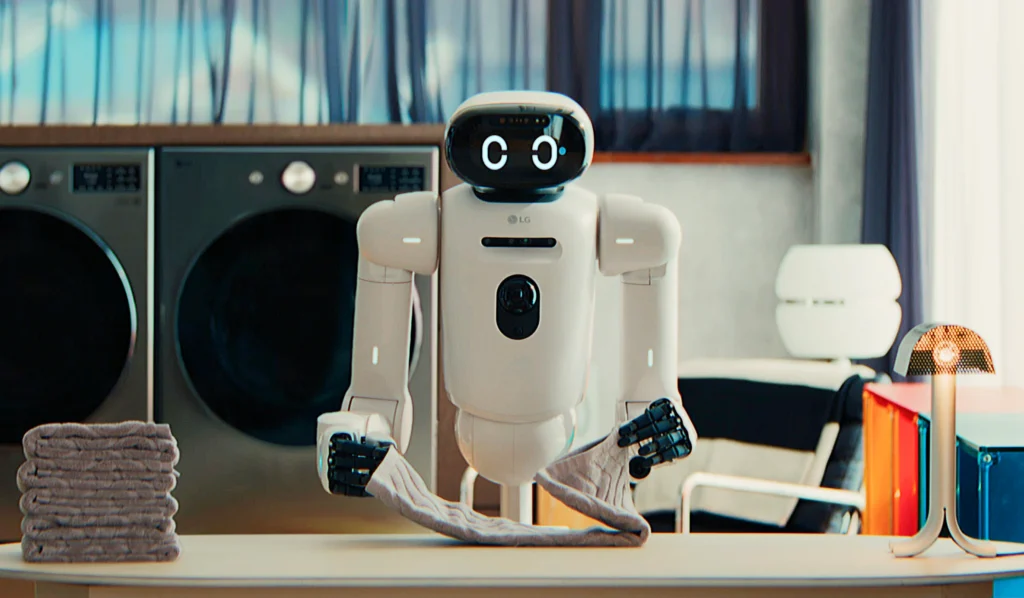
Smart homes are no longer just about voice assistants and connected lights. With the rise of home robots, the idea of having an AI-powered helper moving around your house is starting to feel very real. One of the most interesting examples comes from LG with its CLOiD Home Robot, a friendly-looking AI robot designed to assist with daily household tasks and interact naturally with users.
LG has been investing heavily in robotics for years, and CLOiD represents the company’s vision of how robots can fit into everyday life—not as cold machines, but as helpful, approachable companions.
What Is LG CLOiD Home Robot?
LG CLOiD Home Robot is part of LG’s broader CLOi (pronounced “kloy”) robotics lineup. Unlike industrial robots or delivery bots, CLOiD is designed specifically for indoor, home use. It combines artificial intelligence, sensors, cameras, and smart home integration to help users manage chores, monitor their homes, and interact with smart appliances.
From the outside, CLOiD looks intentionally friendly. Its compact body, smooth white design, and expressive digital face are meant to make users feel comfortable rather than intimidated. This design choice reflects LG’s belief that home robots need to blend into daily life, both physically and emotionally.
A Robot That Understands Your Home
One of CLOiD’s main strengths is its ability to understand and adapt to its environment. Equipped with cameras and sensors, the robot can navigate around furniture, recognize objects, and avoid obstacles. Over time, it learns the layout of your home, making its movements smoother and more efficient.
CLOiD can also connect to LG’s smart home ecosystem. This means it can interact with LG appliances like washing machines, air conditioners, and smart TVs. For example, the robot could notify you when laundry is done, adjust room temperature, or remind you to clean an appliance based on usage data.
This level of integration turns CLOiD into more than just a robot—it becomes a mobile control center for your smart home.
Helping With Daily Tasks
While CLOiD isn’t meant to replace humans, it can definitely make daily routines easier. One of the showcased use cases is laundry assistance. CLOiD can monitor washing cycles, remind users to move clothes from the washer to the dryer, and even help organize laundry schedules.
In addition, the robot can act as a personal assistant. It can deliver reminders, answer questions, provide weather updates, and help manage daily schedules. For busy households, this kind of support can reduce mental load and help everyone stay organized.
Some concepts even show CLOiD assisting elderly users by checking on them regularly, reminding them to take medication, or alerting family members if something seems wrong.
AI That Feels More Human
LG emphasizes natural interaction as a key feature of CLOiD. Instead of relying only on voice commands, the robot uses visual recognition and contextual understanding. It can recognize familiar faces, respond to gestures, and adjust its behavior based on who it’s interacting with.
This approach makes CLOiD feel less like a gadget and more like a presence in the home. The expressive digital face plays a big role here, showing simple emotions or reactions that help users understand what the robot is doing.
By combining conversational AI with visual cues, LG aims to create a more intuitive and comfortable user experience—especially for children and older adults.
Privacy and Security Concerns
As with any AI-powered device that uses cameras and microphones, privacy is a major concern. LG states that CLOiD is built with security in mind, using encrypted data and giving users control over what information is collected and stored.
Users can choose when cameras or microphones are active, and data processing is designed to comply with global privacy standards. Still, the idea of a robot moving around your home and observing daily activities raises important questions about trust and transparency.
LG knows that for home robots to succeed, users need to feel confident that their personal data is safe.
Designed for the Future of Living
LG CLOiD Home Robot isn’t just about today’s needs—it’s about anticipating how people will live in the future. As households become more connected and AI becomes more capable, robots like CLOiD could take on a larger role in managing homes.
Think about energy efficiency, for example. CLOiD could monitor appliance usage and suggest ways to reduce electricity consumption. It could also support remote work by managing home environments for productivity, such as adjusting lighting and temperature based on time of day.
For families, CLOiD could act as a central hub for communication, reminders, and shared schedules, helping everyone stay in sync.
Competition in the Home Robot Space
LG is not alone in exploring home robotics. Companies like Samsung, Amazon, and several startups are also working on AI-powered home assistants with physical mobility. However, LG’s advantage lies in its deep experience with home appliances and consumer electronics.
By integrating CLOiD with its existing ecosystem, LG can offer a more seamless experience than competitors who rely mainly on third-party devices. This could be a key factor in making CLOiD appealing to consumers already invested in LG products.
Is CLOiD Ready for Mass Adoption?
While LG has demonstrated impressive prototypes and concepts, widespread adoption of home robots still faces challenges. Cost is a major factor—advanced AI robots are not cheap. There’s also the question of real-world usefulness: users need to feel that the robot genuinely adds value to their lives.
LG seems aware of this and is focusing on practical use cases rather than flashy demos. By positioning CLOiD as a helper that supports daily routines, LG is trying to make the robot feel necessary rather than optional.
Final Thoughts
LG CLOiD Home Robot offers a glimpse into a future where AI is no longer limited to screens and speakers. With its friendly design, smart home integration, and focus on everyday assistance, CLOiD represents LG’s vision of how robots can become trusted partners in the home.
While there are still hurdles to overcome—especially around cost and privacy—the concept shows how far home robotics has come. CLOiD isn’t just about technology; it’s about redefining how humans and machines live together.
If this vision becomes reality, home robots like CLOiD could soon feel as normal as smart TVs or washing machines. And when that happens, the idea of a robot folding laundry or reminding you of your schedule might not sound futuristic at all—it might just feel convenient.