

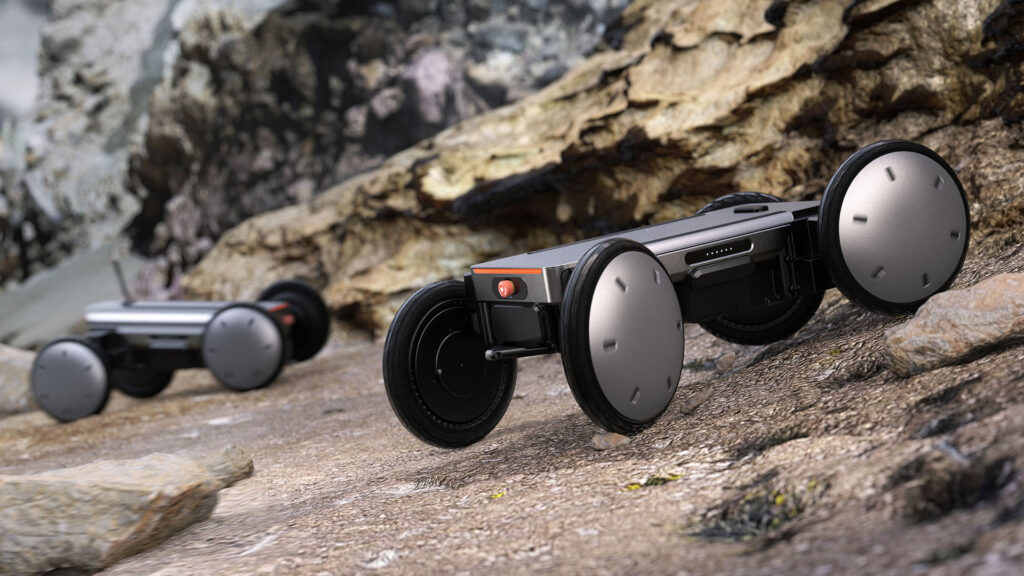
When people think about mobility, they usually imagine cars, buses, or maybe electric scooters. But Hyundai Motor Group is looking far beyond traditional vehicles. One of its most interesting projects in recent years is MobED, a compact, autonomous mobility platform designed to move in ways that regular vehicles simply cannot.
MobED is not just another robot or concept vehicle. It represents Hyundai’s broader vision of how mobility could work in a future where cities are smarter, spaces are more crowded, and technology is expected to blend naturally into everyday life.
MobED stands for Mobile Eccentric Droid, a name that reflects both its robotic nature and its unusual movement system. At first glance, MobED looks like a small, box-shaped platform sitting on four large wheels. But once it starts moving, it becomes clear that this device is very different from anything on the road today.
Unlike conventional vehicles, MobED is designed to remain stable even while traveling over uneven surfaces. It can tilt, adjust its height, and maintain balance using a combination of advanced suspension technology, sensors, and software.
In simple terms, MobED is a self-driving mobility platform that can carry people, equipment, or devices while staying remarkably steady.
The most distinctive feature of MobED is its eccentric wheel system. Each wheel includes its own independent suspension and steering, allowing the platform to respond quickly to changes in terrain. If one wheel hits a bump or moves onto a slope, the others adjust in real time to keep the top surface level.
This is especially important for applications where stability matters. Whether MobED is carrying sensitive equipment, a camera system, or even a person, the goal is to reduce shaking and sudden movement.
MobED also uses a range of sensors, including cameras, LiDAR, and other perception technologies, to understand its surroundings. These sensors help it navigate autonomously, avoid obstacles, and adapt to different indoor and outdoor environments.
Unlike modified cars or delivery robots adapted from existing designs, MobED was built specifically with autonomy in mind. Its electric drive system allows precise control of speed and direction, while onboard computers handle navigation and balance control.
Because of its size and low center of gravity, MobED can operate safely in areas where larger vehicles would struggle. This makes it especially suitable for locations like airports, warehouses, campuses, factories, and even crowded urban spaces.
Hyundai sees MobED not as a single product, but as a platform that can be adapted for many different use cases.
MobED’s flexibility is one of its strongest points. Instead of being locked into one role, it can serve multiple functions depending on how it is configured.
For example, MobED could be used as:
An autonomous delivery platform inside large facilities
A mobile base for security or surveillance systems
A robotic assistant in factories and logistics centers
A camera platform for filming or inspection
A personal mobility solution for controlled environments
Its ability to move smoothly over uneven ground also makes it suitable for outdoor spaces like parks, construction sites, or event venues.
One of the key ideas behind MobED is that mobility doesn’t always mean transportation from point A to point B at high speeds. Sometimes, mobility means bringing movement to services.
In this sense, MobED fits well into Hyundai’s vision of Mobility as a Service (MaaS). Instead of owning a vehicle, users interact with mobile platforms that deliver services on demand. MobED can act as a moving workspace, a delivery assistant, or a functional robot that supports daily tasks.
This approach is especially relevant as cities become more focused on efficiency, sustainability, and automation.
Because MobED is intended to operate around people, safety plays a major role in its design. Its moderate speed, compact size, and stable movement help reduce risks in shared spaces.
The platform is designed to move predictably and smoothly, which makes it easier for people to feel comfortable around it. Clear visual cues and controlled motion help avoid sudden movements that could cause concern or confusion.
This focus on human-friendly design highlights that MobED is not meant to replace people, but to work alongside them.
MobED is not an isolated experiment. It fits into Hyundai Motor Group’s larger push into robotics and smart mobility. Over the past few years, Hyundai has invested heavily in robotic technology, including service robots, industrial automation, and advanced mobility platforms.
By developing projects like MobED, Hyundai is exploring how robotics can blend with automotive engineering. Motors, batteries, sensors, and software developed for vehicles are finding new life in robotic systems.
This cross-industry approach gives Hyundai an advantage in building reliable, scalable robotic platforms.
While MobED is impressive, it is still an early-stage platform. Real-world deployment will require further testing, regulatory approval, and adaptation to specific use cases.
Battery life, cost, and large-scale deployment remain important challenges. Autonomous systems must also prove their reliability over extended periods, especially in busy or unpredictable environments.
However, concept platforms like MobED exist precisely to explore these challenges and improve future designs.
MobED matters because it changes how people think about mobility. It shows that movement doesn’t have to look like a car or follow traditional rules of transportation.
By focusing on stability, adaptability, and autonomy, Hyundai is exploring mobility solutions that serve practical needs beyond personal travel. In many ways, MobED represents the convergence of robotics, automotive technology, and smart infrastructure.
Even if consumers never buy a MobED for personal use, the technologies behind it will likely influence future robots, autonomous vehicles, and mobility platforms.
MobED offers a glimpse into a future where mobility is smaller, smarter, and more specialized. Instead of one vehicle trying to do everything, multiple purpose-built platforms work together to support daily life.
For Hyundai, MobED is a statement of intent. It shows that the company sees mobility not just as transportation, but as a flexible service made possible by robotics and automation.
As cities and industries continue to evolve, concepts like MobED may quietly shape how people move, work, and interact with technology—sometimes without even noticing it.