

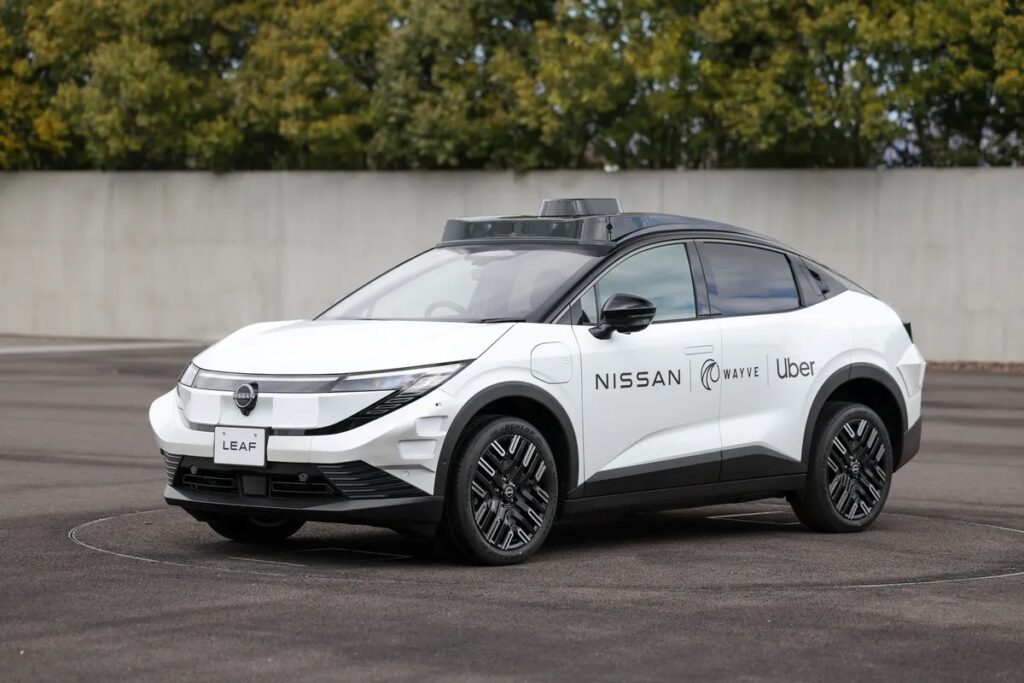
The race to build the future of transportation is getting more intense. A new partnership between Nissan, Uber, and Wayve aims to bring robotaxis to the streets of Tokyo. The companies recently announced plans to launch an autonomous ride-hailing service in the Japanese capital, marking another big step toward driverless mobility in one of the world’s most advanced urban environments.
If everything goes according to plan, Tokyo could soon become one of the first cities where regular commuters can hail a robotaxi directly from their phones. The collaboration combines Nissan’s vehicle manufacturing expertise, Uber’s massive ride-hailing platform, and Wayve’s cutting-edge AI driving technology.
Let’s break down what this robotaxi project means, how it will work, and why Tokyo was chosen as the testing ground.
Launching a robotaxi service isn’t something a single company can easily pull off. It requires expertise in cars, artificial intelligence, and large-scale transportation networks. That’s why this project brings together three companies with different strengths.
Here’s how each partner contributes:
1. Nissan – The Vehicle Manufacturer
Nissan will provide the vehicles used for the robotaxi fleet. The Japanese automaker has been investing heavily in autonomous driving technology and smart mobility solutions for years. Their cars will serve as the physical platform equipped with sensors, cameras, and onboard computing systems.
2. Uber – The Ride-Hailing Platform
Uber will integrate the robotaxi service into its existing app. That means riders will likely book autonomous rides the same way they already order regular Uber trips. With millions of global users, Uber provides the digital infrastructure needed to manage ride requests, routing, and payments.
3. Wayve – The AI Driving Technology
London-based startup Wayve is responsible for the autonomous driving software. Unlike traditional self-driving systems that rely heavily on detailed mapping, Wayve focuses on AI-based learning models that adapt to real-world driving environments.
This combination of hardware, software, and platform services is what makes the robotaxi project possible.
Choosing Tokyo as the launch location was not random. The city offers several advantages for testing autonomous mobility.
Tokyo already has advanced infrastructure that supports innovation in transportation. Smart traffic systems, well-organized roads, and reliable connectivity make it easier to test autonomous vehicles safely.
Japan’s government has been actively promoting autonomous driving development. Officials see driverless vehicles as a solution to transportation challenges, especially with an aging population and a shortage of professional drivers.
Tokyo’s busy streets provide a complex environment for testing AI driving systems. If a robotaxi can successfully navigate Tokyo traffic, it will likely perform well in many other cities around the world.
While the companies have not revealed every detail yet, the general idea of the service is already clear.
Passengers will open the Uber app and request a ride just like they normally would. Instead of a human driver arriving, an autonomous vehicle powered by Wayve’s AI will show up.
The system will likely operate in stages:
At first, the robotaxi fleet will operate in limited areas of Tokyo. Safety operators may remain inside the vehicle during early trials to monitor the system.
Once the technology proves reliable, the service area could expand to more districts within the city.
Eventually, the goal is to remove the human safety operator entirely, allowing the robotaxi to function as a fully autonomous ride-hailing service.
One of the most interesting aspects of this project is the technology developed by Wayve.
Traditional autonomous vehicle systems rely on extremely detailed maps and pre-programmed driving rules. Wayve, however, uses a machine learning approach that allows the car to learn how to drive by analyzing huge amounts of real-world data.
Some key features of Wayve’s AI system include:
End-to-end learning models that process camera inputs directly
Adaptive driving behavior that improves over time
Less dependence on high-definition maps
Scalable deployment across different cities
This approach could potentially make autonomous driving more flexible and easier to roll out globally.
The Nissan-Uber-Wayve partnership is part of a much bigger global race to dominate robotaxi services.
Several companies are already developing or deploying similar systems.
For example:
Waymo, owned by Alphabet Inc., operates robotaxi services in several US cities.
Tesla continues to develop its autonomous driving technology with plans for a future robotaxi network.
Chinese companies like Baidu are also expanding autonomous taxi programs in multiple cities.
The launch in Tokyo could strengthen Japan’s position in this rapidly evolving industry.
If successful, robotaxi services could bring major changes to urban transportation.
Autonomous vehicles are designed to remove human errors such as distraction, fatigue, or drunk driving. That could significantly reduce accident rates over time.
Without the need for human drivers, ride-hailing companies could reduce operational costs, potentially making rides cheaper for passengers.
Robotaxis could provide mobility options for people who cannot drive, including elderly individuals and people with disabilities.
AI-controlled fleets can optimize routes, reduce congestion, and improve overall traffic flow in crowded cities.
Despite the excitement, autonomous ride-hailing still faces several challenges before becoming mainstream.
Governments must create new regulations for fully driverless vehicles. Safety testing and certification will be critical before large-scale deployment.
Many people remain skeptical about riding in a car without a human driver. Building trust will take time and consistent safety performance.
Autonomous systems still struggle with certain complex situations such as extreme weather, unpredictable pedestrian behavior, and unusual road conditions.
The Tokyo pilot program will likely play an important role in addressing these challenges.
The partnership between Nissan, Uber, and Wayve signals that the autonomous mobility revolution is accelerating.
Instead of a distant concept, robotaxis are quickly becoming a real transportation option in major cities. If the Tokyo project proves successful, similar services could expand to other urban areas across Asia, Europe, and North America.
For Uber, integrating autonomous vehicles could eventually reshape its entire business model. For Nissan, it’s a chance to position itself as a leader in smart mobility. And for Wayve, this deployment could demonstrate the power of AI-driven autonomous systems at scale.
In short, the streets of Tokyo might soon give us a glimpse of what everyday transportation could look like in the near future.
And if the robotaxi experiment works, the next time you order a ride, the driver might not be human at all.