

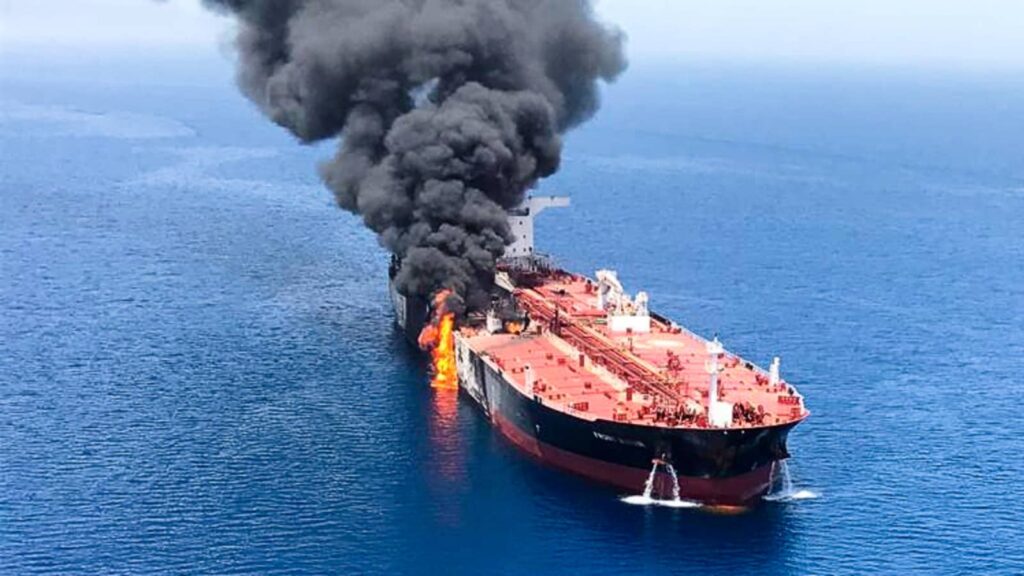
The Strait of Hormuz is often called the “world’s jugular vein.” This narrow stretch of water connects the Persian Gulf to the open ocean. It is the most important shipping path on the planet. For decades, it has been the center of a high-stakes power struggle. In 2026, a new wave of Oil Tanker Attacks in Strait of Hormuz Crisis has made the global energy market very nervous. This crisis is not just a local fight; it is a threat to the entire world economy.
At its narrowest point, the Strait is only 21 miles wide. The actual paths for ships are even smaller—just two miles wide in each direction. Every day, about 20 to 21 million barrels of oil flow through this tiny gap. That is nearly one-fifth of all the oil the world uses. When tankers are attacked here, the effects are felt everywhere, from gas stations in the U.S. to factories in Asia. This article looks at the history, tactics, and results of this dangerous crisis.
The ways people disrupt tanker traffic have changed since the 1980s. In the past, navies fought openly. Today, attackers use “gray zone” tactics. These are hostile acts designed to stay just below the level of an all-out war. This makes it hard for other countries to stop the attacks without starting a much larger conflict.
The main tool today is the “limpet mine.” These are small magnetic bombs that divers or small boats stick to the side of a ship. They are made to disable a vessel, not necessarily to sink it. This allows the attacker to send a strong political message while claiming they didn’t do it. In early 2026, reports showed these mines are becoming more high-tech. Some now have sensors that “listen” for a specific ship’s engine before they explode.
To understand the crisis, you have to look at the map. The Strait of Hormuz is the only way out for ships leaving the Persian Gulf. Most of the oil and gas from Saudi Arabia, Qatar, and Kuwait must pass through this funnel. There are very few other ways to move this much fuel.
In 2026, big Asian countries still rely on this route for almost everything. Japan and South Korea get more than 80% of their energy through this Strait. For China, it is over 40%. Any trouble in these waters quickly becomes a national security crisis for these nations. Because Iran controls the northern coast, they have a lot of power over the world’s energy supply.
The current crisis got much worse in late 2025. Several tankers were seized, not by pirates, but as a political move. After some Iranian money was frozen in Western banks, their navy began a “tit-for-tat” campaign. They would stop a foreign ship for “pollution rules” as a way to force a deal.
One famous case was the Starlight Horizon. This massive ship was carrying two million barrels of oil. Commandos dropped from helicopters onto the deck at night while the ship was in open water. Global oil prices jumped 15% in just two days. The U.S. Navy moved more ships to the area, but they couldn’t just attack. The water was too narrow and full of mines. The ship stayed captured for months. This shows how hard it is for big navies to stop these types of stealthy attacks.
The first victim of these attacks is the shipping business. When a region is declared a “War Risk Area,” the cost of doing business goes up. Ship owners have to pay extra fees called “War Risk Premiums.” These can cost tens of thousands of dollars every day.
In the 2026 crisis, these fees have hit record highs. For a normal tanker, the cost of insurance for one trip has gone up 400% since 2024. These costs are eventually paid by you at the gas pump. Also, many ship owners are now too scared to go into the Gulf at all. This creates a shortage of ships, which drives oil prices even higher. It is a cycle of economic pain that affects everything from the price of plastic to home heating.
To fight this threat, several countries have teamed up. They formed groups like the International Maritime Security Construct (IMSC). Their job is to watch over tankers and provide escorts. Seeing a billion-dollar warship sailing next to a rusty oil tanker is now common in the Strait.
However, the navy cannot protect every ship. There are hundreds of tankers in the Gulf, but not enough warships to go around. Instead, they use a “monitored” system. They use drones and satellites to track every vessel. If a tanker reports trouble, a nearby warship sends a helicopter. The risk in 2026 is that having so many warships in one small area increases the chance of an accidental fight between the U.S. and Iran.
Attackers are now using cheap drones, so the defense must improve. In this crisis, we are seeing the first use of AI at sea. These systems use computers to scan the horizon. They can tell the difference between a harmless fishing boat and a “suicide drone” looking for a target.
Navies are also testing laser weapons. Standard missiles cost too much to fire at a $20,000 drone. A laser shot costs only a few dollars. The race between the “saboteurs” and the “protectors” is the most active part of military research today. For tankers, having high-tech cameras and “panic buttons” connected to the navy is now a standard rule for entering the Strait in 2026.
We often forget the sailors who work on these ships. For a crew, sailing through the Strait in 2026 is terrifying. Many now call the Strait “The Gauntlet.” The threat is always there: you could be hit by a drone while sleeping or taken prisoner for months.
This stress is causing a “brain drain” in the shipping world. Many experienced officers are quitting. They simply refuse to work on routes in the Persian Gulf. When ships are seized, the crews are held as pawns in a political game they didn’t start. The human side of this crisis is often ignored, but the whole world’s energy trade depends on these brave people.
Beyond the money, there is a huge risk to nature. The Persian Gulf has rare coral reefs and vital plants that clean salt out of water. Millions of people in the UAE and Qatar depend on this water for drinking. If a tanker is actually sunk, the oil spill would be a disaster.
A major spill could shut down water plants, leaving millions thirsty within days. In 2026, environmental groups warned that attacks are getting bolder. If an attacker accidentally hits an oil tank instead of the engine, the damage to the region’s health would be worse than any economic crisis. The Gulf is a closed sea, so oil doesn’t wash away easily.
Countries in the Gulf have tried to build “insurance” pipelines. Saudi Arabia and the UAE have pipes that carry oil to the Red Sea, skipping the Strait entirely.
However, these pipes are not enough. They can only carry about one-third of the oil that usually goes by ship. Also, these pipelines can be attacked by drones too. In 2026, the world is realizing that pipelines cannot replace massive tankers. The only real solution is to keep the water safe and stable, but that is very hard to do right now.
The tanker crisis of 2026 feels like it might never end. We are in a state of “unstable balance.” Everyone knows that closing the Strait would cause a global depression, but no one wants to back down.
The path forward will likely involve more private security on ships. We might also see “neutral zones” in the water guarded by many nations, including China and India. Until the big political fights in the region are solved, the oil tanker will remain a target. This crisis reminds us that even in our high-tech world, we still depend on one narrow stretch of water and the people who sail it.
The oil tanker attacks in 2026 show how the world’s need for fuel meets new, high-tech warfare. Key points to remember:
No Real Shortcut: Pipelines help, but the world still needs the Strait of Hormuz to stay open.