

When most people think about a Category 5 hurricane, the first images that come to mind are chaos, destruction, and danger. Winds stronger than 250 kilometers per hour, massive waves, and rain that seems endless. For humans, being anywhere near a storm like that is extremely risky. For scientists, it’s almost impossible to collect real-time data from inside the hurricane itself.
But a new ocean robot built by a startup called Oshen is changing that reality.
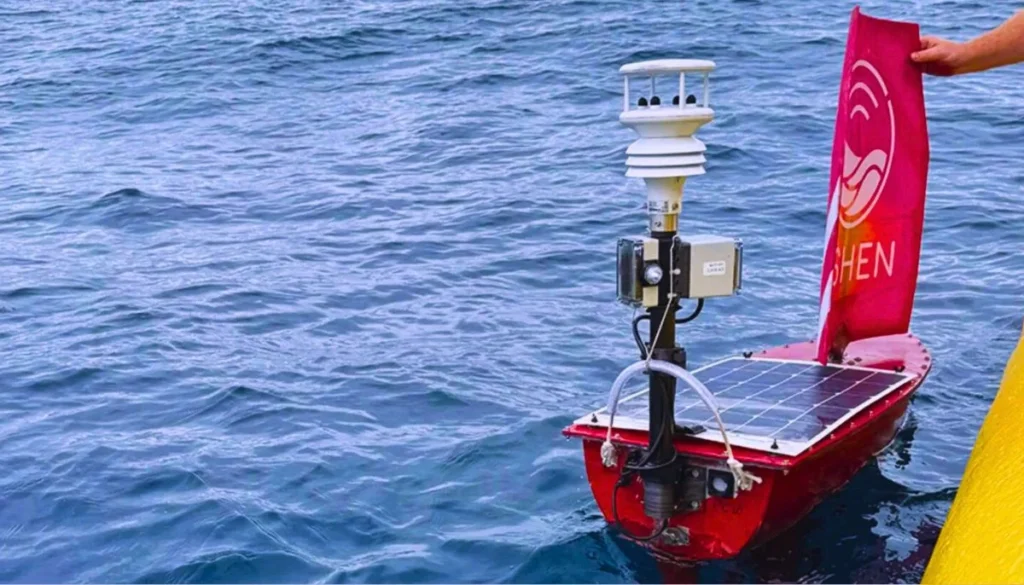
Oshen has developed what it claims to be the first ocean robot capable of operating inside a Category 5 hurricane, collecting critical data right from the heart of the storm. This breakthrough could completely change how we understand, predict, and respond to the most powerful storms on Earth.
Hurricanes form and evolve over the ocean, far away from land-based weather stations. Satellites can provide valuable images from above, but they can’t measure everything. Things like wave energy, ocean temperature at different depths, and real-time surface conditions are incredibly hard to capture.
Crewed research vessels cannot operate safely in Category 5 conditions… Even hurricane-hunting aircraft, while impressive, still have limits. This means scientists often rely on models and indirect data, which can lead to uncertainty in forecasts.
That’s the gap Oshen wants to fill.
Oshen’s ocean robot is not your typical research buoy or underwater drone. It’s designed specifically for extreme environments, where waves can reach several stories high and winds are strong enough to tear apart conventional equipment.
The robot is built with a low-profile design, allowing it to ride massive waves rather than fight against them. Instead of being destroyed by the storm, it becomes part of it—floating, adjusting, and surviving while continuously collecting data.
According to Oshen, the robot can measure ocean surface temperature, wave height, wind interaction, and energy transfer between the ocean and the atmosphere. These are exactly the variables scientists need to better understand why some storms intensify so rapidly.
What makes this robot truly groundbreaking is its ability to survive Category 5 hurricane conditions, the most extreme level on the hurricane scale. At this level, storms can cause catastrophic damage, and even advanced instruments often fail.
Oshen’s engineers focused heavily on durability and autonomy. The robot doesn’t rely on constant human control. Once deployed, it can operate independently for long periods, transmitting data via satellite whenever conditions allow.
This autonomy is crucial. During a major hurricane, communication can be limited or completely disrupted. The robot is designed to store data locally and send it out once a stable connection becomes available.
Better data leads to better forecasts. Right now, one of the biggest challenges in hurricane prediction is rapid intensification—when a storm suddenly becomes much stronger in a short period of time.
By collecting real-time data from inside the storm, scientists can improve models that predict how hurricanes grow, change direction, and weaken. Even small improvements in forecasting accuracy can save lives by giving communities more time to prepare or evacuate.
Emergency planners, governments, and disaster response teams could all benefit from more reliable hurricane data.
As climate change warms the oceans, scientists expect hurricanes to become more intense and destructive. Warmer water provides more energy, increasing the likelihood of powerful storms reaching Category 4 or 5 strength.
Oshen’s ocean robot arrives at a critical moment. With stronger storms becoming more common, the need for accurate, real-time ocean data is more urgent than ever.
Instead of guessing what’s happening at the ocean’s surface during a hurricane, scientists can now observe it directly.
Beyond weather forecasting, the robot could become an important tool for climate research. Hurricanes play a significant role in redistributing heat across the planet. Understanding how energy moves between the ocean and atmosphere during extreme storms can improve long-term climate models.
This kind of data has been missing for decades, not because scientists didn’t want it, but because the technology simply didn’t exist. Oshen’s robot changes that equation.
Traditional ocean buoys are often damaged or destroyed in extreme storms. Underwater drones typically avoid surface chaos and are not designed to interact with hurricane-level waves.
Oshen’s robot sits in a unique category. It’s not trying to escape the storm—it’s built to live inside it.
This design philosophy represents a shift in how scientists think about extreme weather research. Instead of building stronger barriers, they’re building smarter systems that adapt to nature’s most violent conditions.
Oshen plans to deploy more of these robots in hurricane-prone regions around the world. Over time, a network of storm-resilient ocean robots could provide continuous data coverage across major ocean basins.
The company is also exploring partnerships with government agencies, research institutions, and climate organizations. With enough support, this technology could become a standard tool in global weather monitoring systems.
Future versions of the robot may include additional sensors, improved energy efficiency, and even AI-driven data analysis onboard.
While flashy AI chatbots and humanoid robots often dominate tech headlines, Oshen’s ocean robot represents a quieter but equally important revolution. It doesn’t talk, walk, or generate content—but it could help save lives.
By venturing into places humans can’t safely go, this robot gives scientists a clearer picture of one of nature’s most dangerous forces.
As hurricanes grow stronger and more unpredictable, tools like Oshen’s ocean robot may become essential. Not just for understanding storms, but for preparing humanity to live with a changing climate.
In the face of a Category 5 hurricane, data is power—and Oshen has built a machine brave enough to go straight into the storm.