

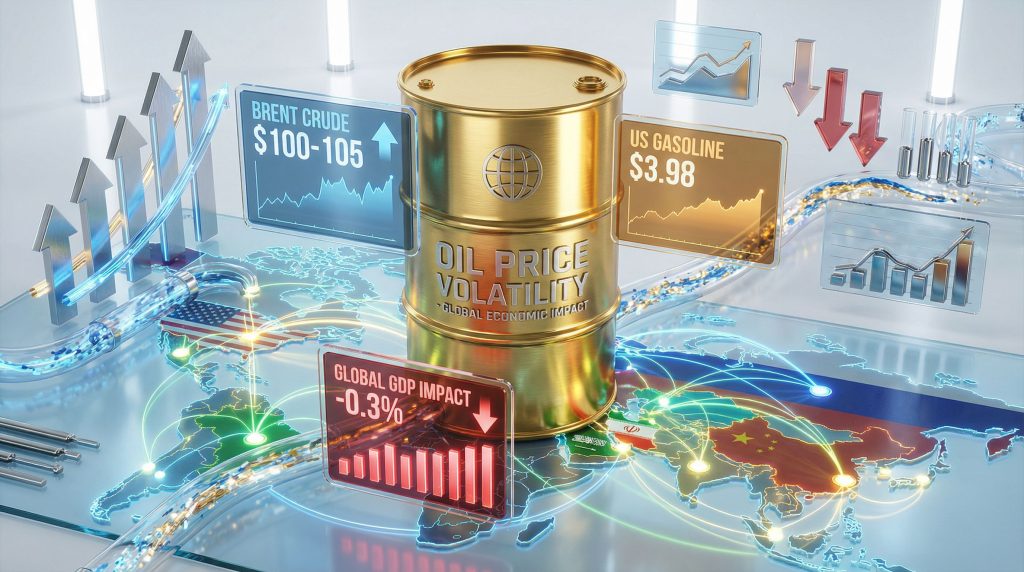
As we progress through 2026, the global economy is once again grappling with a familiar but formidable foe: the rapid ascent of crude oil prices. The topic of Rising Crude Oil Prices and Their Profound Economic Impact in 2026 is more relevant now than ever, as after a period of relative stability, a combination of geopolitical friction, underinvestment in traditional energy infrastructure, and an unexpectedly robust post-pandemic industrial recovery has pushed Brent and WTI benchmarks toward triple digits. The world is beginning to feel Rising Crude Oil Prices and Their Profound Effects in 2026 throughout key economic sectors. Crude oil is more than just a commodity; it is the fundamental input for the transport, chemical, and manufacturing industries.
The economic impact of rising oil prices is rarely linear. It acts as a “regressive tax” on consumers, a margin-crusher for businesses, and a pivot point for national monetary policies. According to the World Bank’s 2026 Energy Outlook, every permanent $10 increase in the price of a barrel of oil can shave approximately 0.2% to 0.5% off global GDP growth while adding nearly 0.8% to global inflation. This article explores the intricate mechanisms through which expensive energy reshapes the modern economic landscape.
The most immediate effect of rising crude oil prices is the surge in headline inflation. This occurs through two primary channels: direct and indirect. The direct impact is felt at the gas pump and in home heating bills. When a consumer pays more for fuel, they have less “discretionary income” to spend on other goods and services, which slows down the retail and hospitality sectors.
The indirect impact is often more insidious. Oil is a major component of the “producer price index” (PPI). It powers the trucks that deliver food to supermarkets and the planes that move global cargo. It is also a feedstock for plastics, fertilizers, and synthetic fibers. When energy costs rise, manufacturers eventually pass these costs down the supply chain. In early 2026, several major logistics firms implemented “energy surcharges,” causing a secondary wave of price hikes in everything from grocery staples to electronics.
For the average household, rising oil prices function like an un-voted tax increase. Because energy demand is “inelastic”—meaning people still need to drive to work and heat their homes regardless of the price—consumers cannot easily switch to alternatives in the short term. This forced expenditure drains the “velocity of money” in the wider economy.
A 2025 case study in the European Union showed that during a sustained oil price spike, lower-income households were forced to reduce spending on healthcare and education by nearly 12% to cover rising utility costs. This creates a drag on social mobility and long-term economic health. In the United States, the “Rule of Thumb” often cited by economists is that every one-cent increase in the price of gasoline takes roughly $1 billion out of annual consumer spending power.
Central banks, such as the Federal Reserve and the European Central Bank (ECB), face a nightmare scenario when oil prices rise: Stagflation. This occurs when inflation is high (driven by oil) but economic growth is slowing (also driven by oil). Standard monetary policy dictates that high inflation should be met with higher interest rates, but higher rates can further stifle an already struggling economy.
In 2026, we are seeing a “Hawkish Pivot” across many central banks. To prevent “de-anchored” inflation expectations—where workers demand higher wages because they expect prices to keep rising—central banks are maintaining high interest rates despite the risk of a recession. This creates a difficult environment for the stock market, as higher rates discount the value of future corporate earnings, leading to increased volatility in the S&P 500 and the FTSE 100.
Heavy industry is the silent victim of energy spikes. Sectors such as steel, aluminum, and cement production are incredibly energy-intensive. When oil and gas prices (which are often correlated) rise, the “energy intensity” of these businesses becomes a liability. This is leading to a global realignment of manufacturing bases.
In 2026, we are witnessing “Energy-Shoring,” where manufacturers are moving operations to regions with cheaper or more stable energy sources, such as those with abundant nuclear or geothermal power. For example, several European glass manufacturers have recently relocated assembly lines to North America to take advantage of lower natural gas and oil-derivative costs. This shift is not just about profit; it is about industrial survival in a high-cost environment.
If there is a “silver lining” to expensive crude oil, it is the economic incentive it provides for the green transition. In 2026, the “Payback Period” for a residential solar installation or a corporate wind power purchase agreement (PPA) has dropped by nearly 30% due to the high cost of fossil-fuel-based alternatives. High oil prices act as a market-driven “Carbon Tax.”
The automotive industry is the primary battleground. At $100+ per barrel, the “Total Cost of Ownership” (TCO) for Electric Vehicles (EVs) becomes significantly lower than Internal Combustion Engine (ICE) vehicles, even without government subsidies. Statistics from the first half of 2026 show that EV adoption rates have spiked in regions where gasoline has crossed the $5.00 per gallon (or €1.80 per liter) threshold. The oil crisis is essentially doing the work that environmental policy has struggled to do for decades: making fossil fuels economically unappealing.
Rising oil prices lead to a massive transfer of wealth from energy-consuming nations to energy-producing nations. This “petrodollar recycling” changes the geopolitical balance of power. Oil exporters (the “Winners”) see massive surpluses in their current accounts, which they often use to fund Sovereign Wealth Funds (SWFs) that then buy up assets in the West.
Conversely, the “Losers” are energy-poor emerging markets. Countries like India, Japan, and much of Southeast Asia face deteriorating trade balances. India, which imports over 80% of its crude oil, sees its currency, the Rupee, come under immense pressure whenever oil prices rise. This can lead to political instability as the cost of living outpaces wage growth. In 2026, “Energy Diplomacy” has become the primary tool of international relations, with nations forming new alliances to secure reliable, long-term supply contracts.
Perhaps the most significant impact of the 2026 oil price rise is the permanent change in human behavior. Economists call this “Demand Destruction.” When prices stay high for too long, consumers and businesses don’t just “wait it out”; they change their infrastructure. They buy smaller cars, insulate their buildings, and switch to digital meetings instead of flying.
History shows that after the oil shocks of the 1970s, the world’s energy intensity per dollar of GDP dropped significantly and never returned to previous levels. We are seeing a similar “Structural Pivot” today. Even if oil prices were to crash tomorrow, the investments made in 2026 in EV charging stations, heat pumps, and high-speed rail would remain. This suggests that high prices today may be the very thing that accelerates the “Peak Oil Demand” that OPEC and other producers have been fearing.
The rising price of crude oil in 2026 is far more than a statistic on a trading screen; it is a profound economic force that is currently reshaping the world. By driving inflation, squeezing consumer budgets, and forcing the hand of central banks, high energy costs are creating a period of significant volatility and challenge. However, the crisis is also serving as a powerful catalyst for industrial innovation and the green energy transition.
Key Takeaways:
Ultimately, the impact of rising oil prices is a story of adaptation. The global economy is being forced to shed its 20th-century dependence on cheap carbon and embrace a more efficient, diversified, and resilient energy future. While the transition period is painful, the result will likely be an economy that is less susceptible to the geopolitical whims of oil-producing regions and more focused on sustainable, long-term growth.