

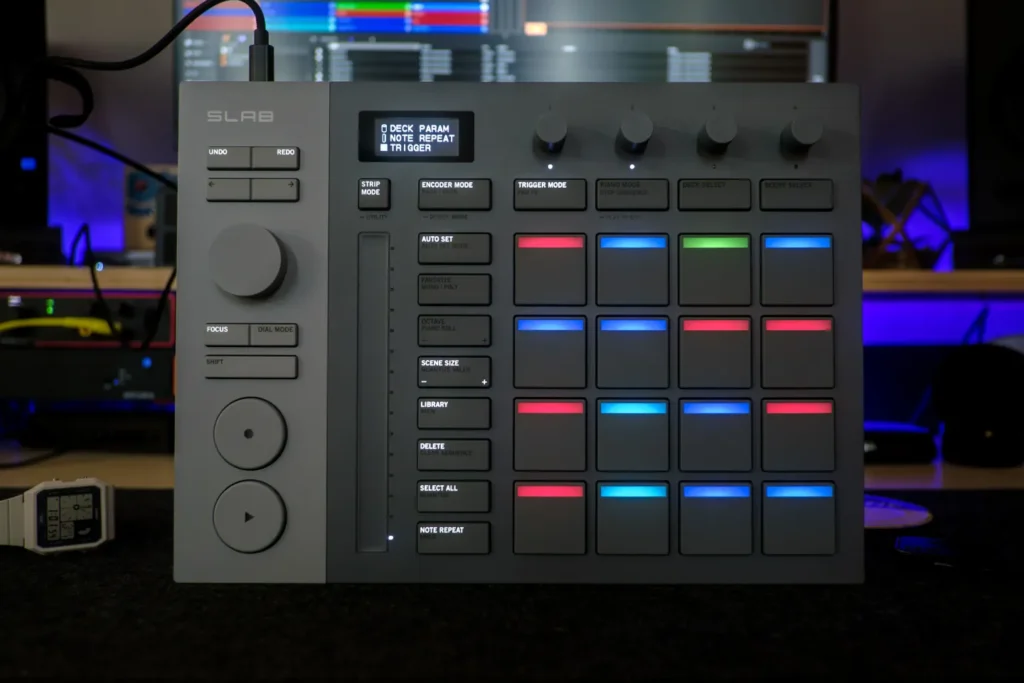
In the world of music production, gear trends come and go. One year it’s all about analog synths, the next it’s modular setups that look like sci-fi control panels. But quietly, slab MIDI controllers have been carving out their own space. Flat, minimal, and often without traditional keys, these controllers are changing how musicians think about performance and creativity.
So what exactly is a slab MIDI controller, and why are more producers, composers, and live performers starting to prefer them?
A slab MIDI controller is basically a flat control surface designed to send MIDI data to software or hardware instruments. Unlike traditional MIDI keyboards with piano-style keys, slab controllers usually feature pads, touch-sensitive surfaces, sliders, knobs, or even fully customizable layouts.
They’re called “slab” because of their shape: thin, flat, and often rectangular, with little to no physical depth. Some popular examples include grid-based controllers, touch controllers, and hybrid devices that mix pads with pressure sensitivity.
These controllers don’t try to look like a piano. Instead, they focus on flexibility, expression, and modern workflows.
One big reason slab MIDI controllers are becoming popular is that modern music production doesn’t always start with piano playing anymore. Many producers build tracks using loops, samples, automation, and sound design rather than traditional melodies.
Slab controllers fit perfectly into this mindset. They allow users to:
Trigger samples and clips quickly
Control effects in real time
Play drums and rhythms naturally
Perform expressive gestures using pressure and touch
For electronic music producers, beatmakers, and experimental artists, slab controllers feel more intuitive than keys.
Traditional keyboards are great, but they come with limitations. Keys are either on or off, with limited expression unless you add aftertouch or external controls. Slab MIDI controllers often offer much more nuanced control.
Many slab controllers support:
Velocity sensitivity
Polyphonic aftertouch
Pressure and tilt detection
X/Y touch control
This means a single finger movement can change pitch, filter cutoff, reverb depth, and modulation all at once. For sound designers and live performers, that kind of expressiveness is a huge deal.
Instead of thinking in terms of notes, users start thinking in textures, movement, and dynamics.
Another reason slab MIDI controllers feel so relevant today is how well they integrate with modern digital audio workstations (DAWs). Many are designed specifically for software like Ableton Live, Logic Pro, Bitwig, or FL Studio.
Grid-based slab controllers, for example, are perfect for clip launching, pattern sequencing, and live looping. Everything is visual, fast, and hands-on. You don’t need to look at your computer screen as much, which helps keep you in a creative flow.
Some controllers even let users design their own layouts, mapping controls exactly how they want. This level of customization makes slab controllers feel more like personal instruments rather than generic tools.
Slab MIDI controllers are usually lightweight and easy to carry. That might sound like a small thing, but for musicians who move between home studios, coffee shops, rehearsal spaces, and live venues, it matters a lot.
You can throw a slab controller into a backpack, plug it into a laptop, and start making music anywhere. No heavy keyboard stands, no bulky gear. This portability fits perfectly with modern, mobile music production lifestyles.
For touring artists, it also means faster setup and less stress during soundchecks.
Some musicians worry that slab MIDI controllers are harder to learn, especially if they come from a piano background. In reality, it’s less about difficulty and more about mindset.
Instead of scales and chords, slab controllers encourage pattern-based thinking. Muscle memory still develops, just in a different way. Many users find that once they stop trying to “play piano” on a slab controller, things click much faster.
For beginners, slab controllers can even be less intimidating. There’s no expectation to know music theory right away. You can start by tapping rhythms, triggering sounds, and experimenting.
While slab MIDI controllers are closely associated with electronic and experimental music, they’re not limited to those genres. Film composers, ambient artists, jazz musicians, and even pop producers are finding creative uses for them.
A slab controller can be used to:
Control orchestral dynamics in scoring
Shape evolving ambient textures
Perform live effects automation
Add expressive layers to traditional instruments
In hybrid setups, slab controllers often sit next to keyboards rather than replacing them. They become complementary tools, each serving a different purpose.
Visually, slab MIDI controllers tend to look clean and modern. No unnecessary buttons, no confusing labels. This minimal design isn’t just about aesthetics—it affects how people work.
With fewer distractions, users focus more on sound and movement. The controller becomes an extension of the body rather than a technical interface. For many musicians, that feeling is incredibly inspiring.
There’s also something refreshing about using a tool that doesn’t look like it belongs to the past. Slab controllers feel like instruments designed for today’s creative workflows.
Of course, slab MIDI controllers aren’t perfect. They lack physical keys, which can be a deal-breaker for pianists. Playing complex chord voicings or fast melodic runs can feel less natural without traditional keys.
They also rely heavily on software. Without a DAW or external sound module, many slab controllers can’t do much on their own. This makes them less suitable for musicians who prefer fully standalone hardware.
But for users who live inside digital environments, these trade-offs are usually worth it.
As MIDI standards evolve and software becomes more expressive, slab MIDI controllers are likely to become even more powerful. Features like MPE (MIDI Polyphonic Expression) are already pushing boundaries, allowing each note to have its own expressive data.
We’re moving toward instruments that respond more like real-world objects—flexible, dynamic, and deeply personal. Slab MIDI controllers fit perfectly into that future.
They may not replace keyboards entirely, but they’re clearly here to stay.
Slab MIDI controllers represent a shift in how music is created. They prioritize expression over tradition, flexibility over fixed layouts, and creativity over rules. For modern producers and performers, they offer a fresh way to interact with sound.
Whether you’re triggering beats, shaping textures, or performing live, slab MIDI controllers invite experimentation. And in a creative world that constantly evolves, that invitation might be their biggest strength.