

Space used to feel like a limitless place. But after more than six decades of launches, Earth’s orbit is starting to look a bit crowded. Thousands of satellites, rocket parts, and fragments from past missions are floating around our planet. Many of them are no longer active. This growing problem is known as space debris, and it has become a serious concern for the future of space exploration.
That’s where space debris removal technology comes in. Scientists and aerospace companies are now developing new tools and missions designed to clean up Earth’s orbit. From robotic arms to giant nets and even laser systems, these technologies aim to capture or push debris out of orbit before it causes damage.
As more satellites are launched every year, especially for global internet networks and space research, cleaning up space is becoming more important than ever.
Space debris refers to any human-made object in orbit that no longer serves a useful purpose. These objects can range from large, inactive satellites to tiny fragments created by past collisions.
Common types of space debris include:
Some debris pieces are only a few millimeters wide, but even tiny fragments can be dangerous. Objects in low Earth orbit travel at speeds of around 28,000 kilometers per hour (17,500 mph). At that speed, even a small piece of metal can damage or destroy a satellite.
Today, experts estimate that there are millions of debris fragments orbiting Earth. Many of them are too small to track, making the situation even more complicated.
A collision between a satellite and debris can destroy valuable equipment. Modern satellites provide essential services like:
If debris damages these systems, it could disrupt many technologies people rely on every day.
Space debris also threatens astronauts aboard spacecraft and space stations. Even small fragments can puncture spacecraft hulls if they collide at high speed.
The International Space Station has had to perform avoidance maneuvers several times to avoid potential debris impacts.
One of the worst-case scenarios is known as Kessler Syndrome. This happens when collisions create more debris, which then causes even more collisions in a chain reaction.
If that happens, some orbital regions could become too dangerous for satellites or space missions.
Scientists and engineers are now developing space debris removal technologies to tackle the problem before it becomes uncontrollable.
Here are some of the most promising solutions.
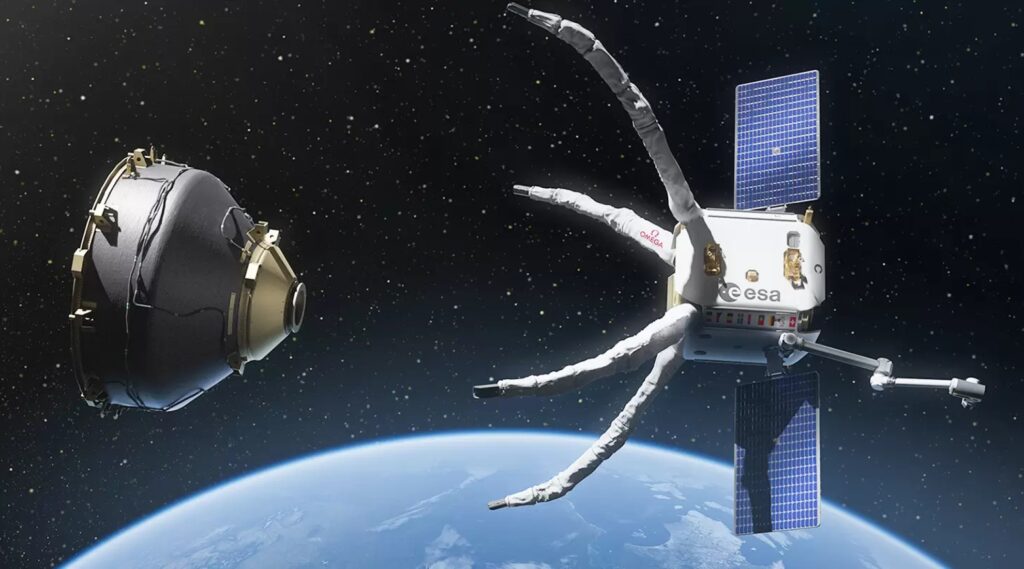
These cleanup satellites approach a target object, capture it using robotic arms, and then guide it back toward Earth’s atmosphere. Once the debris reenters the atmosphere, it burns up safely.
A well-known mission testing this concept is ClearSpace-1, a project supported by the European Space Agency. The mission aims to capture a piece of rocket debris and remove it from orbit.
Robotic systems are precise and controllable, making them ideal for capturing larger debris objects.
A spacecraft can deploy a net to trap debris or use a harpoon system to attach to a target object. Once captured, the debris can be pulled into a lower orbit where it eventually burns up.
The RemoveDEBRIS mission, led by researchers in the United Kingdom, successfully tested both technologies in orbit. The experiments showed that nets and harpoons could be practical tools for future cleanup missions.
Some pieces of space debris are made from metal. Engineers are exploring ways to use magnetic systems to capture these objects.
A spacecraft equipped with strong magnets could latch onto metallic debris without needing complex mechanical arms.
This approach could simplify debris removal missions and reduce the risk of damaging target objects during capture.
However, magnetic systems only work with certain types of materials, so they would likely be used alongside other technologies.
Instead of destroying the debris, lasers can gently push objects by heating their surfaces. This creates tiny forces that slowly alter the debris’ orbit.
Over time, the debris could be pushed into Earth’s atmosphere where it burns up.
Laser systems could be installed on the ground or mounted on satellites. If successful, they could help manage smaller debris pieces that are difficult to capture physically.
Space debris cleanup is not only a government effort anymore. Several private space companies are now working on orbital cleanup solutions.
These companies see debris removal as a potential future industry, especially as satellite launches increase dramatically.
Commercial cleanup missions could offer services such as:
With thousands of new satellites planned for the next decade, demand for these services may grow quickly.
Cleaning up existing debris is only part of the solution. Preventing new debris from forming is just as important.
Space agencies are now introducing orbital sustainability guidelines.
These include:
Many new satellites are already designed to automatically burn up in Earth’s atmosphere after their missions are complete.
The development of space debris removal technology marks an important step toward protecting Earth’s orbital environment.
Over the next decade, we may see:
If these technologies succeed, they could help keep space safe for future generations of satellites, astronauts, and exploration missions.
Space debris has become one of the biggest challenges facing modern space exploration. With thousands of inactive satellites and millions of debris fragments orbiting Earth, the risk of collisions continues to grow.
Fortunately, scientists and engineers are developing innovative solutions. Technologies such as robotic capture systems, nets, magnetic devices, and lasers could soon help remove dangerous debris from orbit.
As satellite launches continue to increase, space debris removal technology will play a crucial role in maintaining a safe and sustainable space environment.
Cleaning up Earth’s orbit may sound like science fiction, but it is quickly becoming one of the most important missions in the future of space.