

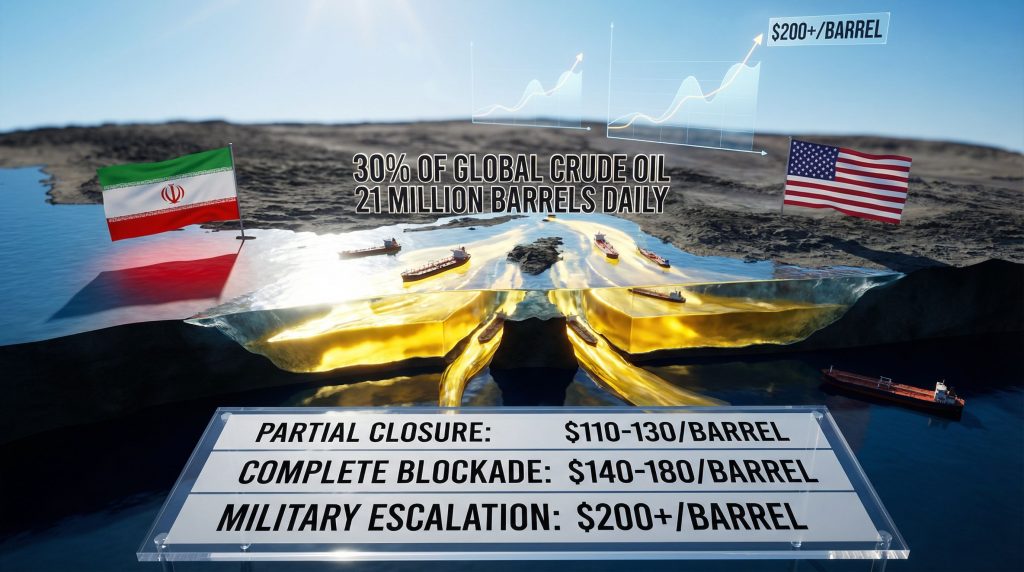
As we move through 2026, the global energy market remains precariously balanced on a razor’s edge, centered on a narrow strip of water separating the Persian Gulf from the Gulf of Oman. The Strait of Hormuz is not merely a geographic location; it is the most vital artery of the global economy. Measuring only 21 miles wide at its narrowest point, this chokepoint handles the transit of roughly one-fifth of the world’s total petroleum liquids consumption.
Recent escalations in regional conflicts, involving both state and non-state actors, have once again placed the “oil lifeline” under threat. In this environment, the mere rumor of a blockade or a naval skirmish can send Brent Crude prices soaring, triggering a ripple effect that impacts everything from jet fuel costs in Europe to the price of plastic goods in Asia. This article explores the geopolitical dynamics of the Strait, the economic consequences of supply disruptions, and the strategic responses developed by global powers to safeguard the flow of energy.
To understand why tension in this region causes global panic, one must look at the sheer volume of trade involved. According to data from the U.S. Energy Information Administration (EIA) and maritime tracking services in 2025-2026, an average of 20 to 22 million barrels of oil pass through the Strait every single day. This accounts for more than 30% of all seaborne-traded oil.
The Strait serves as the primary exit route for the world’s most significant oil producers, including Saudi Arabia, the United Arab Emirates (UAE), Kuwait, Iraq, and Iran. Furthermore, it is the exit point for nearly all of Qatar’s Liquefied Natural Gas (LNG), making it as critical for the heating of homes in the UK and Japan as it is for powering cars in the United States. Unlike other maritime routes where ships can simply take a longer path, there is no physical alternative for ships leaving the Persian Gulf; if the Strait is closed, the oil is trapped.
The tension in the Strait of Hormuz is rarely about the water itself; it is a manifestation of broader regional power struggles. Historically, Iran has used its proximity to the Strait as a strategic “trump card” in its dealings with the West. By threatening to close the Strait, Tehran can exert immense pressure on global markets to protest sanctions or military threats.
In 2026, the situation has become even more complex with the increased use of “asymmetric warfare.” This involves the use of low-cost drones, fast-attack boats, and limpet mines to disrupt shipping without escalating to a full-scale conventional war. This “shadow war” makes it difficult for international insurance companies to assess risk, leading to skyrocketing premiums for tankers. Even without a formal blockade, the increased cost of insurance acts as a hidden tax on global energy consumption, driving up prices at the pump for consumers worldwide.
A series of incidents throughout late 2025 served as a stark reminder of the Strait’s vulnerability. Multiple tankers were harassed or seized by naval forces under the guise of “maritime violations,” while others were targeted by unidentified aerial drones. These events mirrored the infamous “Tanker War” of the 1980s but with modern, high-tech twists.
The impact on the market was instantaneous. For each reported incident, oil prices spiked by 3% to 5% within minutes of the news hitting the wires. Shipping companies responded by rerouting vessels where possible or, more commonly, demanding naval escorts. The United States and its allies expanded “Operation Sentinel,” a maritime security initiative designed to provide a protective umbrella over commercial shipping. However, the sheer density of traffic in the Strait means that providing an escort for every tanker is a logistical impossibility, leaving a “security gap” that keeps the market in a state of constant anxiety.
When the Strait of Hormuz is under tension, the global economy suffers from “Energy Inflation.” Because oil is a foundational input for almost every industry—from transportation and plastics to agriculture (fertilizers)—a price spike in crude translates into higher costs for nearly all consumer goods.
Economists have long modeled the “Hormuz Premium.” In a scenario where the Strait is partially blocked for 30 days, Brent Crude could easily surpass $150 per barrel. In 2026, with the world still recovering from the inflationary cycles of the early 2020s, such a spike would likely trigger a global recession. Developing nations are particularly at risk; countries like India and China, which import a vast majority of their oil via the Strait, would see their trade deficits balloon, leading to currency devaluation and social unrest.
Recognizing the danger of being “bottled up” in the Gulf, several regional powers have invested billions in infrastructure to bypass the Strait of Hormuz. These bypasses are the primary defense against a total energy collapse.
The two most significant bypasses are the Saudi East-West Pipeline (Petroline) and the UAE’s Habshan-Fujairah Pipeline. The Saudi pipeline can move roughly 5 million barrels per day across the peninsula to the Red Sea, while the UAE’s pipeline carries 1.5 million barrels per day to the port of Fujairah, which sits outside the Strait on the Indian Ocean. However, even if these pipelines operate at maximum capacity, they can only handle about 6.5 to 7 million barrels per day—less than 40% of what normally passes through the Strait. This means that while these pipelines can soften the blow, they cannot prevent a global shortage if the Strait were to close completely.
Tension in the Strait is often linked to the enforcement of international sanctions. This has given rise to a massive “Shadow Fleet”—aging tankers that operate without standard insurance and frequently turn off their Automatic Identification Systems (AIS) to move sanctioned oil through the Strait undetected.
In 2026, the shadow fleet accounts for an estimated 10% of the traffic in the region. These vessels pose a dual threat: they complicate naval monitoring of the Strait and present a massive environmental risk. Because they are often old and poorly maintained, a collision or mechanical failure in the narrow shipping lanes could cause a catastrophic oil spill. An environmental disaster of that scale would physically block the Strait for cleanup operations, achieving the very closure that geopolitical actors might only threaten, but by accident.
The ongoing volatility in the Strait of Hormuz has become one of the strongest drivers for the global transition to renewable energy. Many nations now view energy security as a matter of national sovereignty. In 2026, the “Electrification of Transport” has moved from an environmental goal to a strategic imperative in Europe and parts of Asia.
However, the reality of 2026 is that the world is still deeply addicted to fossil fuels. While renewable capacity is growing at record rates, it cannot yet replace the high-density energy required for heavy shipping, aviation, and industrial manufacturing. Consequently, the Strait of Hormuz will remain the world’s “geopolitical center of gravity” for the foreseeable future. The struggle is no longer just about the price of oil, but about the stability of a global system that still relies on a 21-mile wide channel for its daily survival.
Defending the Strait in 2026 requires more than just aircraft carriers. The nature of the threat has evolved toward “swarm tactics”—dozens of small, unmanned drones or boats attacking simultaneously to overwhelm defenses.
To counter this, international navies have deployed advanced directed-energy weapons (lasers) and AI-driven surveillance systems. These technologies allow for the rapid identification and neutralization of small-scale threats without the need for expensive missiles. Furthermore, autonomous underwater vehicles (AUVs) are used to scan the seabed for mines, ensuring that the shipping lanes remain clear. The defense of the Strait has become a high-stakes testing ground for the future of naval warfare, where technology must stay one step ahead of the “asymmetric” tactics employed by those who wish to disrupt the flow of oil.
The tension in the Strait of Hormuz remains the single greatest risk to global energy security in 2026. As this article has detailed, the Strait is a bottleneck for 20% of the world’s petroleum and a significant portion of its LNG.
In conclusion, while the world moves toward a greener future, the “artery” of the Strait of Hormuz remains vital. Protecting this narrow passage is not just a regional concern but a global necessity to prevent economic collapse. The stability of the 21st-century economy continues to depend on the peaceful transit of tankers through these few miles of volatile water.