

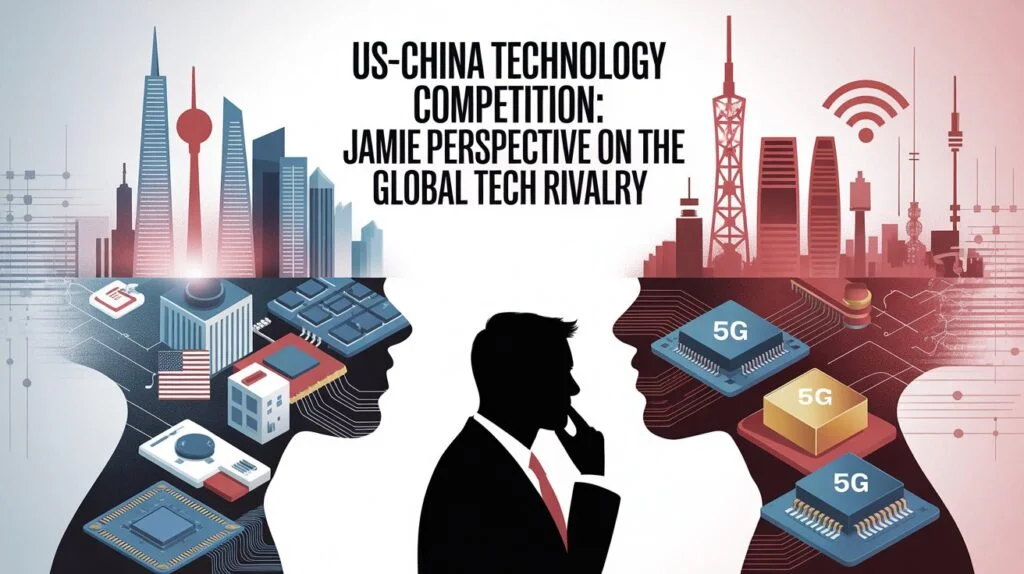
The intensifying technology competition between the United States and China has become one of the defining geopolitical and economic narratives of the 21st century. At the heart of this rivalry lies not only a struggle for technological supremacy but also a broader contest over global influence, economic resilience, and national security. Prominent business leaders, including JPMorgan Chase CEO Jamie Dimon, have weighed in on the implications of this rivalry, offering nuanced perspectives on how it may reshape global markets, innovation ecosystems, and political alliances.
This article explores the dynamics of US-China technology competition, examines key sectors driving the rivalry, and analyzes Jamie Dimon’s views on the issue. By incorporating real-world examples, statistics, and case studies, we aim to provide a comprehensive understanding of this critical global development.
The roots of the US-China technology competition can be traced back several decades, but the rivalry intensified significantly in the 2010s. As China rapidly expanded its technological capabilities, the United States began to perceive its rise as both an economic and strategic challenge.
China’s ambitious initiatives, such as “Made in China 2025,” aimed to transform the country into a global leader in high-tech industries. Meanwhile, the United States sought to maintain its leadership in innovation, particularly in areas like semiconductors, artificial intelligence, and advanced manufacturing.
This competition is not merely economic; it reflects deeper ideological and governance differences that influence how technology is developed and deployed.
Several critical sectors are at the forefront of the US-China technology race. These industries are not only economically valuable but also strategically important.
Semiconductors are the backbone of modern technology. The United States has historically dominated chip design, while Asia—including China and Taiwan—plays a major role in manufacturing.
Artificial intelligence represents a transformative technology with applications across industries. Both nations are investing heavily in AI research and development.
The rollout of 5G networks has been a contentious area of competition, with Chinese firms playing a dominant role in global infrastructure deployment.
The US-China technology competition has far-reaching economic consequences. It affects global supply chains, investment flows, and corporate strategies.
One major impact is the fragmentation of the global technology ecosystem. Companies are increasingly forced to choose between US and Chinese standards, leading to inefficiencies and increased costs.
According to various economic analyses, partial decoupling between the US and China could cost the global economy hundreds of billions of dollars annually.
Jamie Dimon, CEO of JPMorgan Chase, has offered a pragmatic and balanced view of the US-China technology competition. Rather than framing it purely as a zero-sum conflict, Dimon emphasizes the importance of cooperation alongside competition.
Dimon has repeatedly highlighted that while the United States must remain competitive, it should avoid policies that unnecessarily escalate tensions or disrupt global economic stability.
Dimon’s perspective reflects the concerns of many global business leaders who operate across both markets and depend on stable international relationships.
A notable example of the US-China technology rivalry is the implementation of semiconductor export controls by the United States. These restrictions aim to limit China’s access to advanced chip technologies.
The policy has had significant ripple effects:
This case illustrates how technological competition can quickly escalate into broader economic and geopolitical tensions.
One of the central debates in the US-China technology competition is whether decoupling is beneficial or detrimental. While some argue that reducing reliance on a strategic competitor enhances security, others warn that it could stifle innovation.
Jamie Dimon has expressed concerns about excessive decoupling, noting that global collaboration has historically driven technological progress.
The challenge lies in finding a balance between protecting national interests and preserving the benefits of globalization.
The technology competition between the US and China is deeply intertwined with geopolitical considerations. Both nations view technological leadership as essential to maintaining global influence.
This rivalry extends beyond bilateral relations, affecting alliances and international institutions.
The outcome of this competition will shape the global order for decades to come.
The future of US-China technology competition remains uncertain. While tensions are likely to persist, there are also opportunities for cooperation in areas of mutual interest.
Jamie Dimon and other leaders suggest that a pragmatic approach—balancing competition with collaboration—may be the most effective path forward.
Ultimately, the trajectory of this rivalry will depend on political leadership, economic priorities, and global developments.
The US-China technology competition is a complex and multifaceted phenomenon that extends beyond economics into the realms of geopolitics, security, and global governance. Key sectors such as semiconductors, artificial intelligence, and telecommunications are driving the rivalry, while policies like export controls highlight its tangible impacts.
Jamie Dimon’s perspective offers a valuable lens through which to view this competition. His emphasis on balancing competitiveness with cooperation underscores the importance of maintaining global stability while pursuing technological leadership.
As the world navigates this evolving landscape, the choices made by policymakers, businesses, and international institutions will determine whether the competition leads to fragmentation or fosters innovation and shared progress. The stakes are high, and the outcomes will shape the future of the global economy and technological advancement for generations to come.