

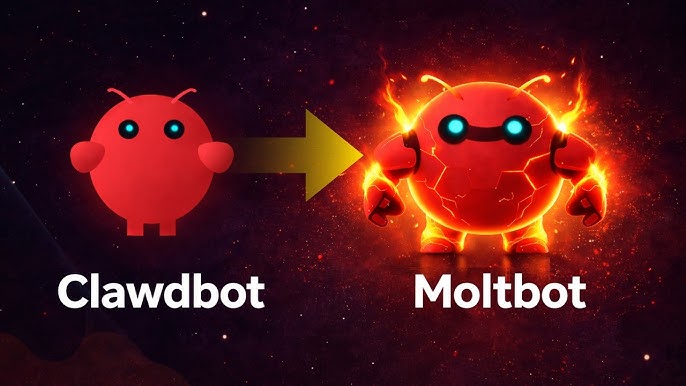
Personal AI assistants are no longer just about setting reminders or answering simple questions. They’re slowly turning into digital companions that understand context, habits, and even personality. One interesting example of this shift is Clawdbot, a personal AI assistant that recently rebranded itself as Moltbot. The name change may sound simple, but it actually reflects a bigger transformation in how this AI wants to position itself in a crowded and fast-moving market.
So what exactly is Clawdbot now Moltbot and why is it getting attention?
Clawdbot started as a lightweight personal AI assistant designed to help users manage everyday tasks. Think note-taking, idea organization, reminders, quick research, and productivity support. Unlike big-name assistants that are deeply tied to ecosystems like smartphones or smart homes, Clawdbot focused on being personal-first, not platform-first.
It wasn’t trying to replace your phone assistant. Instead, it aimed to be something closer to a digital sidekick always available, flexible, and customizable. Users could interact with it in a conversational way, making it feel less robotic and more like a helpful collaborator.
From early on, Clawdbot leaned heavily into AI-powered conversation, task memory, and contextual understanding. The idea was simple: the more you used it, the better it understood how you think and work.
The shift from Clawdbot to Moltbot wasn’t just about aesthetics or branding. The word “molt” itself is interesting it refers to the process where animals shed an old layer to grow a new one. That metaphor fits perfectly with what the team behind the assistant is trying to communicate.
Moltbot represents growth, adaptation, and evolution.
As personal AI assistants become more advanced, users expect more than static features. They want tools that can evolve with their workflow, adapt to changing needs, and improve over time. The rebrand signals that Moltbot is not a fixed product, but an AI that’s constantly learning and reshaping itself.
In other words, Moltbot isn’t just a renamed Clawdbot it’s meant to be a more mature, more capable version of it.
One of Moltbot’s main selling points is personalization. Instead of giving the same answers to everyone, it tries to tailor responses based on user behavior, preferences, and past interactions. Over time, it can learn how you like information presented, what tasks you prioritize, and even your tone of communication.
Another key feature is context awareness. Moltbot doesn’t treat every message as a standalone request. It remembers previous conversations, ongoing projects, and unfinished tasks. This makes interactions feel more natural and reduces the need to constantly repeat yourself.
Moltbot also positions itself as a thinking assistant, not just an execution tool. It can help brainstorm ideas, organize thoughts, summarize complex information, and assist with decision-making. For creators, freelancers, and knowledge workers, this kind of support can be more valuable than simple automation.
Unlike some AI tools that aim to fully automate work, Moltbot leans toward collaboration. The idea is not to replace human thinking, but to enhance it.
For example, instead of automatically generating a final answer or document, Moltbot might suggest outlines, ask clarifying questions, or offer alternative perspectives. This approach helps users stay in control while still benefiting from AI efficiency.
This mindset is especially appealing in a time when people are becoming more cautious about over-relying on AI. Moltbot positions itself as a partner, not a replacement.
Personal AI assistants naturally raise questions about privacy. After all, the more personal an assistant becomes, the more data it needs to function well. Moltbot’s success depends heavily on how it handles this issue.
The platform emphasizes user control over data, transparency, and responsible AI usage. While details may evolve over time, the messaging is clear: trust is a core part of the product. Without it, a personal AI assistant simply doesn’t work.
As AI tools face increasing scrutiny from regulators and users alike, assistants like Moltbot will need to balance intelligence with ethical design.
Moltbot enters a market filled with powerful competitors, from general-purpose AI chatbots to specialized productivity tools. What sets it apart is its identity as a personal assistant built around long-term relationships, not one-off interactions.
Instead of trying to do everything, Moltbot focuses on becoming deeply useful to each individual user. That’s a bold strategy, but also a risky one. It requires patience, consistent improvement, and a clear understanding of user needs.
If done right, though, this approach can lead to strong user loyalty. People are more likely to stick with tools that truly understand them.
The Clawdbot-to-Moltbot transition reflects a broader trend in AI development. We’re moving away from generic, one-size-fits-all AI and toward adaptive, personalized systems.
Users don’t just want smarter AI they want AI that fits into their lives naturally. Names, branding, and metaphors matter because they shape how people emotionally connect with technology. Moltbot’s new identity suggests growth, learning, and evolution, which aligns well with where AI is headed.
The future of Moltbot will depend on execution. Promises of personalization and adaptability are easy to make, but hard to deliver consistently. Continuous learning, ethical design, and clear communication with users will be critical.
If Moltbot can maintain its focus on human-centered AI while scaling its capabilities, it has the potential to stand out in a noisy space. Not as the loudest or flashiest assistant, but as one that quietly becomes indispensable.
Clawdbot’s evolution into Moltbot is more than a name change it’s a statement. It reflects a belief that personal AI assistants should grow alongside their users, shedding old limitations and adapting to new challenges.
In a world where AI is everywhere, Moltbot is betting on something simple but powerful: personal connection. If it succeeds, it could redefine what people expect from a personal AI assistant not just a tool, but a long-term digital partner.