

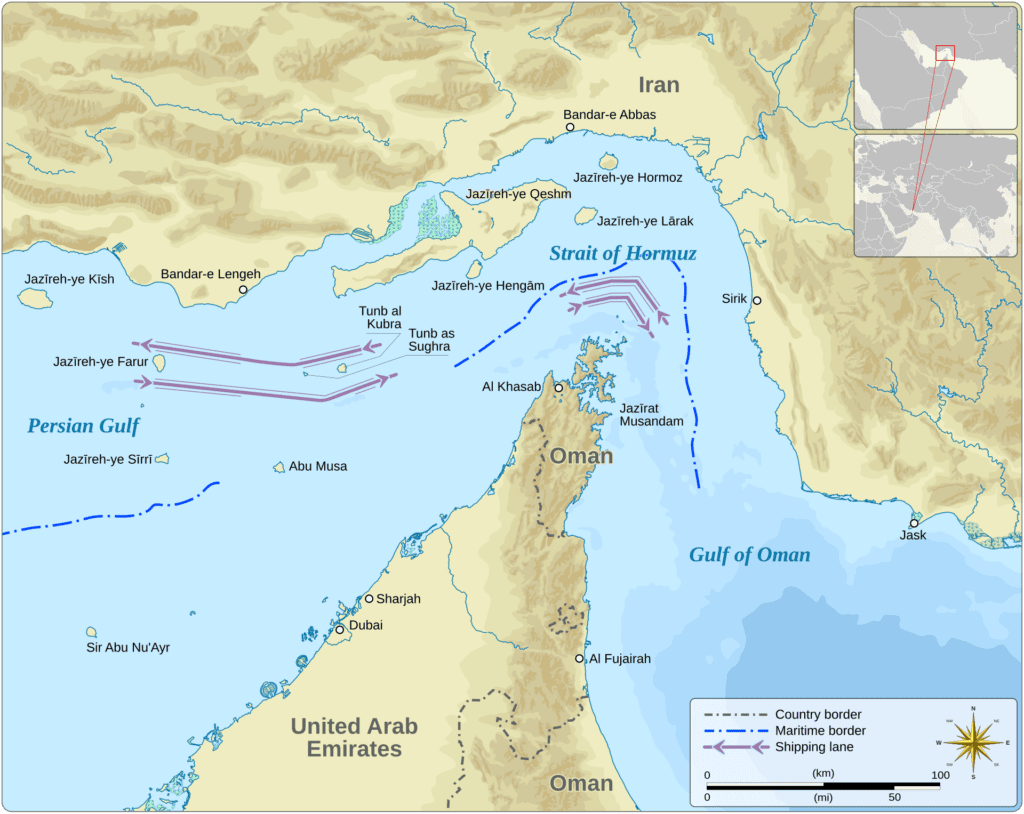
The Strait of Hormuz is often called the “world’s jugular vein.” This narrow stretch of water connects the Persian Gulf to the open ocean. It is the most important oil path on the planet. For decades, it has been the site of a high-stakes drama involving world powers, local rivals, and rebel groups. In recent years, Geopolitical Instability Around Strait of Hormuz Waters has captured the world’s attention. As we navigate 2026, the trouble in these waters remains the main way we measure global energy safety and peace in the Middle East.
The Strait is only 21 miles wide at its narrowest point. It is the only way for ships to get from the Persian Gulf to the sea. Its value comes from the massive amount of oil that moves through it every day. However, its shape makes it very easy to attack. With Iran to the north and Oman and the UAE to the south, any fight between these nations can cause immediate shocks to the global economy. This article looks at why the Strait is so unstable, from military threats to the use of oil as a weapon.
The Strait’s shape creates a difficult military situation. While the water is 21 miles wide, the actual shipping paths are much smaller. To keep ships safe, they use two-mile-wide lanes for coming and going, with a two-mile buffer in between. Because it is so narrow, even a small military force can watch, bother, or block the entire world’s energy flow.
Adding to the danger are several small islands, like Abu Musa and the Tunbs. Iran controls these islands, but the UAE claims them too. Iran uses these spots like “unsinkable ships” to keep missiles, fast boats, and sea mines ready. Because these weapons are so close to the shipping lanes, navies have only seconds to react to an attack. This keeps the area in a constant state of high alert.
The Strait of Hormuz is the main artery for global oil. About 20% to 25% of all the oil the world uses moves through this spot. In 2026, that is roughly 21 million barrels every single day. Trouble here isn’t just a local problem; it is a threat to the entire world’s economy.
Whenever fighting looks likely, the “Fear Tax” (risk premium) is added to the price of oil. Traders worry about a total shutdown. Experts say a closure could send oil prices over $150 or even $200 per barrel. This is known as the “Oil Weapon.” Iran often threatens to close the path if it is hit with trade bans. While closing it would hurt Iran’s own money, the mere threat is often enough to change global prices or win political points.
Trouble in the Strait usually doesn’t look like a big naval battle. Instead, it is a “Shadow War” of secret attacks. Between 2019 and 2026, many ships were hit by “limpet mines.” These are magnetic bombs stuck to the side of a ship. They cause enough damage to stop the ship without sinking it or starting a full-scale war.
This confusion is on purpose. By using secret tactics, groups can show they are powerful without causing a direct fight with the United States. We have also seen “Tanker Seizures.” Iran’s forces sometimes board and take over foreign ships. They often use these ships as bargaining chips to get what they want in political deals. This turns regular sailors into tools for international games.
The United States has long been the main guard for the Strait. The U.S. Navy’s Fifth Fleet stays nearby in Bahrain. They keep big ships and planes in the area to make sure trade doesn’t stop. This started with the “Carter Doctrine,” which says the U.S. will protect the Persian Gulf because it is vital to American interests.
However, the U.S. role is changing. Since America now produces much of its own oil, some leaders wonder why the U.S. should pay to guard a path that mostly helps Asia. Today, China, India, and Japan buy most of the oil from the Strait. Because of this, the U.S. is asking other countries to help patrol the waters. Still, the U.S. military is the only force strong enough to stop a full-scale blockade.
The stress in the Strait comes directly from the rivalry between Iran and its neighbors, like Saudi Arabia and the UAE. This local “Cold War” is fought in many countries, but the Strait of Hormuz is where they meet face-to-face.
Neighboring countries fear that Iran could choke their economies at any time. To stop this, they have tried to build an “Arab NATO”—a team of armies meant to balance Iran’s power. They have also spent billions on “bypass pipes” to move oil across land to different seas. However, these pipes can only carry about 30% of their oil. The Strait of Hormuz remains their “Achilles’ heel”—the one spot where they are most vulnerable.
In 2026, the threat isn’t just about bombs. Cyber war is a new way to cause chaos. Modern oil tankers run on computers and satellites. Hackers have shown they can “spoof” these signals. This makes a ship’s computer think it is in a different place than it really is.
This can cause ships to crash or wander into dangerous waters where they can be legally seized. Hackers can also target the ports and refineries on land. A digital attack that shuts down an oil port has the same economic effect as sinking a ship, but it is much harder to prove who did it. This makes cyber war a perfect weapon for groups that want to cause trouble without getting caught.
China buys more oil through the Strait than anyone else. For Beijing, the trouble in the Strait is a huge risk. If the path closes, China’s factories would stop working within weeks. This is a massive problem for their economy.
To fix this, China tries to be friends with everyone. They stay close to Iran while also doing huge business with Saudi Arabia. China has also started keeping its own navy ships in the Indian Ocean. In 2026, we see China acting as a peacemaker to keep the oil flowing. However, China’s growing power makes the U.S. nervous, as both giants want to control the world’s most important trade routes.
Instability has a real price tag. Shipping companies must pay for “War Risk” insurance every time they enter the Persian Gulf. When fighting starts, these costs can go up by 1,000%. This makes every gallon of gas more expensive for everyone.
Beyond insurance, there is the “Logistics of Fear.” Sailors may refuse to work on ships in war zones, or they may ask for “hazard pay.” These costs are eventually paid by you. A drone attack in the Strait of Hormuz can cause the price of food or gas to go up in London, New York, or Tokyo. The world is so connected that trouble in this one narrow path affects everyone’s wallet.
The trouble around the Strait of Hormuz is not a temporary problem. It is a permanent part of our world. It is driven by geography, the need for oil, and the fights between powerful nations. The Strait is where modern weapons, oil money, and hackers all meet.
As long as the world needs oil, the Strait of Hormuz will be a flashpoint. The balance kept there today is the only thing protecting the world from a massive economic shock.