

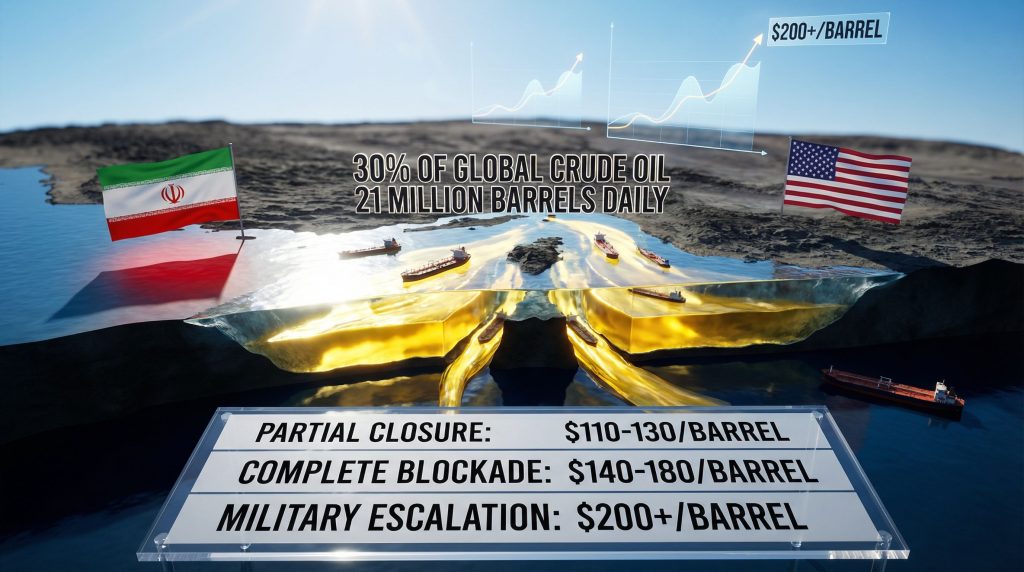
In the complex world economy, few things are as jumpy or as powerful as the price of crude oil. It fuels our factories, moves our goods, and is a main cause of rising costs. However, the price of a barrel isn’t just about how much oil we have. Instead, it often shows how peaceful the world is. In fact, how military tension drives up global oil prices is a major factor influencing costs. As we move through 2026, we are seeing a big jump in energy costs. This isn’t because we are running out of oil, but because of the shadow of war and political games.
Military tension creates a “risk premium”—an extra cost added to oil because people fear future trouble. When a missile is fired or a navy starts a drill in a busy sea, traders don’t wait for the oil to stop flowing. They react to the chance that it might stop. This article looks at how military friction turns into economic pain, examining the world’s narrow sea paths, the mood of the markets, and long-term changes in global energy.
The “risk premium” is the extra money added to oil prices when investors think war might limit the supply. In a calm world, oil prices stay near the cost of pumping it. But in 2026, with many active war zones, this “fear tax” has added as much as $15 to $25 to the price of every barrel.
The market works like a guessing machine. It prices today’s oil based on how safe tomorrow looks. If war looks likely for a big producer—like Iran or Russia—the price jumps right away. This is a mental game as much as a physical one. Even if not one drop of oil is lost, the threat of a shortage causes buyers to scramble. This drives up the price for everyone, from big factories to families at the gas station.
The global oil trade depends on a few narrow paths called chokepoints. These are the weakest spots in the energy chain. Military tension in these areas acts like a clog in the system. If a navy threatens to close one of these paths, the cost of moving oil shoots up as ships are forced to take longer, more expensive routes.
The Strait of Hormuz is the most important path on Earth. Nearly 20 million barrels of oil pass through it every day. Military threats in the Persian Gulf in 2026 have caused insurance costs for ships to jump by 500%. When paths like the Suez Canal become war zones, ships must sail around Africa. This adds about two weeks to the trip. This delay creates a “fake” shortage that pushes prices even higher.
In modern war, energy plants have become main targets. The move toward “asymmetric war”—using drones and cyber-attacks—makes it easy for small groups to cause global trouble. A single $50,000 drone can break a billion-dollar refinery and stop production for months.
Recent events show a scary trend of targeting energy sites on purpose. Unlike old wars over land, these fights aim to hurt the enemy’s wallet. When a refinery is hit, it cannot be fixed overnight. This leads to a shortage of gasoline and jet fuel. These local shortages eventually raise the global average price, as countries race to buy fuel from other places to fill the gap.
Military tension often leads to trade bans called sanctions. These are used to punish aggressive nations, but they hurt both sides. When a big oil producer is blocked, their oil is removed from the official market. While this hurts that nation, it also means there is less oil for everyone else, which naturally pushes prices up.
By 2026, we have seen two different oil markets emerge. Blocked oil often flows into a “shadow market.” It is sold at a discount to nations that don’t care about the bans. However, this oil is hard to track or insure, making the whole system less efficient. The loss of steady supply from big producers forces Western nations to fight over “clean” oil from safe areas, leading to the high prices seen in the U.S. and Europe lately.
Not all military tension is between countries. Fights inside a country, like coups or civil wars, hurt oil prices just as much. In nations that rely on oil money to survive, the military often fights for control of the wells. When oil fields become battlefields, pumping stops.
In 2026, several oil-rich nations have faced internal fights. When a coup happens, the oil company is the first thing seized. During the chaos, repairs are ignored and expert workers flee. This “tech neglect” causes production to drop. These small breaks in many different countries add up to a big global shortage. Investors see these areas as risky and demand higher prices to cover the danger.
To help stop price jumps, many nations keep a “Strategic Petroleum Reserve” (SPR). These are giant piles of oil kept for war or emergencies. However, by 2026, many of these stocks are at their lowest levels in years because they were used to fight inflation in the past.
When these stocks are low, the market gets even more nervous about military threats. If a new fight starts and the world knows the U.S. or China has little “extra” oil to use, prices jump even faster. These stocks act like a safety net; without them, there is nothing to stop the fall. This makes the economy very sensitive to “headline risk,” where one angry tweet or troop movement can cause a $5 price hike.
One major effect of high oil prices is the speed-up of green energy. For many countries, moving away from oil isn’t just about the planet anymore; it’s about safety. “Energy independence” in 2026 means having a power grid that a foreign army cannot shut down.
However, this creates a “security paradox.” As Western nations move to electric cars and wind power, the world’s remaining oil needs are met by only a few producers. These producers are often the source of military tension. This makes the “last barrels” of oil the most expensive and dangerous in history. Also, the metals needed for batteries (like lithium) are now starting their own military tensions.
The final step is the hit to the average person. High oil prices caused by war act like a “global tax.” Because almost everything is moved by trucks or ships, a jump in fuel costs makes everything more expensive. This forces banks to raise interest rates, which slows down the economy and risks a recession.
In 2026, we have seen that high energy prices cause social anger. When people can’t afford to drive to work or heat their homes, they protest. This creates a loop: war leads to high oil prices, which leads to anger at home, which makes the government weaker. This makes them more likely to start military distractions or face a coup. The barrel of oil is truly the center of global stability.
The high oil prices of 2026 remind us that energy is never truly free from politics. Military tension doesn’t just put lives at risk; it hurts the wallet of every person on Earth. Whether it’s through sea blocks, drone attacks, or the simple fear of what might happen next, conflict is the biggest driver of high costs.
The Risk Premium is Here to Stay: As long as oil is in war-prone areas, a “fear tax” will be part of the price.
Sea Paths are Weak: The world economy relies on narrow strips of water that any navy can close.
Tech Threats are Cheap: Drones and hacking allow small groups to cause massive price jumps.
Energy Safety is Vital: The move to green energy is now a way to escape the dangers of oil war.
Our future depends on whether we can build an energy system that is safe from war or whether we will stay stuck to the jumpy oil barrel.