

When Donald Trump returned to the White House, one thing became clear very quickly: global trade was about to get uncomfortable again. Tariffs, protectionist rhetoric, and the “America First” playbook made a comeback, leaving many of the world’s biggest economies scrambling to rethink their strategies. Among those most affected were India and the European Union two massive markets that suddenly found themselves on the receiving end of tougher U.S. trade policies.
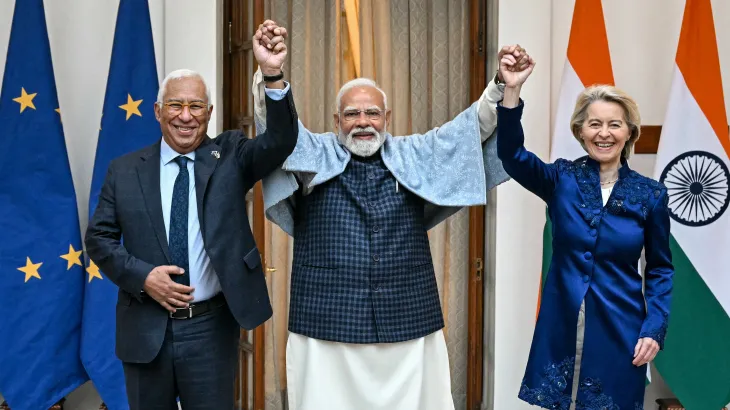
Instead of fighting alone, India and Europe are now looking at each other. What’s emerging is an ambitious push for what some officials have dramatically called the “mother of all trade deals.” It’s not just about lowering tariffs. It’s about reshaping global trade alliances in a world where the United States is becoming less predictable.
Trump’s trade philosophy has always been blunt: trade deficits are bad, tariffs are good, and allies should not expect special treatment. Europe already knows this story well. From steel and aluminum tariffs to threats against the auto industry, the EU has spent years clashing with Washington over trade.
India, meanwhile, has also felt the sting. Preferential trade status was revoked, tariffs were imposed on key exports, and negotiations often stalled amid sharp rhetoric. For New Delhi, Trump’s return signaled that smooth trade relations with the U.S. were far from guaranteed.
So while the U.S. remains a crucial partner for both India and Europe, the message was loud and clear: relying too heavily on Washington comes with risks.
That realization has pushed India and Europe closer together. Talks around a comprehensive trade and investment agreement, which had dragged on for years with little progress, suddenly gained momentum. This time, there’s a sense of urgency and opportunity.
India sees Europe as a stable, high-value market with advanced technology, strong consumer demand, and long-term investment potential. Europe, on the other hand, views India as one of the fastest-growing large economies in the world, with a young population and expanding middle class.
In a global economy marked by uncertainty, that combination looks increasingly attractive.
Calling it the “mother of all deals” might sound like political hype, but there’s a reason for the excitement. If finalized, this agreement would cover nearly a quarter of the world’s population and a huge share of global GDP.
For Europe, the deal could open doors to India’s massive market for cars, machinery, renewable energy technology, luxury goods, and services. European companies have long complained about high tariffs and regulatory barriers in India. A trade agreement could finally ease some of those pain points.
For India, the benefits are just as significant. Better access to European markets would boost exports of pharmaceuticals, textiles, IT services, and engineering goods. It would also encourage more European companies to invest in India, supporting job creation and industrial growth.
This deal isn’t just about economics. It’s deeply political.
Both India and the EU want to project themselves as champions of a rules-based global order especially at a time when that order feels under pressure. Strengthening ties sends a message that major economies can still cooperate, even as geopolitical tensions rise.
There’s also a subtle balancing act at play. Europe is trying to reduce its overdependence on both the U.S. and China. India, meanwhile, wants to position itself as a credible alternative to China in global supply chains. A strong India-Europe partnership fits perfectly into both strategies.
Of course, calling something the “mother of all deals” doesn’t make it easy.
There are serious sticking points. Europe wants India to lower tariffs on cars, wine, and dairy products areas that are politically sensitive in India. New Delhi, meanwhile, is pushing for easier movement of skilled workers and recognition of professional qualifications, something the EU approaches cautiously.
Environmental and labor standards are another potential flashpoint. Europe is increasingly strict about climate rules and sustainability requirements, while India worries these could become disguised trade barriers.
Still, compared to the uncertainty of dealing with an unpredictable U.S. administration, both sides seem more willing than ever to compromise.
Ironically, Trump may end up playing the role of an unintended matchmaker. By pressuring allies and partners alike, his trade policies have encouraged countries to diversify their relationships.
In that sense, the India-Europe push isn’t anti-American it’s pragmatic. It’s about not putting all eggs in one basket. If the U.S. wants tougher terms, then alternatives suddenly look much more appealing.
This dynamic reflects a broader trend in global trade: middle and large powers increasingly hedging their bets, building multiple partnerships to protect themselves from political shocks.
If India and Europe manage to seal this deal, it could reshape trade flows for decades. Supply chains would become more diversified, investment patterns could shift, and both sides would gain more leverage in negotiations with other major powers.
It would also show that big, complex trade agreements are still possible in an era when multilateralism often feels stuck. At a time when global cooperation seems fragile, that would be a powerful signal.
At its core, this emerging India-Europe trade push is a story of adaptation. Faced with renewed pressure from Washington, both sides chose engagement over isolation.
Trump’s return may have brought uncertainty, but it also forced a rethink. And in that rethink, India and Europe found common ground and a shared incentive to move faster, think bigger, and aim higher.
Whether the “mother of all deals” actually gets signed remains to be seen. But one thing is clear: in a world shaken by shifting alliances, India and Europe are no longer waiting on the sidelines. They’re writing their own trade future together.