

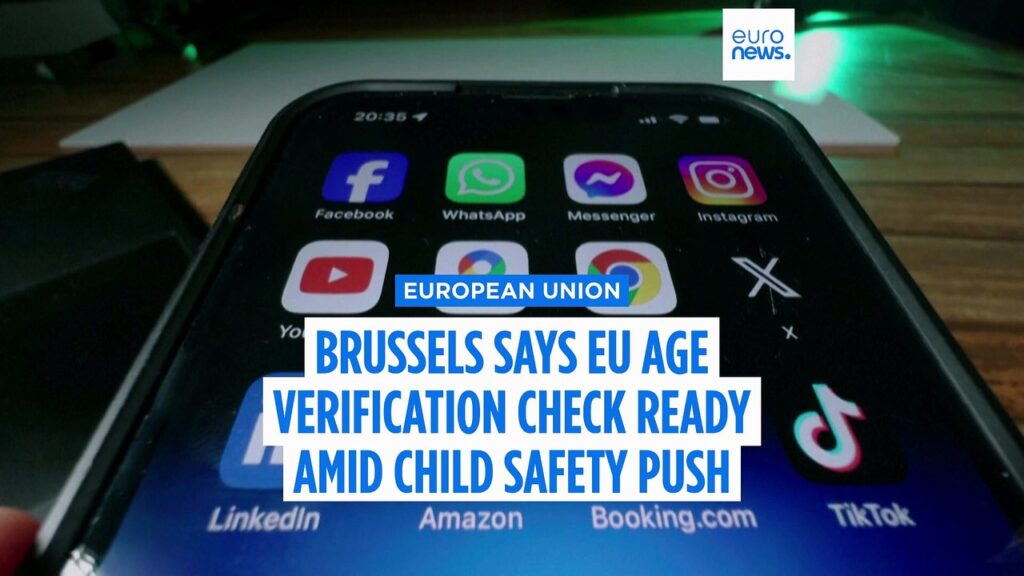
The European Union is intensifying efforts to create a comprehensive age verification framework designed to improve child safety online. In fact, an EU-Wide Child Safety Age Verification Framework now under push in Europe aims to address these concerns. As digital platforms become increasingly central to children’s social, educational, and entertainment experiences, policymakers across Europe are confronting a difficult challenge: how to protect minors from harmful online content while preserving privacy, freedom of expression, and access to digital services.
The debate surrounding age verification is not new, but recent regulatory developments, growing concerns about social media’s impact on young users, and the rapid spread of artificial intelligence-powered content have elevated the issue to the forefront of European digital policy. Advocates argue that stronger age verification measures are necessary to prevent children from accessing inappropriate content, while critics warn that poorly designed systems could undermine privacy, create security risks, and limit civil liberties.
The European Union’s push for a harmonized age verification framework represents one of the most ambitious attempts globally to address these competing concerns. If implemented successfully, it could establish a model that influences internet regulation far beyond Europe.
This article explores the motivations behind the EU’s age verification initiative, examines the technologies under consideration, analyzes the legal and ethical challenges involved, and evaluates the potential implications for children, parents, technology companies, and society as a whole.
Children today spend more time online than any previous generation. Smartphones, tablets, social media platforms, video-sharing services, online gaming environments, and messaging applications have become integral parts of daily life.
While these technologies offer educational opportunities and social connections, they also expose minors to significant risks.
Research conducted across Europe consistently shows that children are accessing digital services at increasingly younger ages. Many platforms formally restrict usage to users above certain age thresholds, yet enforcement mechanisms often remain weak or ineffective.
One of the primary motivations behind the EU-wide initiative is the fragmented nature of existing age verification practices. Different member states currently employ varying approaches to online child protection, creating regulatory inconsistencies and compliance challenges.
A unified framework could establish common standards across all member states, ensuring that online platforms operate under consistent expectations.
European policymakers increasingly view child safety as a fundamental aspect of digital governance, placing it alongside cybersecurity, competition policy, and data protection as major regulatory priorities.
The push for age verification does not exist in isolation. It is part of a broader European effort to regulate digital platforms and strengthen online safety.
Several major legislative frameworks already influence how technology companies operate within the European Union.
Together, these regulations establish obligations related to transparency, risk management, user protection, and data privacy.
Age verification can be implemented through several technological approaches, each with distinct strengths and weaknesses.
One of the central debates in Europe concerns which methods can effectively verify age while minimizing privacy risks.
This approach requires users to submit official identification documents such as passports, driver’s licenses, or national identity cards.
Many privacy advocates argue that requiring identity documents for routine internet access could create significant risks if personal data is compromised.
Another increasingly discussed solution involves biometric age estimation technologies.
These systems use artificial intelligence to estimate a person’s age based on facial characteristics rather than identifying the individual directly.
While age estimation technologies have improved significantly, critics note that no system is perfectly accurate across all populations and age groups.
The European Union is also exploring digital identity solutions as part of its broader digital transformation agenda.
Under this vision, individuals could use secure digital wallets to prove specific attributes—such as being above a certain age—without revealing unnecessary personal information.
Many experts view attribute-based verification as one of the most promising long-term solutions because it aligns child safety goals with data minimization principles.
Privacy remains one of the most contentious aspects of age verification policy.
The European Union has long positioned itself as a global leader in privacy protection, particularly through the GDPR. Any age verification framework must therefore comply with strict data protection requirements.
Critics argue that age verification systems could inadvertently create large databases of personal information that become attractive targets for cybercriminals.
The challenge facing policymakers is not simply technical but fundamentally ethical.
Governments must balance several important objectives:
Achieving this balance requires careful policy design and ongoing oversight.
Social media companies are central stakeholders in the age verification debate.
Platforms increasingly face criticism for allowing underage users access to services that may expose them to harmful content, targeted advertising, or inappropriate interactions.
The EU framework could significantly expand the compliance obligations imposed on major technology platforms.
Most major social media platforms maintain minimum age requirements, often set at 13 years old.
However, enforcement has historically relied heavily on self-declared information.
This approach creates obvious limitations because users can easily provide inaccurate birth dates during registration.
These challenges have contributed to calls for more robust verification frameworks.
Implementation of EU-wide age verification requirements could have substantial operational and financial implications for digital service providers.
Companies may need to invest in new technologies, compliance programs, legal reviews, and privacy safeguards.
Large technology companies may be better positioned to absorb these costs than smaller firms and startups.
Smaller businesses often face unique difficulties when implementing regulatory requirements.
Unlike multinational technology corporations, many small and medium-sized enterprises lack dedicated compliance teams or significant technical resources.
Policymakers may need to consider proportional compliance mechanisms to avoid creating excessive burdens on smaller organizations.
The European Union is not alone in exploring age verification measures.
Several countries around the world have introduced or proposed similar requirements, particularly regarding access to adult content and social media platforms.
However, approaches vary significantly depending on legal traditions, privacy standards, and cultural expectations.
Any large-scale age verification framework must address cybersecurity risks.
Systems responsible for handling identity-related information become attractive targets for attackers.
Failure to implement robust security controls could undermine public confidence in the framework.
Age verification alone is unlikely to solve all child safety challenges.
Experts increasingly advocate a broader approach that combines technological safeguards, educational initiatives, parental involvement, platform accountability, and regulatory oversight.
Long-term success will likely depend on integrating these elements into a coherent digital safety ecosystem.
If successfully implemented, the EU-wide framework could influence digital regulation worldwide.
Technology companies often adopt global compliance strategies based on major regulatory markets, meaning European requirements could affect users far beyond EU borders.
Potential long-term outcomes include:
The framework may ultimately become one of the defining digital policy initiatives of the decade.
The European Union’s push for an EU-wide child safety age verification framework reflects growing concern about the risks children face in an increasingly digital world. Policymakers are seeking to create a harmonized approach that strengthens online protections while respecting Europe’s strong commitment to privacy, data protection, and fundamental rights.
The debate highlights a complex balancing act. Effective age verification can help limit children’s exposure to harmful content and improve platform accountability, but poorly designed systems could introduce privacy risks, cybersecurity vulnerabilities, and barriers to digital participation. As a result, the success of the initiative will depend heavily on technological choices, regulatory safeguards, and ongoing oversight.
Digital identity wallets, privacy-preserving verification methods, biometric age estimation tools, and stronger platform responsibilities are all likely to play important roles in the future framework. However, age verification should be viewed as one component of a broader child safety strategy that also includes education, parental engagement, content moderation, and responsible platform design.
Ultimately, the EU’s efforts may establish a global benchmark for how societies can protect children online while preserving the openness, privacy, and freedoms that define the modern internet.