

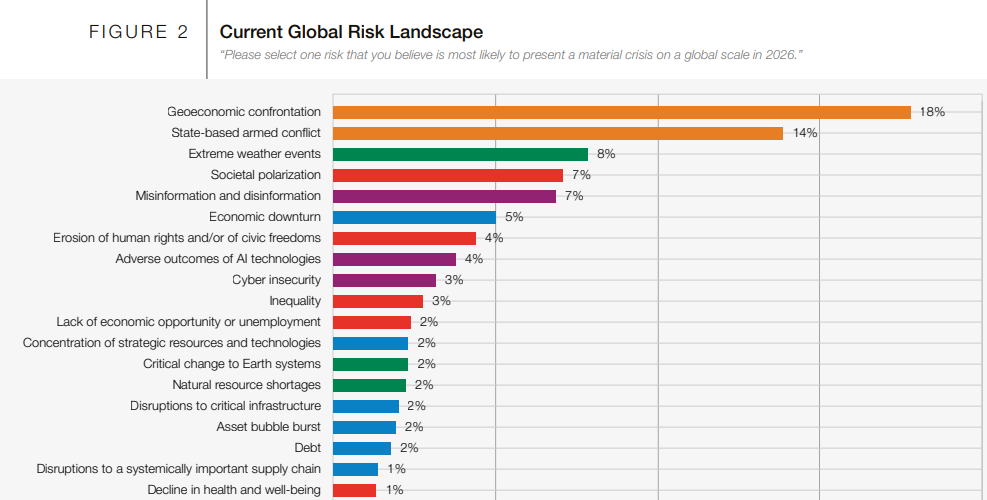
In an increasingly interconnected yet politically fragmented world, geoeconomic confrontation has emerged as one of the most significant global risks. Highlighted prominently by the World Economic Forum (WEF) in its annual Global Risks Report, this phenomenon refers to the strategic use of economic tools—such as trade restrictions, sanctions, and investment controls—by states to achieve geopolitical objectives. Unlike traditional military conflict, geoeconomic confrontation unfolds through financial systems, supply chains, and technological ecosystems, often with far-reaching consequences for global stability.
The growing prominence of geoeconomic tensions signals a shift in how power is exercised internationally. Economic interdependence, once seen as a stabilizing force, is now being weaponized. This article explores the causes, manifestations, and consequences of geoeconomic confrontation, drawing on real-world examples, data, and expert insights to provide a comprehensive understanding of this critical issue.
Geoeconomics lies at the intersection of economics and geopolitics. It involves the use of economic instruments to influence the behavior of other states and secure strategic advantages. While economic competition is not new, the scale and intensity of current confrontations mark a significant escalation.
Key characteristics of geoeconomic confrontation include:
The World Economic Forum consistently ranks geoeconomic confrontation among the top global risks due to its systemic impact. Unlike isolated economic disruptions, geoeconomic tensions can cascade across industries, regions, and sectors, amplifying vulnerabilities.
Several factors explain this prioritization:
Trade wars have become a hallmark of geoeconomic confrontation. Tariffs and quotas are used not only to protect domestic industries but also to exert pressure on rival economies.
For example, the U.S.-China trade conflict saw tariffs imposed on hundreds of billions of dollars’ worth of goods, disrupting global supply chains and increasing costs for businesses and consumers worldwide.
Sanctions are a powerful geoeconomic tool. They can target entire economies, specific industries, or individuals, restricting access to financial systems and markets.
Recent sanctions regimes have demonstrated their ability to isolate economies, reduce trade flows, and reshape global alliances.
Technology has become a central battleground in geoeconomic confrontation. Control over semiconductors, artificial intelligence, and digital infrastructure is seen as critical to national security and economic dominance.
Export controls, investment screening, and restrictions on technology transfers are increasingly common, leading to the fragmentation of global innovation ecosystems.
Countries rich in natural resources are leveraging their assets for strategic advantage. Restrictions on exports of critical minerals, energy supplies, and agricultural products can have significant global repercussions.
The rivalry between the United States and China exemplifies geoeconomic confrontation. Beyond tariffs, the conflict extends to technology restrictions, investment bans, and competition over global influence.
Key developments include:
The conflict involving Russia and Western nations highlights the use of sanctions and energy as geoeconomic tools. Sanctions have targeted financial systems, energy exports, and trade relations, while energy supply disruptions have affected global markets.
The European Union is pursuing “strategic autonomy” to reduce dependence on external powers. This includes diversifying supply chains, investing in domestic industries, and strengthening regulatory frameworks.
Geoeconomic tensions disrupt supply chains, leading to delays, increased costs, and shortages of critical goods. Industries such as electronics, automotive, and pharmaceuticals are particularly vulnerable.
Trade restrictions and supply disruptions contribute to rising prices. Inflation affects households, reduces purchasing power, and complicates monetary policy decisions.
The global economy is increasingly divided into competing blocs. This fragmentation reduces efficiency, limits trade opportunities, and increases geopolitical risks.
Unpredictable policies and geopolitical tensions create uncertainty for investors. Businesses face challenges in planning and allocating resources effectively.
Companies must adapt to a rapidly changing environment shaped by geoeconomic risks.
Developing economies face unique challenges in a fragmented global system.
These include:
International organizations play a critical role in managing geoeconomic tensions, though their effectiveness is increasingly challenged.
Addressing geoeconomic confrontation requires coordinated efforts at multiple levels.
Reinforcing international cooperation can help reduce tensions and promote stability.
Investing in resilient infrastructure and diversified supply chains can mitigate risks.
Diplomatic engagement is essential to prevent escalation and resolve disputes.
Collaborative approaches to technology development can reduce fragmentation and foster innovation.
The trajectory of geoeconomic confrontation remains uncertain. While current trends point toward increased fragmentation, there are opportunities for renewed cooperation.
Key questions for the future include:
Geoeconomic confrontation has emerged as a defining feature of the modern global landscape, reshaping the dynamics of power, trade, and cooperation. As highlighted by the World Economic Forum, it represents a systemic risk with far-reaching implications for economies, businesses, and societies worldwide.
The interplay between economic tools and geopolitical objectives has transformed globalization into a more contested and complex process. While the risks are significant—ranging from supply chain disruptions to market fragmentation—there are also opportunities to build resilience, foster innovation, and strengthen international collaboration.
Ultimately, addressing geoeconomic confrontation requires a balanced approach that combines strategic competition with cooperative frameworks. By prioritizing dialogue, investing in resilience, and reinforcing global institutions, the international community can navigate this challenging landscape and work toward a more stable and inclusive global economy.