

The global oil supply chain has always been a sign of world stability. By 2026, it has become very fragile, with tensions reshaping the global oil supply chain in unprecedented ways. Energy is the lifeblood of our factories and homes. Because of this, the pipes and ships that move oil are now used as weapons in global politics.
Today, we are moving away from global trade and toward “power blocs.” The 2022 invasion of Ukraine started this change. Now, in 2026, new fights in the Middle East and the South China Sea have made it official. Oil is no longer just a product bought for profit. It is a strategic prize. Military ties and sea blockades now decide where oil flows. This article looks at the main areas of tension and what they mean for the world economy.
The Strait of Hormuz is the most important mile of water on Earth. It handles nearly 20% of the world’s oil. If it closes, the global market feels it instantly. In early 2026, the world saw the “largest supply drop in history” when local wars shut the strait.
During this 2026 crisis, oil prices shot past $120 per barrel in just days. This fight was different because it used new tech, like “drone boats” and sea mines. These tools made the cost of insurance for oil ships jump by 400%. For countries like China, India, and Japan, this was a huge threat. They rely on this water for 75% of their oil and had to use their emergency reserves fast.
The war in Ukraine has changed Russian oil forever. By 2026, trade between Russia and the West has mostly stopped. However, Russian oil has not disappeared. It has found a “shadow” path to the market.
To beat price caps and bans, Russia created a “shadow fleet.” This is a group of hundreds of old ships with secret owners and no standard insurance. These ships are risky for the environment but keep the oil moving. By 2026, Europe’s imports of Russian oil have dropped by 90%. Now, India and China are the main buyers. They buy the oil at a discount, refine it, and often sell it back to the Western countries that banned it in the first place.
The Middle East has the oil, but the South China Sea (SCS) is the main “highway” for Asia. In 2026, this area is full of tension between China and its neighbors. They are fighting over two things: safe shipping lanes and the oil and gas buried under the seabed.
A single accident in the SCS can now make oil prices spike. If the main lanes are blocked, ships must take a longer path around Australia. This adds 10 to 15 days to the trip, creating a physical shortage of oil in East Asia. In 2026, countries like the Philippines and Vietnam have increased their sea patrols. These standoffs make energy prices go up even when the oil supply is still steady.
Pipelines are no longer just tubes in the ground; they are military targets. After the Nord Stream attacks, 2026 has seen a huge focus on pipe security.
In 2026, pipelines are turned on or off based on who is friends with whom. For example, a new pipe to China has made Russia and China closer partners. Meanwhile, in Central Asia, pipes are often shut down for “technical reasons” that are actually political. This makes the system very weak. One small explosion or a closed valve can hurt a country more than a traditional bomb.
The Middle East conflict in early 2026 is a perfect example of a modern supply shock. When several big producers cut 9 million barrels of oil per day, the world entered a hard economic time.
This shock slowed down factories in oil-heavy countries by 10%. The pain was felt quickly. While people paid more at the gas pump—with U.S. diesel hitting $5.80—the real damage was in farming and chemicals. Because the Middle East provides a huge amount of the world’s plastic base, factories in Vietnam and China ran out of materials. This led to massive delays for toys, tech, and tools worldwide.
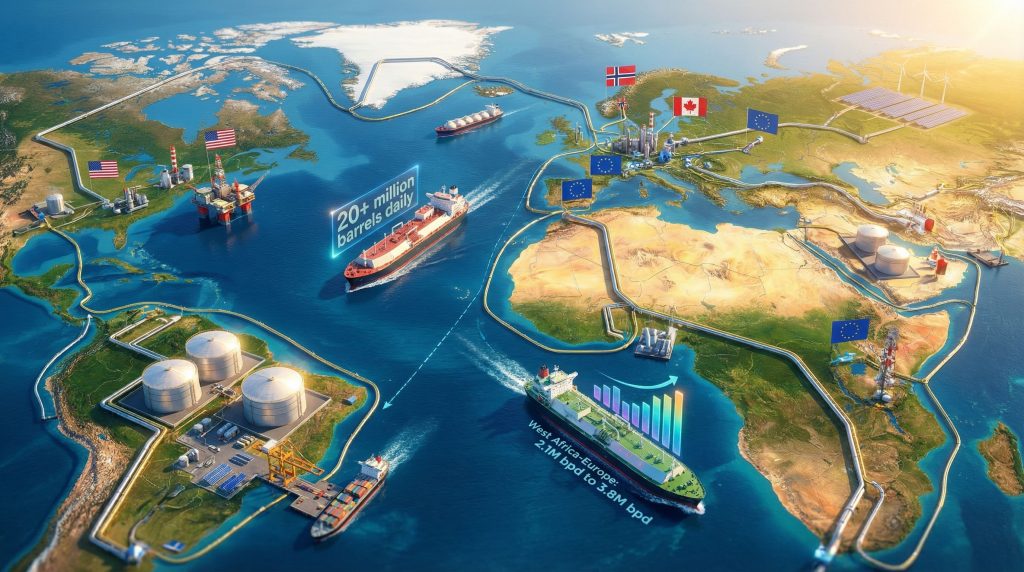
In 2026, nations have stopped looking for the cheapest oil. Instead, they are moving toward “friend-shoring.” This means buying energy only from political allies, even if it costs more.
The U.S. is now sending record amounts of oil and gas to Europe to replace what was lost from Russia. European nations are signing 20-year deals with friends in North America and Africa. This keeps the supply safe, but it makes energy more expensive for everyone. We are now paying a “security tax” on every gallon of gas to ensure the supply doesn’t disappear overnight.
The events of 2026 show that the era of easy, global oil trade is over. The supply chain is now a weapon.
In 2026, energy security is the same as national security. Our alliances will now decide our energy future.