

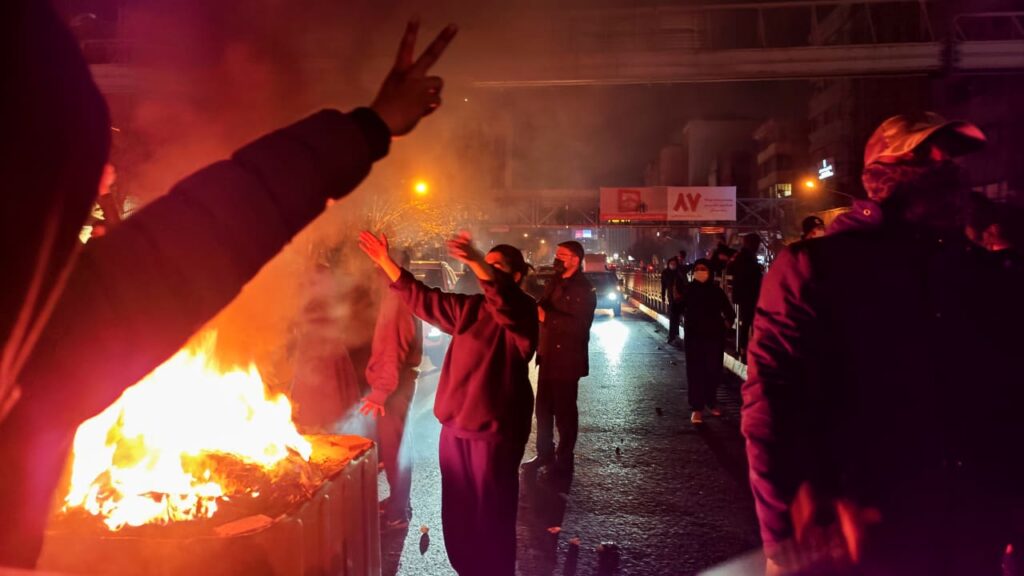
In late December 2025, Iran’s streets burst into protest — not just small demonstrations here or there, but a wave of anger spreading across cities and towns from Tehran to Mashhad. What started with frustration over a collapsing economy and skyrocketing prices quickly turned into something much bigger: people openly demanding the ouster of the clerical establishment that has ruled Iran since the Islamic Revolution in 1979. But even though the situation has reached a boiling point with widespread unrest, the regime hasn’t collapsed. Why? The Iran clerical regime’s survival amid such turmoil will be closely examined here as we break down the reasons in a clear and relatable way.
One big reason the regime stays in power is its security apparatus — a deep and tightly loyal network of military and paramilitary forces. Groups like the Revolutionary Guards (IRGC) and the Basij militia are not just small units; they are huge, disciplined, and embedded throughout Iranian society. These forces are loyal to the regime, not to the public. They are the ones who crack down on protests, enforce order, and intimidate would-be defectors.
Even when protests grow big, as they have in early 2026, the security elite hasn’t shown a significant breakdown or defection. Many experts say as long as these forces stay united and loyal, the regime can withstand huge waves of unrest.
Some people might wonder: If people hate the regime so much, why don’t they just overthrow it? The answer has a lot to do with fear of instability.
Iran is a big, diverse country with different ethnic groups and regions. Without a clear alternative leadership or plan, many ordinary Iranians worry that overthrowing the regime could lead to chaos, economic collapse, or civil war. In other parts of the Middle East, power vacuums have sometimes led to long periods of violence and uncertainty. Many protesters want change, but few feel confident there’s a better system ready to step in.
Even though millions of people are protesting, the movement has been largely leaderless and decentralized. That sounds like a good thing in terms of grassroots energy, but when it comes to overthrowing a powerful state, lack of clear leadership can work against the protesters.
Without a centralized strategy or recognized leaders inside the country, the regime can still paint the movement as chaotic, disorganized, or easily manipulated by foreign enemies. That weakens the impact of the protests politically and makes it harder for the movement to turn street anger into a coherent alternative to the current rulers.
During big moments of civil unrest, communication is crucial. People need to organize, share information, and coordinate actions. The Iranian government has repeatedly cut internet access and blocked phones, making it very hard for protesters to communicate freely.
When the internet goes down, it’s not just inconvenient — it dramatically slows down organizing, especially among younger generations who rely heavily on social media. By limiting the flow of information, the regime reduces the momentum of protests and keeps people isolated and confused.
There’s no easy way to say this: the regime has used real violence and repression to stay in control. Thousands of people have been killed or arrested during current protests, and hundreds more in previous uprisings.
This kind of fear is powerful. When people see that taking to the streets might mean imprisonment or death, many hesitate. Families, friends, and neighbors may support the protests in spirit, but they often choose safety over open confrontation. This doesn’t make the protests go away, but it limits their scale and duration compared to what would be needed to overthrow the regime.
Protests become really dangerous for a government when members of the elite — generals, politicians, bureaucrats — start defecting and refusing to support the leadership. So far in Iran, that hasn’t happened in any major way.
Political and military leaders have largely stayed with Supreme Leader Ayatollah Ali Khamenei and the clerical hierarchy. When insiders remain loyal, it reinforces the regime’s stability and shows that the power structure is still intact.
Iran’s leaders base much of their legitimacy on religious authority. The regime presents itself not just as a government, but as a guardian of Islamic values in a society where religion still plays a big role.
Even though many Iranians — especially young people — are tired of religious control, the idea of rejecting religion entirely or replacing the current system with something unknown isn’t easy for everyone. The regime has spent decades building this religious narrative, and it still matters in shaping how people think about politics and stability.
Another twist is the involvement of foreign powers. The regime often frames protests as being encouraged or orchestrated by external enemies like the United States or Israel. This narrative doesn’t always convince everyone, but it can be enough to rally supporters who fear foreign interference.
At the same time, international pressure — like sanctions or threats of military action — doesn’t automatically weaken the regime. Often, it gives the leadership a chance to tighten control by claiming that the country is under siege and must remain unified.
Right now, Iran is in a moment of deep crisis. The protests are widespread and show real anger toward the clerical establishment. The demands are no longer just about rising prices — they are about systemic change and a desire for political freedom.
But the regime’s survival isn’t just about force. It’s about institutional strength, fear, lack of alternatives, and the control of information and ideology. That combination keeps the current leadership in power, even when millions protest in the streets.
In short, the Iranian regime hasn’t fallen because the state remains stronger than the movement attacking it — at least for now. That doesn’t mean change is impossible. History shows that sustained pressure, unity, and strategic shifts can eventually bring down powerful governments. But as of early 2026, the clerical regime still stands — and the struggle for Iran’s future continues.