

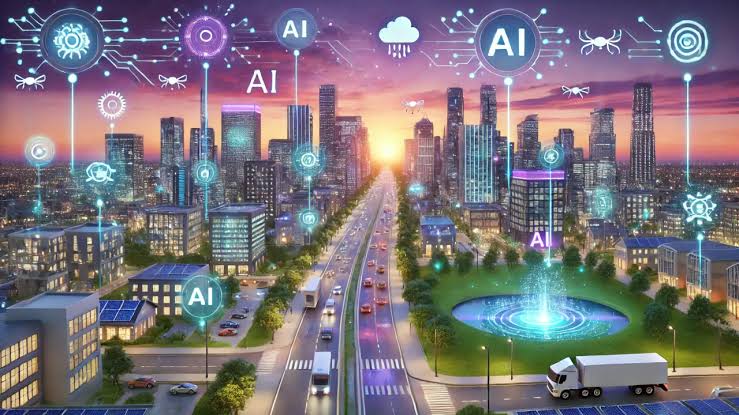
AI-Powered Solutions for Optimizing Smart City Infrastructure… For much of the past decade, the idea of a “smart city” was associated with connected sensors, digital dashboards, intelligent traffic lights, public Wi-Fi, and Internet of Things devices. Today, that definition is changing. The next generation of smart cities will not simply collect more data; they will use artificial intelligence (AI) to interpret that data, predict what is likely to happen, and automatically optimize infrastructure in response.
This shift is becoming increasingly important as urban populations expand and infrastructure systems become more complex. The United Nations’ 2025 World Urbanization Prospects reports that cities are now home to 45% of the world’s population, and that two-thirds of global population growth through 2050 is projected to occur in cities. The number of megacities—urban areas with at least 10 million inhabitants—has grown from just eight in 1975 to 33 in 2025.
That growth creates an enormous infrastructure challenge. Cities must move more people, supply more electricity and water, manage larger volumes of waste, maintain roads and buildings, respond to emergencies, and reduce environmental impacts, often without proportional increases in land, budgets, or personnel.
AI offers a new way to address that challenge. Machine-learning models can forecast traffic demand, identify water leaks, predict equipment failures, optimize energy consumption, detect abnormal patterns, coordinate public transportation, and help cities respond to extreme weather. When combined with sensors, connected devices, cloud platforms, edge computing, digital twins, and automation, AI can turn infrastructure from a largely reactive system into a predictive and adaptive one.
However, AI is not a magic solution. Cities must contend with privacy concerns, cybersecurity risks, fragmented data systems, unreliable sensors, algorithmic bias, high deployment costs, and a shortage of technical expertise. The most successful smart-city programs will therefore combine advanced technology with careful governance, measurable objectives, and human oversight.
Urban infrastructure traditionally operates through fixed schedules and rules. Traffic signals may follow programmed timing plans, streetlights may switch on at predetermined times, waste collection trucks may follow fixed routes, and building heating and cooling systems may operate according to schedules established months earlier.
These approaches work reasonably well when conditions are predictable. Modern cities, however, are highly dynamic. Traffic changes by the minute. Electricity demand fluctuates with weather and human behavior. Water networks experience changing pressure and consumption. Public transportation demand can shift suddenly because of events, accidents, or emergencies.
AI is valuable because it can identify relationships in large, continuously changing datasets that are difficult for human operators to process manually.
A modern AI-enabled urban infrastructure system can potentially:
Research published in Nature Cities emphasizes that smart-city performance depends on more than simply installing sensors. It describes a data-to-decisions process involving devices, communication and data handling, operations, and planning and economics. Failures at any layer can limit the benefits of smart-city technology.
Transportation is one of the most visible areas where AI can improve urban infrastructure. Congestion wastes time, increases fuel consumption, contributes to emissions, and creates economic costs for businesses and residents.
Conventional traffic management generally relies on historical traffic patterns. AI can supplement those patterns with real-time information from cameras, connected vehicles, road sensors, GPS systems, public-transit networks, weather services, and mobile devices.
Machine-learning models can analyze this information to estimate traffic conditions several minutes into the future. Traffic-control systems can then adjust signal timing, recommend alternative routes, prioritize buses, or respond to accidents.
Imagine a four-way intersection where the traffic signal operates according to a fixed cycle. At 7:30 a.m., the system might assume heavy north-south traffic. But if an accident changes traffic patterns, the fixed schedule can create unnecessary queues.
An AI-enabled intersection can instead analyze current traffic volumes and dynamically adjust signal phases. If sensors detect an unusually large queue on one approach, the system can allocate additional green time. If a pedestrian crossing becomes heavily used, the algorithm can account for that demand as well.
AI can also help cities coordinate multiple intersections. Rather than optimizing each traffic light independently, algorithms can attempt to improve traffic flow across an entire corridor or network.
AI can improve buses, trains, and other public transportation systems by forecasting passenger demand and adjusting capacity accordingly.
For example, if historical and real-time data show that a particular bus route experiences unusually high demand after a sports event, a transit agency can deploy additional vehicles or alter schedules. Predictive models can also identify routes where service is underused and help planners redesign networks.
The goal is not simply faster transportation. An effective AI system should improve reliability, accessibility, energy efficiency, and passenger experience simultaneously.
Energy infrastructure may be one of the areas where AI produces the greatest long-term benefits. Cities increasingly contain solar panels, batteries, electric vehicles, heat pumps, smart meters, connected buildings, and other distributed energy resources.
That creates an enormous optimization problem. Electricity demand changes continuously, while renewable generation such as solar and wind is variable.
AI can forecast demand and renewable generation, identify unusual grid conditions, and optimize when flexible loads or batteries should operate.
The International Energy Agency’s 2026 assessment of efficient grid-interactive buildings highlights the importance of combining energy efficiency, smart digital technologies, and demand-side flexibility. Such buildings can reduce or shift electricity consumption, align demand with renewable generation, and improve grid stability.
Buildings are particularly promising because their energy consumption can often be adjusted without significantly affecting occupants.
An AI-powered building-management system can analyze:
The system can then determine when to heat, cool, ventilate, charge batteries, or shift flexible loads.
The U.S. Department of Energy notes that grid-interactive efficient buildings can reduce energy waste, shift demand during peak periods, and help integrate variable renewable generation.
Earlier DOE research also estimated that grid-interactive efficient buildings could potentially save up to $18 billion per year in U.S. power-system costs by 2030 while reducing carbon emissions by 80 million tons annually.
AI can also detect when buildings are consuming more energy than expected. If a cooling system suddenly requires significantly more electricity to maintain the same temperature, an algorithm can flag the change as a possible equipment problem.
Lawrence Berkeley National Laboratory’s Smart Energy Analytics Campaign found median energy savings of 4% for energy-information systems and 9% for fault-detection and diagnostic software among participating organizations, illustrating the value of analytics-driven building management even before more sophisticated AI controls are introduced.
Water systems are another major opportunity for AI. Urban water networks contain thousands of pipes, pumps, valves, meters, and treatment facilities. Many systems are aging, and leaks can remain undetected for long periods.
AI can analyze pressure measurements, flow rates, acoustic signals, meter readings, weather data, and historical consumption to identify anomalies.
For example, if nighttime water consumption in a neighborhood suddenly rises while household demand is expected to remain low, an AI model could flag the area for inspection. If pressure changes indicate unusual flow through a particular section of a network, the system can prioritize that section for maintenance.
This approach changes the economics of water management. Instead of inspecting every component equally, utilities can concentrate limited maintenance resources on assets with the highest probability of failure.
AI can monitor the vibration, temperature, energy consumption, and operating cycles of pumps and other equipment. Changes in these variables can provide early indications of mechanical problems.
Predictive maintenance can reduce emergency repairs, extend equipment life, and minimize service interruptions. It can also help utilities schedule maintenance during periods when demand is lower.
The broader principle is simple: infrastructure should be maintained according to condition and risk rather than merely according to age or a fixed calendar.
Traditional waste collection often operates according to predetermined schedules. A truck may visit a collection point every Monday and Thursday regardless of whether the containers are nearly empty or overflowing.
Smart waste systems use sensors to estimate container fill levels. AI can combine those readings with historical patterns, traffic conditions, vehicle capacity, and collection priorities to optimize routes.
A dynamic system could send trucks only when containers require collection and select routes that minimize travel time and fuel consumption.
AI can also support recycling. Computer-vision systems can identify different materials on sorting lines and help automate separation. Over time, data from these systems can reveal contamination patterns and identify opportunities to improve recycling behavior.
One of the most powerful developments in smart-city technology is the digital twin: a dynamic digital representation of a physical environment.
A city-scale digital twin can incorporate information about buildings, roads, utilities, transportation networks, energy systems, weather, and population patterns. AI can then be used to simulate possible interventions.
Before changing a major intersection, for example, planners could model how the change might affect traffic several kilometers away. Before constructing a large building, they could simulate its effects on energy demand, traffic, sunlight, drainage, and surrounding infrastructure.
This can reduce the risk of expensive infrastructure mistakes.
Digital twins can also help cities prepare for extreme weather. AI models can simulate flood scenarios, heat waves, power outages, and evacuation routes.
Instead of asking only, “What infrastructure do we have?”, planners can ask, “What happens if this infrastructure fails?”
That distinction is increasingly important as cities face more complex climate and resilience challenges.
Roads, bridges, tunnels, rail systems, streetlights, elevators, water pumps, and electrical equipment all deteriorate over time. Conventional maintenance strategies tend to be reactive or calendar-based.
AI enables a more sophisticated approach.
Computer vision can analyze images of roads and bridges to identify cracks, corrosion, potholes, or other defects. Sensors can continuously monitor vibration and structural movement. Machine-learning models can combine these observations with historical maintenance records to estimate failure risk.
City governments can then prioritize repairs according to risk and public impact.
This approach can help cities move from “maintenance after failure” to “maintenance before failure.”
Urban environmental conditions can vary dramatically from one neighborhood to another. Air pollution, temperature, noise, humidity, and particulate concentrations can change over short distances.
AI can combine data from fixed sensors, mobile devices, satellites, weather stations, and other sources to create detailed environmental models.
For example, a city could use AI to predict areas where air pollution is likely to become elevated during certain weather conditions. Authorities could then issue targeted warnings, adjust traffic management, or investigate pollution sources.
AI can similarly help identify urban heat islands by combining satellite imagery, building information, vegetation coverage, surface temperatures, and weather observations.
Such analysis can support decisions about where to plant trees, install reflective surfaces, create cooling centers, or prioritize green infrastructure.
Bogotá provides a useful example of why technology should not be viewed separately from urban planning. Recent reporting on the Colombian capital highlights a strategy combining housing, transport, green infrastructure, and climate resilience. In 2025, 61% of 3.4 million square meters of new residential development was certified under green-building standards, while the city’s transportation system included approximately 1,500 electric buses and more than 630 kilometers of bicycle lanes.
The lesson for AI-enabled cities is important. An algorithm cannot compensate for poor planning. AI becomes most valuable when it helps coordinate good urban policy across multiple systems.
For example, an AI planning platform could evaluate housing development alongside transportation accessibility, electricity demand, water availability, and environmental risks. Instead of optimizing each department separately, the city can optimize the overall urban system.
Not every smart-city decision should depend on a distant cloud server. Traffic cameras, autonomous systems, industrial equipment, and safety infrastructure sometimes require decisions within milliseconds.
Edge computing processes data closer to where it is generated. AI models can therefore run on cameras, roadside computers, gateways, buildings, or other local infrastructure.
This offers several advantages:
Edge AI can be especially useful for traffic safety, industrial monitoring, emergency response, and infrastructure control, where sending every raw data stream to a centralized cloud may be impractical.
AI is only as effective as the data infrastructure supporting it. A city cannot build sophisticated predictive systems if departments operate disconnected databases using incompatible formats.
A successful architecture generally needs several layers:
The ITU’s smart sustainable cities framework emphasizes connectivity, infrastructure, smart services using AI and IoT, policy, business models, assessment mechanisms, and capacity building. It also notes that 57% of the world’s population lived in urban areas in 2022 and projects that share to reach 68% by 2050.
Greater connectivity creates greater exposure. A city with thousands of connected devices has thousands of potential attack surfaces.
A compromised traffic-control system could disrupt transportation. An attack on a water utility could interfere with operations. Ransomware could prevent access to municipal databases. Manipulated sensor data could cause an AI system to make incorrect decisions.
AI therefore needs to be accompanied by strong cybersecurity.
Smart-city operators should implement:
AI itself can assist with cybersecurity by detecting unusual network behavior, but relying entirely on AI for security would create a dangerous circular dependency. Human security teams and independent safeguards remain essential.
Smart cities collect enormous amounts of information. Cameras can observe public spaces, mobility systems can reveal travel patterns, and connected devices can generate detailed information about people’s behavior.
The challenge is to extract useful information without creating unnecessary surveillance.
Responsible smart-city programs should apply principles such as:
AI should improve public services without turning cities into environments where residents are continuously monitored without meaningful safeguards.
One of the biggest misconceptions about smart cities is that governments can simply replace old infrastructure with AI-enabled alternatives.
In reality, cities contain decades-old pipes, roads, electrical equipment, traffic controllers, databases, and buildings. Replacing everything at once would be financially unrealistic.
A more practical approach is incremental modernization.
AI can often be layered onto existing infrastructure through sensors, gateways, software, and analytics platforms. A city might begin with a small number of intersections, buildings, water districts, or maintenance programs and expand after demonstrating measurable value.
This approach reduces risk and allows officials to develop the organizational expertise needed to manage increasingly sophisticated systems.
Technology alone does not guarantee successful infrastructure modernization. Several common problems can undermine smart-city initiatives.
The ITU’s smart-city KPI framework is useful in this context because it encourages cities to evaluate technology across economic, environmental, and social dimensions rather than treating technological deployment as an end in itself.
Municipal governments do not need to transform every infrastructure system simultaneously. A staged strategy can produce better results.
Start with measurable challenges such as congestion, energy costs, water losses, equipment failures, or emergency-response delays.
Standardize data formats, establish secure connectivity, and determine who owns and manages different datasets.
Test AI in a defined geographic area or infrastructure category. Establish a baseline before deployment so improvements can be measured accurately.
Automate routine decisions where appropriate, but retain human oversight for safety-critical and high-impact decisions.
Evaluate projects according to metrics such as energy saved, travel time reduced, water losses avoided, maintenance costs lowered, emissions reduced, or service reliability improved.
Successful pilots should be expanded using interoperable standards rather than locked into isolated proprietary systems.
The ultimate promise of AI-powered infrastructure is not a city filled with gadgets. It is a city that can anticipate problems and respond before they become expensive or dangerous.
Consider a future morning in which AI predicts unusually heavy traffic because of weather, a major event, and an accident. Traffic signals automatically adjust. Public buses receive priority at key intersections. Transit agencies deploy additional vehicles. Drivers receive alternative-route information.
At the same time, the electricity system forecasts a peak in demand. Smart buildings reduce nonessential consumption, batteries discharge strategically, and electric-vehicle charging is shifted to less-congested periods.
Elsewhere, a water utility detects an unusual pressure pattern and dispatches a maintenance team before a major pipe failure. A bridge-monitoring system identifies an abnormal vibration pattern. An environmental model predicts poor air quality in a particular neighborhood, prompting targeted public-health measures.
None of these systems needs to operate independently. The real transformation occurs when they become connected parts of a broader urban intelligence platform.
AI is transforming the concept of smart-city infrastructure from connected hardware into adaptive urban systems. The most important shift is from monitoring to prediction: from asking what is happening now to determining what is likely to happen next and what action should be taken.
Transportation networks can become adaptive rather than fixed. Buildings can respond intelligently to electricity demand. Water utilities can identify leaks before they become major failures. Waste collection can be optimized according to real-world demand. Infrastructure maintenance can become predictive, and digital twins can allow planners to test major interventions before committing billions of dollars to construction.
The scale of the opportunity is enormous because urbanization is continuing worldwide. With cities already home to 45% of the global population and two-thirds of future population growth expected to occur in urban areas, infrastructure systems will face sustained pressure in the decades ahead.