

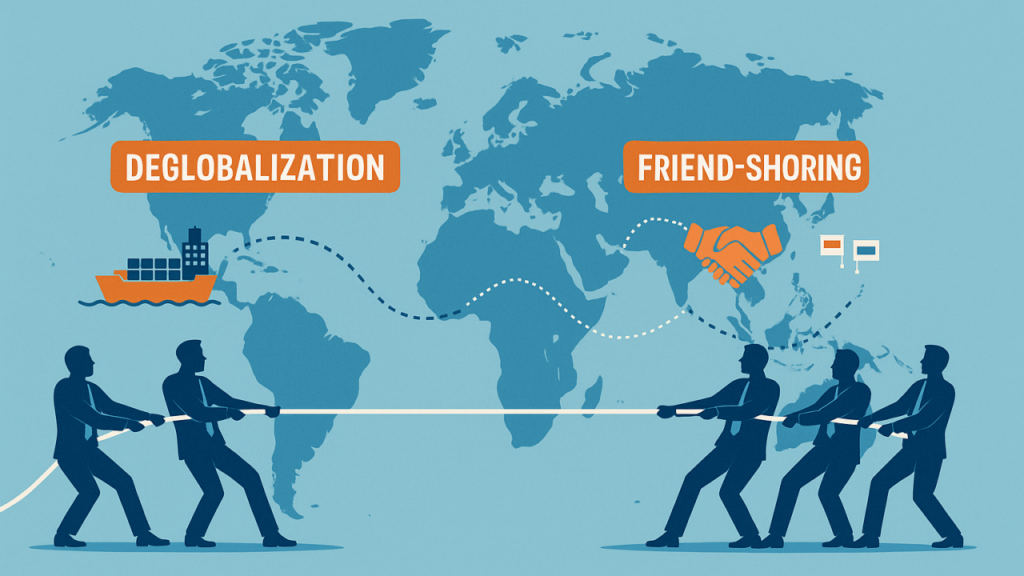
For nearly forty years, the world economy had one main goal: efficiency. This era of “hyper-globalization” turned the world into a single, giant factory. For instance, parts for one smartphone might cross borders a dozen times before reaching a store. However, by April 2026, the rules of trade have changed. The “Just-in-Time” model of the past is gone. It has been replaced by “Just-in-Case” logistics, new trade barriers, and political tension. Deglobalization is Threatening International Supply Chain Stability in ways that were unimaginable just a few decades ago.
Deglobalization is the process of countries becoming less connected. It is no longer just an idea; it is a reality. Driven by national pride, the lessons of the COVID-19 pandemic, and competition between world powers, nations are looking inward. While this might improve national security, it creates a huge risk for global supply chains. This article looks at how this system is coming apart and the economic costs of a less connected world.
The collapse of global trade did not happen in one night. Instead, trust slowly wore away. In the 1990s and 2000s, the World Trade Organization (WTO) helped lower trade barriers to record lows. Most people thought that trading together would lead to world peace.
That hope failed. The 2008 financial crisis created the first doubts. Later, the shocks of the early 2020s pushed deglobalization forward. Nations realized that vital goods—like computer chips and medicine—were controlled by rivals. In 2026, trade is seen as a matter of national security, not just money. When trade is used as a weapon, the supply chain is the first thing to break.
As globalization fades, supply chains are moving. In 2026, the industry uses three main terms: Reshoring (moving production home), Nearshoring (moving it to nearby countries), and Friend-shoring (trading only with allies).
These plans help avoid political shocks, but they create big risks in the short term. You cannot move a supply chain that took thirty years to build in just thirty months. Doing so causes higher prices and shortages. For example, the push to move chip making to the U.S. and Europe has started a “subsidy war.” Countries are spending trillions to build factories that already exist in Asia. This leads to waste and high costs.
Computer chips are a great example of the impact of deglobalization. Chips are the “new oil.” They are needed for everything from AI to home appliances. Because 90% of advanced chips were made in Taiwan, the industry became a major target for change.
By 2026, new laws have split the chip market into two separate zones. This has caused “supply chain whiplash.” Companies can no longer use one global standard. Now, they must design different products for different regions. Statistics show that the cost of making new hardware has risen by 25%. This is due to new rules and the loss of mass production. In the end, this makes gadgets more expensive for everyone.
One of the biggest threats today is “Deglobalization Inflation.” Globalization used to keep prices low. It let companies find the cheapest labor and materials on Earth. As we move away from that, those low prices disappear.
In 2026, banks are fighting high inflation that is hard to stop. This is because of higher wages in local factories and higher shipping costs. When supply chains are local, they cannot easily handle shocks. If a disaster hits a local factory, there is no backup from another part of the world. This leads to sudden price jumps that hurt the whole economy.
Deglobalization has shifted the fight from finished goods to raw materials. In the past, a company could buy lithium or cobalt on the open market. In 2026, “Resource Nationalism” is the new rule. Countries with minerals are forming groups to control prices and demand favors.
This creates a “Supply Chain Siege.” Makers of electric cars and green energy find themselves stuck. They don’t lack customers, but they lack materials because of export bans. This makes it very hard to plan for the future. These problems have delayed green energy goals by about five years, as companies struggle to find reliable sources of minerals.
For years, the oceans were seen as safe for everyone. Deglobalization and local wars have ended that. In 2026, major shipping paths like the Red Sea and the South China Sea are dangerous.
When sea lanes are not safe, the supply chain becomes unstable. Ships must take longer, more expensive routes to avoid danger. This does more than just raise fuel costs. It breaks the tight schedules needed for modern building. A two-week delay for one part can shut down a factory on the other side of the world. This creates a “butterfly effect” that stops work across an entire continent.
Supply chains are digital as well as physical. Every warehouse and ship uses software and data. Deglobalization is now splitting the digital world. Different regions are using different software, 6G networks, and privacy laws.
This “Splinternet” makes it hard to track goods in real time. A manager in 2026 might find that their software works in Europe but is blocked in Asia. This lack of data is a major cause of trouble. Without shared info, companies cannot predict delays. This leads to over-ordering and waste. The cost of running two different digital systems is now a huge hidden expense for world trade.
The most dramatic example of splitting a supply chain is Europe’s move away from Russian energy. While necessary, this sudden break caused a shock that is still felt in 2026. Industries that used cheap gas had to switch to expensive sea-borne fuel and wind power very quickly.
This switch created a second crisis: a shortage of parts for green energy and skilled workers. The problem was not just the energy itself, but the tools needed to change sources. This case shows that even when deglobalization is done for the right reasons, it hurts the economy during the transition. It leads to years of lower output and unstable markets.
Deglobalization hurts small businesses the most. Large companies have the money to build factories in many different regions. A small maker does not.
For a small business, a 10% tax or a sudden export ban on one part can mean bankruptcy. In the past, small firms could buy from anyone in the world. Now, they are often stuck with a few expensive local sellers. By 2026, we are seeing the supply chain move into the hands of only the largest companies. This reduces new ideas and competition, which hurts the economy in the long run.
Finally, deglobalization is stopping the flow of experts. New visa rules and limits on corporate moves mean that technical skills are no longer moving across borders easily.
In 2026, a local factory might have great machines but no engineers who know how to run them. This creates “knowledge silos.” If a new invention happens in one region, it no longer spreads quickly to the rest of the world. This makes supply chains less efficient. The “talent war” is the final force making the global system less stable.
The move toward deglobalization in 2026 is about safety, but it has created new problems. While the old world was fragile, the new one is expensive and less predictable.
The main lesson is that being “resilient” is not the same as being “stable.” While a local chain might be safer from a foreign war, it is more likely to face local shocks and high costs. As the world pulls apart, the challenge will be finding a way to keep trade steady in a world that no longer wants to work together.