

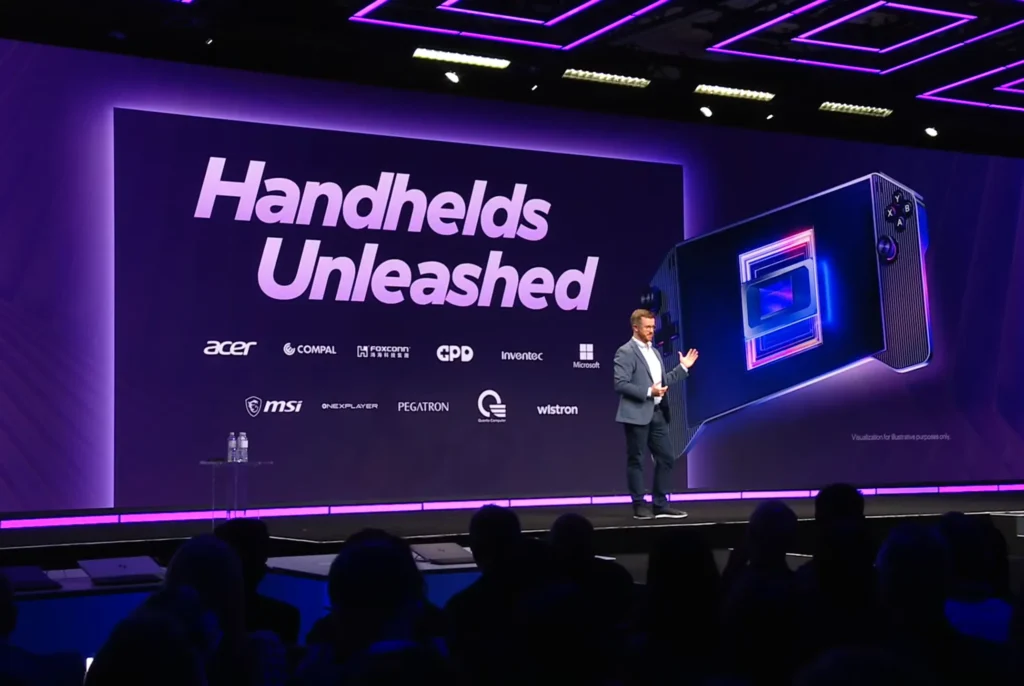
Handheld PCs are no longer a niche gadget for hardcore tech fans. They’re slowly turning into a serious category of personal computing. What started with the Steam Deck has now grown into a whole ecosystem of portable Windows machines that can run AAA games, creative software, and everyday apps. And now, Intel wants in — in a big way.
According to recent industry leaks and reports, Intel is planning a special Panther Lake CPU designed specifically for handheld PCs. Not a cut-down laptop chip. Not a repurposed tablet processor. But a CPU that’s actually optimized for the size, power limits, and real-world usage of handheld gaming devices.
If this plan works, it could reshape the future of portable PC gaming.
For years, Intel focused on desktops and laptops. Handheld PCs didn’t really exist in a meaningful way, so there was no reason to design chips for them. But that’s changed fast.
Today’s handheld PCs:
Run full Windows
Support keyboard, mouse, and controllers
Play modern PC games
Compete directly with consoles and gaming laptops
And more importantly, people are buying them.
AMD has been dominating this space so far, mostly because its chips offer good performance at lower power levels. Intel, on the other hand, has traditionally struggled with power efficiency — especially in small devices. That’s likely why Intel now wants a custom Panther Lake configuration just for handhelds, instead of forcing existing laptop CPUs into devices they weren’t built for.
Panther Lake is Intel’s upcoming CPU platform expected to arrive after Meteor Lake and Lunar Lake. It’s part of Intel’s long-term plan to improve efficiency, modular chip design, and integrated graphics.
What makes Panther Lake interesting for handheld PCs is its focus on performance per watt. In simple terms, that means getting more power without burning through battery life or turning the device into a handheld heater.
For handheld PCs, that balance is everything.
Handheld PCs have very specific constraints:
Small batteries
Tight thermal limits
Limited airflow
Users holding the device for long periods
Intel’s rumored Panther Lake handheld CPU is expected to take all of this into account.
Instead of running at high clock speeds all the time, the chip would dynamically adjust performance based on what you’re doing. Playing an indie game? Low power usage. Running a demanding AAA title? Power ramps up — but only where it’s needed.
This kind of smart power scaling could dramatically improve battery life compared to current Windows handhelds.
Integrated graphics are the heart of handheld PCs. You don’t get space for a discrete GPU, so everything depends on the iGPU.
Panther Lake is expected to come with a new generation of Intel integrated graphics, designed to handle modern game engines more efficiently. That means:
More stable frame rates
Better performance at 720p and 1080p
Improved support for upscaling and modern graphics APIs
For handheld gamers, smoother gameplay matters more than raw benchmark numbers.
One of the biggest complaints about handheld PCs today is heat and fan noise. When chips aren’t optimized for small devices, manufacturers have to rely on aggressive cooling.
A handheld-focused Panther Lake chip could:
Run cooler under sustained load
Reduce fan noise
Make devices more comfortable to hold
This alone would be a huge quality-of-life improvement.
Intel entering the handheld PC space with a purpose-built CPU could have major ripple effects.
Right now, handheld PC manufacturers are mostly tied to one chip supplier. If Intel offers a strong alternative, OEMs suddenly have choices. That competition could lead to:
Better pricing
More device designs
Faster innovation cycles
Consumers usually win when hardware competition increases.
Intel has deep ties with Microsoft. A Panther Lake CPU designed for handheld PCs could help push better Windows optimization for small screens and controllers, something that’s still a weak point today.
If hardware and software start aligning more closely, handheld PCs could feel far more polished than they do now.
A powerful yet efficient Panther Lake handheld CPU could make portable PCs viable for more than gaming. Think:
Editing videos on the go
Coding while traveling
Running creative apps without carrying a laptop
Handheld PCs could become true “all-in-one” devices.
Of course, this isn’t guaranteed success. Intel still faces some serious challenges.
First, efficiency. AMD has years of experience building low-power APUs for gaming devices. Intel needs to prove it can match or beat that efficiency in real-world usage, not just on spec sheets.
Second, software optimization. Intel’s graphics drivers have improved a lot, but gaming performance still depends heavily on driver quality. Handheld users expect plug-and-play reliability.
Third, timing. The handheld PC market moves fast. If Panther Lake arrives too late, OEMs may already be locked into other platforms.
For gamers, Intel’s move is mostly good news.
It means:
More competition
Potentially better battery life
Improved performance in portable devices
More choice in handheld PC designs
Even if you never buy a device with a Panther Lake chip, its existence could push the entire market forward.
Intel’s plan to create a Panther Lake CPU specifically for handheld PCs shows that this category is no longer experimental. It’s becoming a serious platform with its own hardware needs.
If Intel gets the balance right — performance, efficiency, thermals, and price — Panther Lake could become the foundation for a new generation of handheld PCs that feel less like compromises and more like the future of personal computing.
We’re not there yet. But one thing is clear: handheld PCs aren’t going away, and Intel is finally ready to play the game properly.