

Global public health continues to evolve rapidly as governments, healthcare organizations, researchers, and policymakers respond to emerging diseases, technological innovations, demographic changes, and healthcare system challenges. The year 2026 has already produced several significant healthcare developments that are influencing public health outcomes worldwide. Here, we cover the latest healthcare news affecting global public health, including everything from infectious disease outbreaks and vaccine policy debates to artificial intelligence-driven medical breakthroughs and healthcare funding concerns, as these developments have implications that extend far beyond national borders.
The interconnected nature of modern society means that healthcare events in one region can quickly impact populations across continents. International travel, migration, trade, climate change, and digital communication have transformed public health into a truly global concern. Understanding the latest healthcare news is therefore essential for policymakers, healthcare professionals, businesses, and citizens alike.
This article examines the most important healthcare developments currently affecting global public health, explores their implications, and highlights emerging trends that could shape the future of healthcare delivery and disease prevention.
Despite remarkable advances in medicine, infectious diseases continue to pose significant threats to global health security. Recent outbreaks demonstrate that disease surveillance, preparedness, and international cooperation remain critical components of effective public health strategies.
One of the most significant public health developments of 2026 is the ongoing Ebola outbreak involving the Bundibugyo virus strain in the Democratic Republic of the Congo (DRC) and neighboring Uganda. Health authorities have reported hundreds of confirmed cases and numerous fatalities, making it one of the most closely monitored health emergencies of the year.
The outbreak has spread across multiple health zones in eastern DRC, with cross-border transmission documented in Uganda. Public health officials have emphasized the importance of rapid testing, contact tracing, healthcare worker protection, and international coordination to contain the spread. Recent reports indicate that the outbreak has affected dozens of health zones and resulted in more than 600 confirmed cases, highlighting the continuing challenge of controlling infectious diseases in regions affected by conflict and displacement.
The Ebola response serves as a reminder that emerging infectious diseases remain among the greatest threats to global health security.
Another major healthcare story affecting public health is the resurgence of diseases that were previously under control through vaccination programs.
Measles outbreaks have increased in multiple countries, driven largely by declining vaccination rates, healthcare access challenges, and vaccine misinformation. In the United States alone, confirmed measles cases have surpassed 2,000 in 2026, placing the country on track for one of its most significant outbreaks in decades. Public health experts attribute much of the increase to falling immunization coverage in certain communities.
Measles is highly contagious, with one infected individual capable of transmitting the virus to many others in unvaccinated populations. The disease can lead to severe complications, particularly among children, including pneumonia, encephalitis, and death.
Health authorities continue to emphasize that vaccination remains one of the most effective public health interventions ever developed.
Misinformation has emerged as a significant public health threat. False or misleading information about vaccines, treatments, and diseases can influence public behavior and undermine healthcare initiatives.
Healthcare organizations worldwide are investing in communication strategies designed to combat misinformation and improve public trust. Researchers increasingly view misinformation as a public health issue that requires active monitoring and intervention.
Public health experts argue that effective communication and evidence-based education are essential for maintaining confidence in healthcare systems.
Artificial intelligence (AI) continues to reshape healthcare delivery, research, diagnostics, and public health surveillance. The healthcare sector has become one of the fastest-growing areas of AI adoption.
AI-powered systems are increasingly capable of identifying disease outbreaks earlier than traditional surveillance methods. These technologies analyze large volumes of health data, news reports, laboratory results, and social media activity to identify potential public health threats.
Several research initiatives have demonstrated the ability of AI systems to process millions of data points and detect unusual disease patterns that may indicate emerging outbreaks. Such technologies can help public health officials respond more quickly and effectively to health emergencies.
Artificial intelligence is also accelerating biomedical research. Scientists are using machine learning algorithms to identify promising drug candidates, model disease progression, and design vaccine targets.
Recent developments suggest that AI-assisted vaccine research could contribute to broader protection against multiple virus families, potentially improving pandemic preparedness in the future.
Adequate funding remains one of the most important determinants of public health success. Recent discussions about healthcare budgets, international aid, and disease surveillance funding have raised concerns among health experts.
Public health organizations warn that reductions in surveillance programs and healthcare funding can weaken the ability to detect and respond to outbreaks. The effectiveness of public health systems often depends on sustained investments in workforce development, laboratory infrastructure, and emergency preparedness.
Experts emphasize that prevention and preparedness are often far more cost-effective than responding to large-scale health emergencies after they occur.
Climate change is increasingly recognized as a major public health issue. Rising temperatures, extreme weather events, and changing ecosystems are affecting disease patterns, food security, and healthcare infrastructure.
Many public health experts now view climate resilience as an essential component of healthcare planning and policy development.
The COVID-19 pandemic fundamentally changed how governments approach health emergencies. Since then, many countries have expanded preparedness efforts, strengthened surveillance systems, and invested in research.
Recent events demonstrate that preparedness remains critical. A potentially dangerous hantavirus incident aboard an international cruise vessel was successfully contained through rapid isolation, contact tracing, and international coordination. Public health officials have highlighted the response as an example of effective outbreak management.
The ability to detect and contain emerging threats before widespread transmission occurs remains one of the most important goals of global public health.
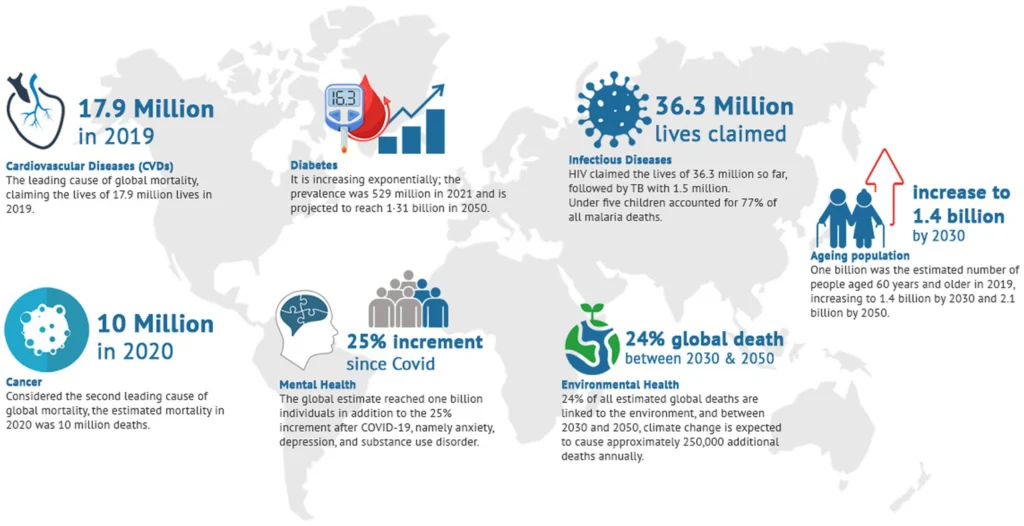
Mental health has become an increasingly prominent component of public health policy. Healthcare systems worldwide are recognizing the importance of addressing anxiety, depression, substance use disorders, and other mental health conditions.
The World Health Organization estimates that mental health disorders affect hundreds of millions of people globally. Economic uncertainty, social isolation, conflict, and environmental stressors continue to contribute to growing mental health needs.
Mental health is increasingly viewed as an essential pillar of overall public health rather than a separate healthcare concern.
Telemedicine and digital health technologies continue to expand globally. Remote consultations, wearable health devices, mobile health applications, and virtual monitoring platforms have become integral components of healthcare delivery.
These technologies improve healthcare access for individuals living in rural areas, underserved communities, and regions with limited healthcare infrastructure.
As digital infrastructure improves worldwide, digital health solutions are expected to play an even larger role in public health management.
One of the most important lessons from recent healthcare events is the value of international collaboration. Whether responding to Ebola outbreaks, monitoring influenza strains, or preparing for future pandemics, cooperation among governments, researchers, and international organizations remains essential.
The successful containment of several emerging health threats has demonstrated that coordinated action can significantly reduce the risk of global spread. Shared surveillance systems, data exchange, and joint research initiatives have become critical tools in modern public health.
The latest healthcare news affecting global public health highlights both remarkable progress and persistent challenges. Ongoing Ebola outbreaks, the resurgence of vaccine-preventable diseases, the rise of healthcare misinformation, and concerns about funding underscore the complexity of modern public health. At the same time, advances in artificial intelligence, digital health technologies, disease surveillance, and international collaboration offer promising opportunities to strengthen healthcare systems and improve health outcomes worldwide.
As global populations become increasingly interconnected, effective public health strategies must prioritize preparedness, scientific innovation, evidence-based communication, and international cooperation. The healthcare developments of 2026 demonstrate that protecting public health requires continuous vigilance, sustained investment, and a commitment to addressing both emerging threats and longstanding challenges. By learning from recent events and embracing innovation responsibly, the global community can build more resilient healthcare systems capable of safeguarding future generations.