

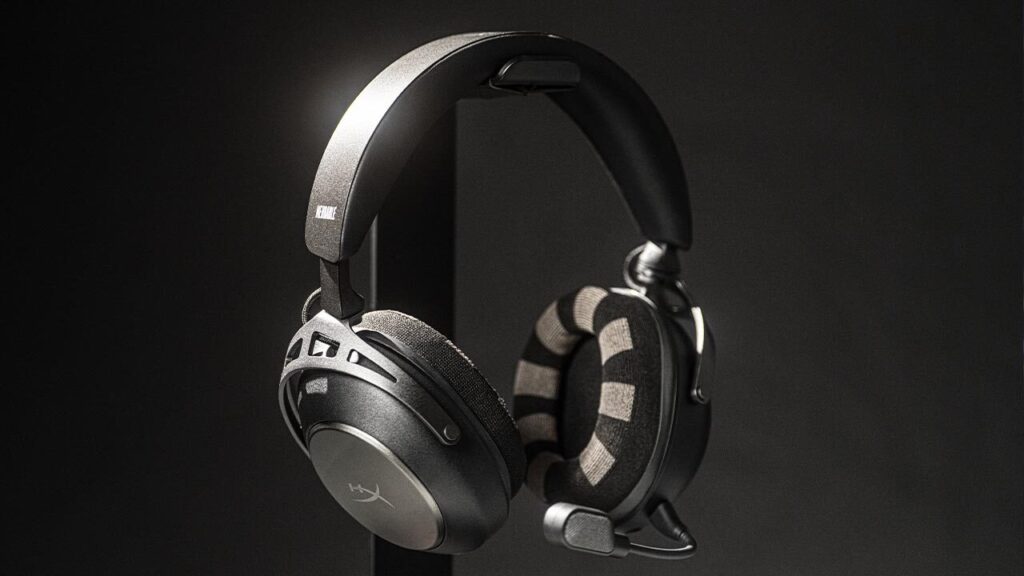
Imagine sitting down to play your favorite game — and instead of clicking buttons or tapping triggers, you control things with your thoughts. Sounds like sci-fi, right? Well, that future is starting to become real thanks to the Neurable x HyperX Headset, a collaboration that’s turning brain-computer interface (BCI) tech into something that gamers can actually use.
This headset isn’t just another gaming accessory. It’s one of the first devices that brings real brain-wave interaction into gaming in a way that feels both exciting and practical. If you’ve ever wondered what it would be like to navigate menus with your mind, make selections with focus, or even influence gameplay with your brain signals — the Neurable x HyperX headset is the first step in that direction.
In this article, we’ll take a closer look at what this headset is all about, how it works, why it matters for gaming, and what the future might hold for brain-controlled tech.
At its core, the Neurable x HyperX Headset is a gaming headset built to capture electrical signals from your brain — known as EEG (electroencephalography) — and translate them into commands that software can understand.
HyperX is well known in the gaming world for making quality headsets, keyboards, and peripherals. Neurable is a company focused on brain-computer interfaces and neural tech. Put them together, and you get a headset that’s designed not just for audio and comfort, but also for thought-based interactions.
In simpler terms: it looks like a gaming headset, sounds like a gaming headset — but it also reads your brain activity to give you new ways to interact with games and apps.
BCI isn’t a new concept — researchers have been exploring it for decades. But until recently, the tech has mostly stayed in labs or was used for medical applications like helping paralyzed patients communicate.
What makes the Neurable x HyperX headset exciting is that this kind of tech is finally being engineered for everyday use — especially for gamers and creators.
In gaming, BCI could:
Let players control abilities or UI elements without pressing buttons
Help developers create more immersive experiences based on player focus or emotion
Make games more accessible for players with limited mobility
And it doesn’t stop with games — productivity tools, creative software, and VR experiences could all benefit from brain-based control.
To understand how this works, imagine the headset has tiny sensors — similar to EEG sensors — that sit against your scalp. These sensors pick up electrical activity in your brain that changes based on what you’re thinking or focusing on.
The data from those sensors is then processed by smart software from Neurable that translates patterns into actions. For example:
A high level of focus could mean “select”
A relaxed mind might mean “back”
Strong attention toward left/right could control movement in a menu
It’s not telepathy — you’re not literally thinking “jump” and the game immediately knows it. But over time, the system learns how your brain responds and interprets those signals into commands reliably.
In essence, the headset reads patterns, not words.
Right now, early demos and partner integrations show some cool possibilities:
Instead of using a controller to scroll through menus, you can navigate by focusing on different options. The headset reads where your attention is strongest and selects accordingly.
Some prototypes let you bind specific brain signal patterns to in-game actions like switching weapons, activating abilities, or opening your inventory.
Imagine a game where you have a power bar — and the more focused you are, the faster it charges. That’s the kind of creative gameplay potential BCI opens up.
For players who find traditional controls challenging due to mobility issues, brain-controlled actions could offer new ways to interact with games without relying solely on hands or fingers.
You might be thinking: “There are VR headsets with sensors, and there are EEG devices. So what’s the big deal?”
Here’s why this is special:
Unlike bulky EEG skullcaps or lab rigs, the Neurable x HyperX headset is designed to be comfortable, wearable, and something you’d enjoy using during a gaming session — not feel like an experiment.
This wasn’t a medical headset repurposed for games. It was engineered with gaming and interactivity in mind, meaning the placement of sensors, audio quality, and comfort were all thoughtfully balanced.
The Neurable software doesn’t just read signals — it adapts to your patterns over time. That means the more you use it, the better it gets you.
While games are a major focus, developers are already exploring productivity and creative software integrations, suggesting this could grow beyond gaming into other fields like creative workflows or virtual meetings.
Before you imagine a future where players fly ships with their minds, it’s worth talking about limitations.
Brain signals are noisy and complex. The headset won’t instantly know what you’re thinking — it interprets patterns of focus and relaxation, not specific thoughts.
Some users may adapt faster than others. There’s a learning process where the system and the user adjust to each other.
Putting sensors on the scalp can sometimes affect comfort, especially during long gaming sessions. Engineers have worked to reduce this, but it’s still something to consider.
At launch, only a few games or apps will support brain control — meaning full functionality might be limited until developers adopt the tech more widely.
But these aren’t unique problems — they’re part of the growing pains of any new technology.
Gamers who’ve tried early demos have had some interesting reactions:
🧠 “It feels weirdly intuitive once you get used to it.”
Players say there’s a “learning moment” where it clicks — much like getting used to a new controller layout.
🎮 “Not for every game yet, but super promising.”
Some genres — like strategy or menus — feel more natural with brain controls than fast twitch shooters.
👀 “Future is here — but it’s early.”
Most agree this is a big step, even if it’s not perfect right now.
Game developers are curious. Some indie studios have already built experimental integrations, while larger studios are watching closely.
Developers see potential in:
New game mechanics
Accessibility features
Enhanced immersion
Adaptive storytelling based on player engagement
This isn’t replacing controllers — but it might be adding another layer of interaction.
The Neurable x HyperX headset feels like a bridge between sci-fi dreams and real gaming tech. It doesn’t replace controllers, but it adds new ways to interact — and that’s huge.
In the future, we might see:
Hybrid control systems (brain + traditional inputs)
Games that change dynamically based on player focus
VR and AR experiences with brain feedback loops
Accessibility tools that make gaming more inclusive
This collaboration could be the spark that pushes BCI from research labs into mainstream entertainment.
The Neurable x HyperX Headset isn’t just a gadget — it’s a glimpse at what’s coming next in gaming and interactive tech. It doesn’t read your thoughts like a mind reader, but it interprets your attention and focus in ways that feel fresh and exciting.
Whether you’re a hardcore gamer, a tech enthusiast, or someone interested in where human-computer interaction is headed, this headset is something to watch.
We’re still in the early days, but if the future looks anything like this — where tech understands us a little more — it’s going to be a very interesting ride.