

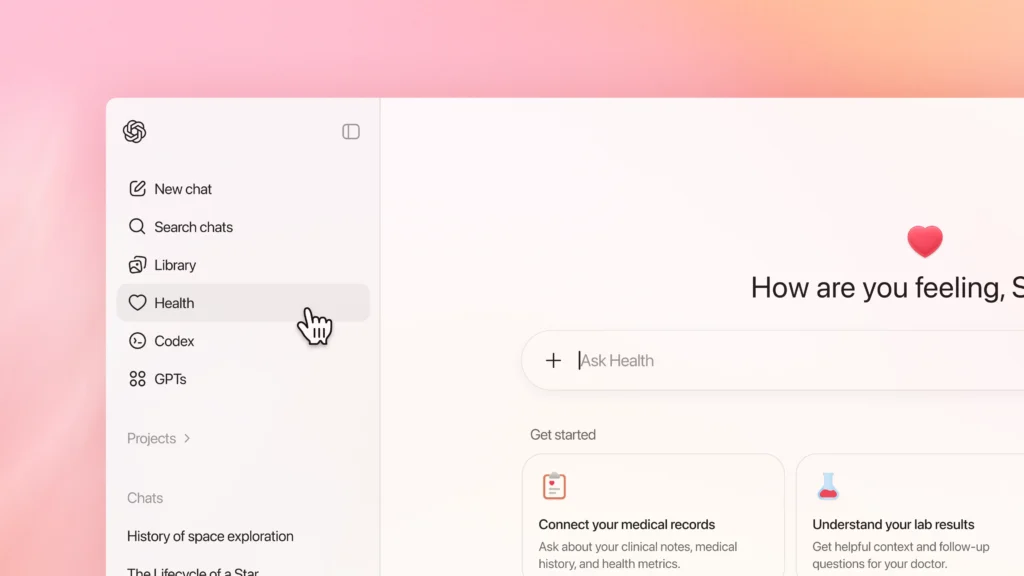
OpenAI just took another big step into everyday life by launching ChatGPT Health, a new feature designed to help people better understand their health using AI. While ChatGPT has already been used for everything from writing emails to debugging code, this move shows how artificial intelligence is slowly but surely entering the personal healthcare space.
ChatGPT Health isn’t about replacing doctors or making medical decisions for you. Instead, it’s more like a smart health companion—one that helps explain medical terms, interpret symptoms in a general way, and guide users toward better conversations with healthcare professionals. For many people who feel overwhelmed when searching for health information online, this could be a game changer.
Why OpenAI Is Entering the Health Space
Healthcare is one of the most complex and sensitive industries in the world. People search for health-related information every day, but the internet is full of confusing, outdated, or even misleading content. OpenAI sees this as an opportunity to use AI responsibly to make health information more accessible and easier to understand.
With ChatGPT Health, the goal isn’t to diagnose diseases or prescribe medication. Instead, it focuses on education, awareness, and clarity. Users can ask questions like “What does this lab result mean?” or “What are common symptoms of migraines?” and get clear, human-like explanations without medical jargon.
This approach reflects a growing trend in tech: empowering users with knowledge while still respecting professional boundaries.
What ChatGPT Health Can Do
ChatGPT Health is built with features specifically tuned for health-related conversations. It uses more careful language, avoids overconfident claims, and regularly reminds users that it’s not a medical professional.
Some of its key capabilities include:
-
Explaining medical terms in simple language
-
Helping users understand general symptoms
-
Providing lifestyle and wellness tips
-
Supporting mental health conversations in a non-judgmental way
-
Helping users prepare questions for doctor visits
For example, if someone receives a blood test report filled with unfamiliar terms, ChatGPT Health can explain what those terms usually mean and why doctors look at them. This can reduce anxiety and help users feel more prepared when talking to a real doctor.
A Strong Focus on Safety and Privacy
Health data is extremely sensitive, and OpenAI knows that trust is everything. ChatGPT Health comes with additional safety layers designed to reduce misinformation and protect users.
The system avoids giving medical diagnoses and does not encourage self-treatment. In cases where a user describes serious or urgent symptoms, ChatGPT Health will clearly recommend seeking professional medical help instead of continuing the conversation.
Privacy is also a major concern. OpenAI states that health-related conversations are handled with extra care, and users are encouraged not to share personally identifiable medical records. This cautious approach shows that OpenAI understands the risks involved in mixing AI and healthcare.
How This Is Different From Regular ChatGPT
At first glance, ChatGPT Health may feel similar to the regular ChatGPT experience, but there are important differences behind the scenes. The health-focused version is trained to be more conservative, more precise, and more empathetic.
Instead of trying to answer everything confidently, ChatGPT Health is designed to say things like “I might be wrong” or “This is general information, not medical advice.” That may sound simple, but in healthcare, this kind of wording matters a lot.
The tone is also noticeably calmer and more supportive, especially for mental health topics. Users dealing with stress, anxiety, or burnout can talk to ChatGPT Health without feeling judged, which could make it a helpful first step before reaching out for professional support.
Potential Impact on Everyday Users
For everyday users, ChatGPT Health could change how people interact with health information. Instead of scrolling through dozens of websites, users can have a focused conversation that adapts to their questions in real time.
This is especially useful in regions where access to healthcare professionals is limited or expensive. While ChatGPT Health is not a replacement for medical care, it can act as a bridge—helping users understand when something is minor and when it’s worth seeing a doctor.
It can also help reduce fear. Many people panic after Googling symptoms, often landing on worst-case scenarios. A calmer, more balanced explanation from ChatGPT Health could help reduce unnecessary anxiety.
What Doctors and Experts Are Saying
Reactions from healthcare professionals are mixed but generally cautious. Some doctors see ChatGPT Health as a useful educational tool that can improve patient understanding. Better-informed patients often ask better questions and follow treatment plans more effectively.
However, experts also warn about overreliance on AI. They stress that no AI, no matter how advanced, can replace clinical judgment, physical exams, or lab testing. OpenAI seems to agree with this perspective, positioning ChatGPT Health as a support tool rather than a medical authority.
The Bigger Picture: AI and the Future of Healthcare
ChatGPT Health is part of a much bigger shift happening in healthcare technology. From AI-powered imaging to virtual health assistants, artificial intelligence is becoming more involved in how healthcare systems operate.
What makes ChatGPT Health interesting is its focus on conversation. Instead of analyzing scans or managing hospital systems, it focuses on how people talk about health. That human-centered approach could make AI feel less intimidating and more helpful.
If used responsibly, tools like this could help reduce misinformation, improve health literacy, and encourage people to seek professional help when needed.
Challenges Ahead
Despite the excitement, ChatGPT Health faces several challenges. Accuracy remains a constant concern, especially in a field where mistakes can have serious consequences. OpenAI will need to continuously update and monitor the system to ensure it stays reliable and aligned with medical standards.
Regulation is another big question. As governments around the world start paying closer attention to AI in healthcare, tools like ChatGPT Health may face stricter rules in the future.
Final Thoughts
OpenAI’s launch of ChatGPT Health marks an important milestone in the evolution of AI. It shows that artificial intelligence is moving beyond productivity and creativity into more personal, meaningful areas of life.
While it’s not a doctor and never claims to be one, ChatGPT Health has the potential to make healthcare information more understandable, less scary, and more accessible. If OpenAI continues to prioritize safety, transparency, and user trust, this could be one of the most impactful uses of AI so far.
For now, ChatGPT Health feels like a smart assistant sitting quietly in your pocket—ready to explain, guide, and remind you when it’s time to talk to a real human expert.