

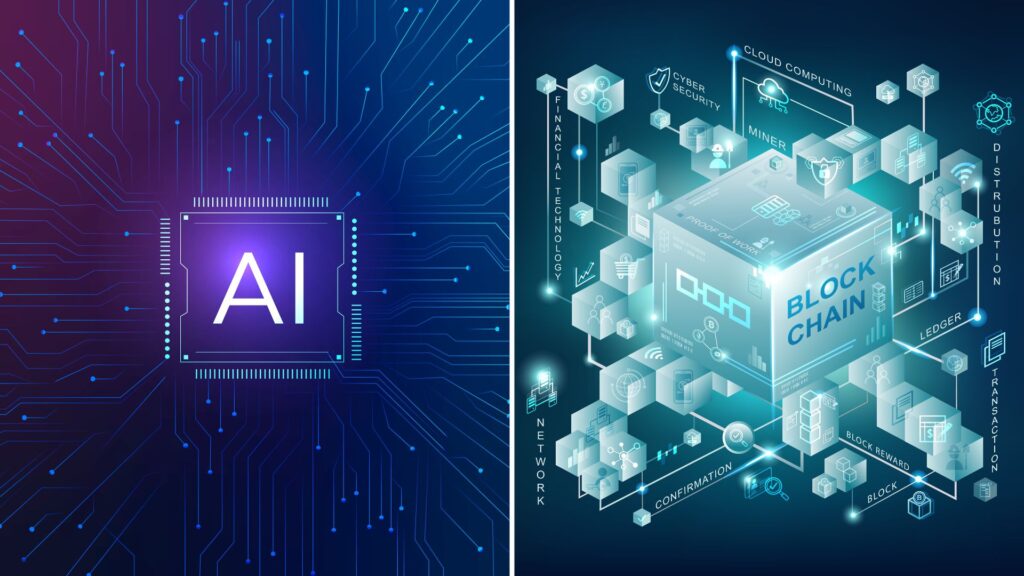
The Intersection of AI and Blockchain for Enhanced Secure Data… Artificial Intelligence (AI) and blockchain are among the most transformative technologies of the modern digital era. Individually, each technology has reshaped industries by solving different classes of problems. AI enables machines to learn from data, recognize patterns, automate decisions, and generate insights at remarkable speed. Blockchain, on the other hand, provides decentralized, tamper-resistant, and transparent record-keeping that strengthens trust among multiple parties.
As organizations increasingly rely on data to drive innovation, they also face growing challenges related to cybersecurity, privacy, data integrity, regulatory compliance, and trust. The convergence of AI and blockchain offers a compelling solution by combining AI’s analytical capabilities with blockchain’s secure and immutable infrastructure. Together, these technologies have the potential to transform healthcare, finance, supply chain management, cybersecurity, government services, and many other sectors.
This article explores the intersection of AI and blockchain for enhanced secure data, examining how these technologies complement one another, their practical applications, real-world examples, challenges, future opportunities, and best practices for responsible implementation.
Artificial Intelligence refers to computer systems capable of performing tasks that traditionally require human intelligence. Modern AI includes machine learning, deep learning, natural language processing (NLP), computer vision, predictive analytics, and generative AI.
Organizations use AI to analyze massive datasets, automate workflows, identify anomalies, generate content, improve customer experiences, optimize operations, and support complex decision-making.
Blockchain is a distributed ledger technology that records transactions across a network of computers. Instead of relying on a single centralized authority, blockchain uses consensus mechanisms to validate and store records in linked blocks, making historical data extremely difficult to alter without network agreement.
Each transaction is cryptographically secured and permanently linked to previous records, creating an immutable audit trail that improves transparency and trust.
AI depends on large quantities of reliable data for training and decision-making. Blockchain strengthens data integrity by maintaining secure, verifiable, and tamper-resistant records. Together, these technologies create a powerful ecosystem in which trustworthy data supports intelligent automation.
At the same time, AI enhances blockchain networks by improving fraud detection, optimizing network operations, identifying anomalies, and supporting predictive maintenance of distributed systems.
One of the most significant advantages of combining AI and blockchain is ensuring that AI systems learn from trustworthy information. Blockchain prevents unauthorized modification of stored records, reducing the risk of data manipulation during model training or operational decision-making.
Organizations frequently collaborate across industries while needing to protect sensitive information. Blockchain enables secure, permission-based data sharing among authorized participants while maintaining detailed records of every transaction.
AI systems can then analyze shared datasets without requiring centralized storage under every implementation model, supporting collaboration while improving accountability.
Blockchain-based digital identity solutions combined with AI-powered authentication techniques can strengthen identity verification processes while reducing fraud and unauthorized access.
Healthcare organizations manage enormous volumes of sensitive patient information. Blockchain helps maintain secure medical records with detailed audit trails, while AI assists physicians through predictive analytics, medical imaging support, and clinical decision assistance.
Financial institutions increasingly combine AI with blockchain to improve fraud detection, transaction monitoring, regulatory compliance, and customer identity verification.
AI analyzes transaction behavior to detect suspicious patterns, while blockchain provides immutable records supporting transparency and auditability.
Supply chains involve numerous organizations exchanging goods and information across multiple regions. Blockchain records product movement throughout the supply chain, while AI predicts demand, optimizes logistics, and identifies potential disruptions.
The result is improved visibility, traceability, and operational efficiency.
Governments may use blockchain to improve record management, digital identity, land registration, and document verification, while AI assists with public service delivery, fraud detection, and administrative automation.
AI-powered cybersecurity systems continuously monitor networks for suspicious behavior. Blockchain enhances security by protecting log integrity, supporting identity management, and creating tamper-resistant audit records for forensic investigations.
A pharmaceutical manufacturer implemented blockchain to record the movement of medications across suppliers, distributors, and pharmacies. AI analyzed shipment data to identify unusual distribution patterns, forecast inventory requirements, and detect potential counterfeit risks.
The integrated solution improved product traceability, strengthened regulatory compliance, and increased confidence throughout the supply chain.
A multinational financial institution combined blockchain-based transaction records with AI-driven fraud detection models. The blockchain ledger provided trusted transaction histories, while AI continuously evaluated customer behavior and transaction characteristics to identify potentially fraudulent activity.
This approach reduced investigation times, improved monitoring efficiency, and enhanced regulatory reporting capabilities.
Several healthcare research initiatives have explored blockchain-enabled data sharing among hospitals while using AI to analyze anonymized patient information for disease prediction and treatment research.
By maintaining secure access controls and transparent audit trails, participating organizations can collaborate more effectively while respecting patient privacy and applicable regulatory requirements.
Smart contracts are self-executing agreements stored on blockchain networks that automatically perform predefined actions when specified conditions are satisfied.
AI can enhance smart contracts by providing predictive insights and intelligent decision support, while blockchain ensures execution transparency and tamper-resistant record keeping.
Blockchain strengthens confidence in data authenticity, allowing AI systems to operate on verifiable information with improved reliability.
Cryptographic protection, distributed storage, and immutable records reduce opportunities for unauthorized data modification.
Organizations can demonstrate how data has been collected, shared, and processed, supporting accountability and regulatory compliance.
Reliable data enables AI models to generate more dependable predictions, recommendations, and operational insights.
Automation through AI combined with blockchain-enabled trust reduces manual verification processes and administrative overhead.
Many blockchain networks face scalability limitations compared with centralized databases. High transaction volumes may require specialized architectures or complementary technologies to maintain performance.
Some blockchain consensus mechanisms require substantial computational resources. Increasing adoption of more energy-efficient approaches aims to reduce environmental impact.
Although blockchain improves integrity, organizations must carefully determine which information should be stored directly on-chain versus securely referenced through other architectures to protect sensitive data.
Even when data integrity is strengthened through blockchain, AI systems still require continuous monitoring for fairness, bias, explainability, accuracy, and security.
Organizations deploying AI and blockchain internationally must navigate evolving regulations concerning privacy, cybersecurity, financial services, healthcare, digital identity, and cross-border data transfers.
Researchers are exploring decentralized AI frameworks that distribute model training and inference across multiple participants while reducing dependence on centralized infrastructure.
Federated learning enables AI models to learn from distributed datasets without requiring all underlying data to be centralized. Blockchain can support secure coordination among participating organizations by maintaining trusted records of model updates and permissions.
Digital identity solutions increasingly combine blockchain’s secure credential management with AI-powered verification techniques, improving authentication while reducing identity fraud.
Emerging platforms are investigating token-based incentive models that encourage secure data sharing and collaborative AI development while respecting participant permissions and governance requirements.
As digital ecosystems continue to expand, the integration of AI and blockchain is expected to become increasingly important. Organizations are likely to adopt hybrid architectures that combine cloud computing, edge computing, AI, blockchain, and advanced cybersecurity to support secure, intelligent, and scalable digital services.
Future developments may include more explainable AI models, privacy-enhancing machine learning techniques, interoperable blockchain networks, automated compliance monitoring, and increasingly sophisticated smart contracts capable of supporting complex business processes.
Success will depend not only on technological advancement but also on thoughtful governance, transparent standards, international collaboration, and ongoing investment in cybersecurity and digital trust.
The intersection of AI and blockchain represents one of the most promising developments in the digital economy. By combining AI’s ability to analyze data, automate decisions, and generate valuable insights with blockchain’s decentralized, transparent, and tamper-resistant infrastructure, organizations can build systems that are both intelligent and trustworthy.
Across healthcare, finance, cybersecurity, government, supply chain management, and many other industries, the integration of these technologies is improving data integrity, strengthening security, enhancing transparency, and enabling more efficient collaboration. Although challenges involving scalability, privacy, governance, interoperability, and regulation remain, continued innovation and responsible implementation are likely to unlock significant long-term value. Organizations that thoughtfully integrate AI and blockchain while maintaining strong ethical standards and robust security practices will be well positioned to build resilient, data-driven solutions for the future.