

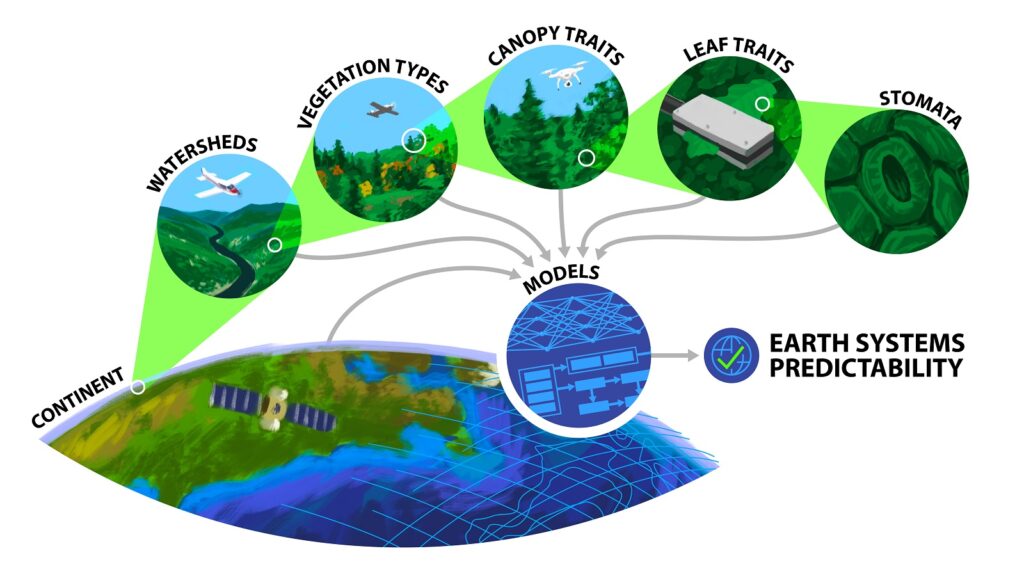
Artificial intelligence (AI), next-generation wireless communication, and environmental science are converging to address some of humanity’s greatest challenges. The Potential of AI in Climate Modeling and Environmental applications is becoming increasingly evident as new technologies develop. As climate change accelerates and extreme weather events become more frequent, governments, researchers, and industries require faster, more accurate methods to understand environmental changes and make informed decisions. AI-powered climate modeling, combined with ultra-fast 5G networks and the emerging capabilities of 6G, is transforming how environmental data is collected, processed, and applied in real time.
Traditional climate models have provided valuable insights for decades, but they often require enormous computing resources and long processing times. Modern AI algorithms can analyze massive datasets, identify hidden patterns, improve weather predictions, and optimize resource management. Meanwhile, high-speed wireless networks connect billions of sensors, satellites, drones, autonomous vehicles, and Internet of Things (IoT) devices, enabling continuous environmental monitoring on an unprecedented scale.
This convergence is creating a hyper-connected ecosystem capable of supporting sustainable development, disaster preparedness, biodiversity conservation, precision agriculture, smart cities, and clean energy management. As these technologies mature, they are expected to play an increasingly important role in mitigating climate risks while improving environmental decision-making across the globe.
Climate modeling uses mathematical equations, historical observations, satellite imagery, ocean measurements, atmospheric data, and computer simulations to understand how Earth’s climate changes over time. Artificial intelligence enhances this process by learning from enormous datasets and generating highly accurate predictions much faster than many traditional computational approaches.
Machine learning, deep learning, and neural networks are particularly valuable because they can recognize complex relationships among variables such as temperature, precipitation, greenhouse gas concentrations, ocean currents, vegetation, and land use.
Although conventional climate models remain essential scientific tools, they face several limitations.
Artificial intelligence complements—not replaces—traditional climate science by accelerating simulations, improving regional forecasts, and helping researchers interpret increasingly large environmental datasets.
AI contributes across nearly every stage of environmental analysis.
Instead of analyzing information manually, scientists can use AI systems to process millions of observations within minutes, allowing faster and more informed decision-making.
Modern environmental research generates enormous amounts of information every day through satellites, weather stations, ocean buoys, drones, smart sensors, and scientific instruments.
AI transforms these massive datasets into practical insights by identifying long-term climate trends, predicting natural hazards, and optimizing environmental management strategies.
Fifth-generation (5G) wireless networks significantly improve communication speed, network capacity, and latency compared with previous mobile technologies. These improvements allow billions of connected devices to exchange environmental information almost instantly.
When integrated with AI, 5G enables:
This combination supports faster decision-making while reducing communication delays during critical environmental events.
Although still under development, sixth-generation (6G) networks are expected to provide dramatically higher data rates, lower latency, enhanced reliability, and native AI integration.
Potential environmental applications include:
These capabilities could fundamentally transform how researchers observe and respond to environmental changes.
Networks of connected IoT sensors continuously collect environmental information such as air quality, soil moisture, water quality, temperature, humidity, and biodiversity indicators.
AI processes this information immediately, allowing authorities to identify pollution events, detect illegal deforestation, monitor protected habitats, and optimize conservation efforts.
One of AI’s most valuable contributions is improving forecasts for hurricanes, floods, droughts, heatwaves, and wildfires.
Machine learning models analyze historical weather observations together with satellite imagery and atmospheric measurements to improve prediction accuracy and provide earlier warnings.
Earlier warnings help governments reduce casualties, improve emergency planning, and protect critical infrastructure.
Advanced AI systems analyze thermal satellite images, weather conditions, vegetation health, and smoke patterns to identify wildfires during their earliest stages.
Drones connected through 5G networks can transmit live video streams to emergency centers where AI automatically identifies fire boundaries and predicts likely spread patterns.
Marine ecosystems benefit significantly from AI-powered environmental monitoring.
These technologies improve marine conservation while supporting sustainable fisheries.
Agriculture increasingly depends on AI, satellite imagery, drones, and connected sensors to improve productivity while reducing environmental impacts.
Applications include:
By reducing unnecessary water, fertilizer, and pesticide use, AI supports both food security and environmental sustainability.
Renewable energy systems depend heavily on weather conditions. AI helps forecast solar radiation, wind speeds, electricity demand, and battery storage requirements.
Smart grids connected through 5G and future 6G networks automatically balance electricity production and consumption while integrating distributed renewable energy sources.
Several electricity system operators have implemented machine learning models that improve solar and wind generation forecasts. More accurate predictions allow utilities to schedule backup generation efficiently, reduce operating costs, and improve grid reliability.
These improvements help increase renewable energy penetration without compromising electricity stability.
Environmental agencies increasingly deploy AI-enabled drones together with satellite imagery to monitor forests.
Machine learning identifies illegal logging, insect infestations, disease outbreaks, and vegetation stress much earlier than manual inspections. Rapid detection allows conservation authorities to respond before damage becomes widespread.
Urban areas generate large volumes of environmental data through traffic systems, energy infrastructure, water networks, and public transportation.
AI helps cities improve sustainability by:
Hyper-connected communication networks ensure continuous information exchange among these systems.
Despite remarkable progress, important challenges remain.
Addressing these issues requires responsible governance, international cooperation, and continued technological innovation.
Several trends demonstrate the growing importance of AI in environmental sustainability.
These developments highlight the increasing importance of integrating AI with advanced communication technologies.
The future of climate science will increasingly rely on intelligent, connected systems capable of observing environmental changes continuously and responding automatically. Advances in edge computing, quantum computing, autonomous robotics, digital twins, and next-generation wireless communications will further enhance AI-powered climate modeling.
Scientists envision a future where global environmental conditions can be monitored almost instantly, allowing policymakers to make faster, evidence-based decisions regarding climate adaptation, disaster preparedness, biodiversity conservation, and sustainable development.
Organizations seeking to benefit from these technologies should focus on:
Early investment will help maximize both environmental and economic benefits.
The convergence of artificial intelligence with advanced communication technologies such as 5G and future 6G networks is reshaping climate science and environmental sustainability. AI enables faster climate modeling, more accurate weather forecasting, intelligent renewable energy management, precision agriculture, biodiversity conservation, and real-time disaster response. Meanwhile, hyper-connected wireless networks provide the infrastructure needed to collect and transmit enormous volumes of environmental data with unprecedented speed and reliability.
Although challenges related to cybersecurity, infrastructure investment, governance, and energy consumption remain, the opportunities far outweigh the obstacles. Continued collaboration among governments, researchers, technology companies, and international organizations will be essential to unlock the full potential of AI-driven environmental intelligence. As these innovations continue to mature, they will play a critical role in helping societies better understand climate change, protect natural ecosystems, strengthen resilience against environmental risks, and build a more sustainable and connected future for generations to come.