

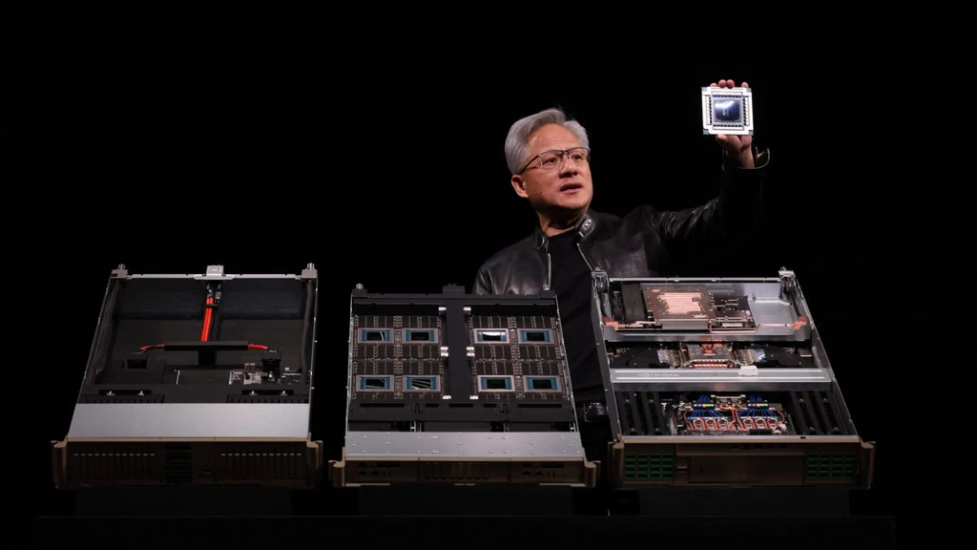
The explosive growth of artificial intelligence (AI), machine learning, and high-performance computing has transformed graphics processing units (GPUs) from specialized gaming hardware into some of the world’s most sought-after technological assets. At the center of this transformation stands Nvidia, whose GPUs have become the dominant infrastructure powering modern AI applications, large language models, cloud computing platforms, and data centers. Many companies are now considering Vertical Integration as a Strategic Play to Reduce on Nvidia Supply and secure access to crucial hardware resources.
While Nvidia’s technological leadership has delivered tremendous value to enterprises and developers, it has also created a significant strategic challenge for technology companies: dependency on a single supplier. As demand for AI computing accelerates, organizations increasingly face supply constraints, rising costs, extended delivery times, and reduced bargaining power. In response, many industry leaders are pursuing vertical integration strategies designed to reduce reliance on Nvidia while gaining greater control over their technology stacks.
This article explores how vertical integration is emerging as a critical strategic play in the AI era, examining its benefits, challenges, real-world examples, and long-term implications for the semiconductor and cloud computing industries.
Over the past decade, Nvidia has evolved from a graphics card manufacturer into a cornerstone of the AI revolution. The company’s GPUs are widely used for training and deploying advanced AI models due to their parallel processing capabilities and mature software ecosystem.
Several factors contribute to Nvidia’s dominance:
Industry estimates suggest Nvidia controls a substantial majority of the AI accelerator market, often exceeding 70% to 80% in many segments. Such concentration creates vulnerabilities for organizations that depend heavily on Nvidia products.
Dependence on a single supplier introduces several operational and strategic risks:
During recent AI infrastructure booms, some enterprises reported waiting months to secure high-end GPUs, highlighting the risks associated with concentrated supply chains.
Vertical integration refers to a business strategy in which a company gains ownership or control over multiple stages of its value chain. Instead of relying entirely on external suppliers, companies develop internal capabilities that reduce dependency on third parties.
In the AI infrastructure market, vertical integration may involve:
The objective is not always to eliminate Nvidia completely. Rather, organizations seek to diversify supply sources and improve strategic independence.
The unprecedented demand for AI computing has fundamentally altered infrastructure economics.
Training large-scale foundation models can require thousands or even tens of thousands of accelerators operating simultaneously. As hardware costs rise into billions of dollars annually for major technology companies, executives increasingly question whether purchasing all computing resources from external vendors remains sustainable.
These factors have encouraged many of the world’s largest technology companies to invest heavily in proprietary silicon development.
One of the most successful examples of vertical integration in AI computing comes from Google.
Recognizing the growing computational demands of machine learning, Google began developing Tensor Processing Units (TPUs) to complement and eventually reduce dependence on external GPU vendors.
TPUs are now a major component of Google’s AI infrastructure and serve customers through its cloud platform. This strategy demonstrates how proprietary hardware can become a competitive advantage rather than merely a cost-saving measure.
Amazon Web Services (AWS) provides another powerful example of vertical integration.
As cloud customers increasingly demanded AI computing resources, AWS faced the challenge of scaling while managing costs. Rather than relying exclusively on Nvidia GPUs, Amazon developed its own AI accelerators, including Trainium and Inferentia chips.
By integrating hardware design into its cloud strategy, AWS has expanded its ability to serve AI workloads while reducing dependence on a single supplier.
Microsoft has invested aggressively in AI infrastructure due to growing demand from enterprise customers and generative AI applications.
The company has pursued a hybrid strategy that combines extensive Nvidia deployments with proprietary silicon initiatives. This balanced approach allows Microsoft to maintain access to industry-leading GPUs while building internal alternatives.
Such diversification illustrates an important lesson: vertical integration does not necessarily mean abandoning existing suppliers. Instead, it creates strategic flexibility and negotiating leverage.
Meta has also emerged as a major proponent of custom silicon development.
The company operates some of the world’s largest AI infrastructure clusters to support social media platforms, recommendation systems, and generative AI initiatives.
Given the scale of its operations, even modest efficiency improvements can translate into hundreds of millions of dollars in savings.
Meta’s investments highlight how custom hardware has become a strategic necessity for hyperscale operators.
Developing proprietary AI chips requires substantial investment.
Advanced semiconductor design projects can cost hundreds of millions—or even billions—of dollars before reaching production. This raises an important question: when does vertical integration make financial sense?
For smaller organizations, these costs may outweigh potential benefits. However, hyperscale cloud providers and large technology firms often achieve sufficient scale to justify the investment.
Over time, these benefits can offset initial development expenditures.
Hardware is only part of Nvidia’s competitive advantage. One of the company’s greatest strengths lies in its software ecosystem.
CUDA, Nvidia’s parallel computing platform, has become deeply embedded in AI development workflows. Thousands of applications, frameworks, and research projects rely on CUDA compatibility.
This creates a significant barrier for organizations pursuing vertical integration.
As a result, successful vertical integration often requires parallel investment in software tools, libraries, and developer ecosystems.
Even companies that design their own AI chips frequently depend on external manufacturing partners.
Advanced semiconductor fabrication is dominated by a small number of foundries capable of producing cutting-edge chips. Consequently, vertical integration may reduce dependence on Nvidia while still leaving organizations reliant on manufacturing partners.
This highlights an important distinction: vertical integration can improve control over product design and deployment, but complete supply chain independence remains difficult to achieve.
The industry is increasingly moving toward vertically integrated ecosystems rather than isolated hardware components.
Leading companies now seek control over multiple layers of the technology stack:
This broader approach allows organizations to optimize performance across the entire system rather than focusing solely on individual hardware components.
While financial considerations often drive integration efforts, several additional benefits deserve attention.
Companies controlling their own hardware roadmaps can align infrastructure development directly with business objectives. This enables faster innovation cycles and more specialized solutions.
Custom silicon allows organizations to build capabilities competitors cannot easily replicate.
Alternative infrastructure options strengthen bargaining positions when purchasing third-party hardware.
Diversified supply chains reduce vulnerability to shortages and market disruptions.
Despite its advantages, vertical integration is not a guaranteed success.
History contains numerous examples of ambitious chip projects that failed to achieve commercial viability despite significant funding.
The AI infrastructure market is entering a new phase characterized by increasing competition and diversification.
Rather than a single dominant supplier serving every need, the future may feature a mix of specialized accelerators optimized for specific workloads.
Cloud providers, social media companies, enterprise software firms, and AI startups are all exploring custom silicon strategies. This trend suggests a gradual shift toward a more distributed and resilient ecosystem.
While Nvidia is likely to remain a major industry force, its customers are increasingly seeking strategic alternatives.
Vertical integration has emerged as one of the most important strategic responses to growing dependence on Nvidia’s AI hardware ecosystem. As AI adoption accelerates and infrastructure requirements expand, organizations are recognizing the risks associated with relying heavily on a single supplier for critical computing resources.
Companies such as Google, Amazon, Microsoft, and Meta demonstrate that proprietary silicon and integrated infrastructure strategies can deliver meaningful benefits, including lower costs, improved performance, greater resilience, and enhanced competitive positioning. However, these advantages come with substantial challenges, including high development costs, software ecosystem requirements, and manufacturing dependencies.
Ultimately, the goal of vertical integration is not necessarily to replace Nvidia entirely but to create a more balanced and diversified infrastructure strategy. Organizations that successfully integrate hardware, software, and cloud capabilities will be better positioned to manage future AI demand, navigate supply constraints, and maintain strategic flexibility in an increasingly competitive technology landscape.