

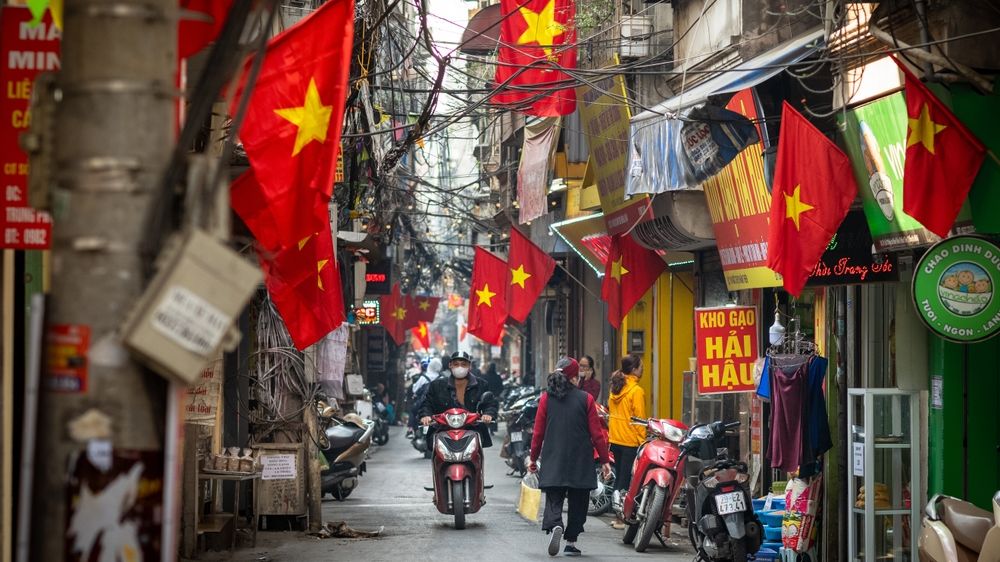
Vietnam’s political spotlight is once again focused on Hanoi as the Communist Party of Vietnam (CPV) holds an important congress meeting to select new national leaders. While these gatherings don’t usually come with dramatic speeches or public campaigns, their impact on the country’s future is massive. Behind closed doors, decisions made during this congress will shape Vietnam’s direction for years to come.
For a country that operates under a one-party system, leadership transitions are carefully managed events. Still, this congress comes at a particularly sensitive time, with economic pressures, global uncertainty, and internal political shifts all playing a role.
In Vietnam, real political power sits with the Communist Party, not with public elections or televised debates. The Party Congress is where top leadership positions are decided, including key roles such as the General Secretary, members of the Politburo, and the Central Committee.
These leaders influence everything—from economic policy and foreign relations to anti-corruption efforts and internal security. So while the process may look quiet from the outside, the stakes are extremely high.
This meeting is especially important because Vietnam is facing a period of transition. Several senior leaders are reaching retirement age, and there is growing pressure to bring in a new generation of leadership.
Unlike multiparty democracies, Vietnam’s leadership selection process is tightly controlled. Candidates are vetted long before the congress begins. Discussions happen internally, often months or even years in advance.
By the time delegates gather, many of the major decisions are already largely agreed upon. Still, negotiations and compromises continue behind the scenes, as different factions within the party push for influence.
The goal is stability. The party wants to avoid sudden shifts or internal conflict that could weaken its grip on power.
One of the key themes surrounding this congress is generational change. Vietnam’s current leadership includes many figures who came of age during or shortly after the Vietnam War. While they are respected for their experience, there is growing recognition that the country’s challenges today are very different.
Vietnam is now deeply integrated into the global economy. It’s a major manufacturing hub, a key player in global supply chains, and an increasingly important diplomatic partner in Southeast Asia.
Younger leaders are seen as better equipped to handle issues like digital transformation, climate change, and relations with major powers such as the United States and China.
Vietnam’s success story over the past few decades has been built on a delicate balance. On one hand, the country has embraced market-oriented reforms, attracting foreign investment and lifting millions out of poverty. On the other hand, the Communist Party has maintained tight political control.
The new leadership will be expected to continue walking this fine line. Too much reform could weaken the party’s authority. Too little reform could slow economic growth and frustrate a young, increasingly connected population.
This balancing act is one of the biggest challenges facing whoever emerges from the congress as the new leadership team.
Another big topic hanging over the congress is anti-corruption. In recent years, Vietnam has seen a sweeping crackdown on corruption that has brought down senior officials, business leaders, and even members of the Politburo.
While the campaign has boosted public trust in some ways, it has also created uncertainty within the bureaucracy. Officials have become more cautious, sometimes slowing decision-making to avoid mistakes.
The new leadership will need to decide how aggressively to continue these efforts—and how to balance accountability with effective governance.
Vietnam’s economy has been resilient, but it’s not immune to global shocks. Slowing global growth, trade tensions, and supply chain disruptions all pose risks.
At the same time, Vietnam is under pressure to upgrade its economy. Low-cost manufacturing alone won’t be enough in the long run. The country needs investment in technology, education, and green energy.
The leaders chosen at this congress will play a critical role in setting economic priorities and sending signals to international investors.
Vietnam’s foreign policy has become increasingly complex. The country is trying to maintain good relations with both the United States and China—a tricky balancing act given rising tensions between the two superpowers.
Vietnam also has ongoing disputes in the South China Sea, making national security and diplomacy key concerns for the next leadership.
Party leaders selected at the congress will shape how Vietnam navigates this geopolitical landscape, deciding when to cooperate, when to push back, and how to protect national interests without escalating conflicts.
For many ordinary Vietnamese, the party congress feels distant. It’s not something they directly participate in, and coverage tends to be formal and controlled.
Still, people care deeply about the outcomes. Leadership decisions affect everyday life—jobs, housing prices, education, and the cost of living.
There’s also growing public interest in transparency and accountability, especially among younger generations who are more exposed to global ideas through social media and travel.
If there’s one principle guiding the Communist Party of Vietnam, it’s stability. The congress is designed to project unity, continuity, and confidence.
Internal disagreements may exist, but they are kept out of public view. The party wants to send a clear message: Vietnam is stable, predictable, and open for business.
That message matters not just domestically, but also to foreign governments and investors watching closely.
Once the congress concludes, attention will shift to implementation. New leaders will begin shaping policy, appointing officials, and setting the tone for the next political cycle.
Some changes may be subtle, others more visible. But don’t expect sudden or dramatic shifts. In Vietnam, political change tends to be gradual and carefully managed.
Over time, however, the decisions made during this congress could have long-lasting effects on how Vietnam governs, grows, and engages with the world.
Vietnam’s Communist Party Congress may not generate dramatic headlines, but it represents one of the most powerful political moments in the country. The selection of new leaders will influence Vietnam’s future at a time of global uncertainty and domestic transformation.
As the doors close on the meeting halls and delegates cast their votes, the direction of one of Southeast Asia’s fastest-growing nations is quietly being decided.
In Vietnam’s political system, silence doesn’t mean inactivity. It often means the most important decisions are being made.