

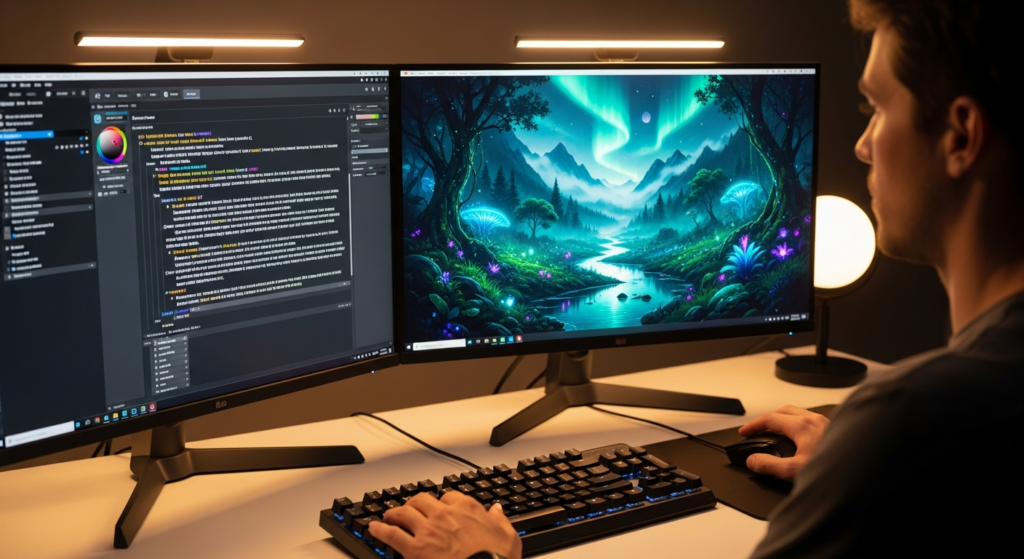
AI Image Generation Technology Reaching Professional Quality… Artificial intelligence image generation technology has evolved from a fascinating experiment into a powerful professional tool capable of producing visuals that rival the work of skilled human artists, designers, photographers, and creative agencies. In just a few years, AI-generated images have moved from simple, often unrealistic outputs to highly detailed, commercially viable artwork used in advertising, entertainment, product design, publishing, and digital media.
The rapid improvement of generative AI models has created a major shift in how visual content is created and consumed. Tools powered by advanced machine learning systems can now understand complex prompts, generate realistic lighting and textures, reproduce artistic styles, and create images that meet professional production standards. While AI does not replace human creativity, it has become an important collaborator that expands what individuals and organizations can achieve.
The journey toward professional-quality AI images began with early computer vision experiments and neural networks designed to recognize patterns. Traditional image software relied heavily on manual input from designers, but modern AI systems learn from enormous collections of images and use that knowledge to generate new visual content.
A major breakthrough came with the development of deep learning architectures, particularly generative adversarial networks (GANs) and later diffusion models. GANs introduced the ability for AI systems to create new images by having two neural networks compete: one generating images and another evaluating their realism. Diffusion models improved the process further by gradually transforming noise into detailed images based on learned patterns and text instructions.
Modern systems such as OpenAI’s image generation technology, Midjourney, and Stability AI’s Stable Diffusion ecosystem demonstrate how far the technology has progressed. These platforms can generate realistic portraits, architectural concepts, product mockups, illustrations, and cinematic scenes within seconds.
Professional-quality visual content requires more than attractive colors or interesting compositions. Designers and artists consider accuracy, consistency, emotional impact, technical quality, and suitability for a specific purpose. Recent AI systems have improved significantly in each of these areas.
Several technological advancements have contributed to this progress:
The combination of these improvements allows AI tools to function not only as image generators but also as creative assistants capable of supporting professional workflows.
The advertising industry has been among the earliest adopters of AI-generated imagery because campaigns often require large volumes of visual content. Companies can use AI to create concept images, social media graphics, product advertisements, and personalized marketing materials.
For example, marketing teams can test multiple versions of an advertisement featuring different backgrounds, audiences, or product arrangements without organizing expensive photo shoots. This allows brands to experiment more efficiently while maintaining creative quality.
AI-generated visuals are also helping smaller businesses compete with larger companies. A startup with limited resources can create professional-looking promotional images without hiring a full production team, reducing barriers to entry in competitive markets.
The entertainment industry has embraced AI image generation for concept development, storyboarding, character design, and visual effects planning. Before filming begins, production teams can use AI tools to visualize scenes, explore costume ideas, and develop fictional worlds.
For example, a filmmaker creating a science fiction project can generate hundreds of possible spaceship designs or alien landscapes before selecting the final direction. This accelerates pre-production and gives creative teams more opportunities to experiment.
Fashion designers and product developers are also benefiting from AI-generated imagery. Instead of creating physical prototypes immediately, designers can visualize clothing collections, furniture concepts, packaging designs, and consumer products digitally.
This approach reduces development costs and allows companies to evaluate customer reactions before manufacturing. AI-generated prototypes can help identify promising ideas earlier in the design process.
Architects and real estate professionals increasingly use AI visualization tools to create realistic representations of buildings, interiors, and environments. These images help clients understand projects before construction begins.
AI can transform simple descriptions into detailed architectural concepts, allowing designers to explore different materials, layouts, and styles quickly. This capability improves communication between architects, developers, and clients.
Many design agencies now incorporate AI image generation during brainstorming sessions. Instead of spending hours producing initial sketches manually, creative teams can generate dozens of possible concepts within minutes. Designers then select the strongest ideas and refine them using traditional tools.
This workflow demonstrates an important trend: AI is most effective when combined with human expertise. Professionals provide artistic direction, cultural understanding, and strategic decision-making, while AI accelerates exploration and experimentation.
Large-scale marketing campaigns increasingly require personalized content for different audiences. AI image generation allows companies to create variations of advertisements tailored to specific customer segments.
A travel company, for example, could generate different destination visuals based on customer preferences. One audience might see luxury vacation imagery, while another might receive adventure-focused visuals. This level of customization was previously expensive and time-consuming.
Independent creators have gained access to professional-level visual production through AI tools. Artists, writers, game developers, and entrepreneurs can create illustrations, promotional materials, and visual assets without requiring large budgets.
This democratization of design technology has expanded opportunities for creative individuals worldwide.
The rise of AI image generation is part of a broader expansion of generative artificial intelligence. Industry research has shown significant growth in adoption among businesses and creative professionals.
These trends indicate that AI image generation is moving beyond experimentation and becoming part of mainstream professional workflows.
Despite remarkable progress, AI-generated imagery still faces important challenges. Professional adoption requires addressing concerns related to accuracy, ethics, copyright, and creative ownership.
These challenges do not eliminate the value of AI tools, but they highlight the importance of responsible development and thoughtful use.
The future of AI-generated images is likely to involve deeper collaboration between humans and machines. Rather than replacing creative professionals, AI is expected to become a more advanced assistant that helps people transform ideas into visual experiences faster.
Future developments may include:
As AI models become more sophisticated, the distinction between traditional and AI-assisted creative workflows will continue to change. The most successful professionals will likely be those who understand how to combine human imagination with artificial intelligence capabilities.
Creative professionals do not need to view AI image generation as a competitor. Instead, learning how to use these tools effectively can provide significant advantages.
Important skills for the AI-powered creative industry include:
The future belongs not simply to those who can generate images, but to those who can use AI strategically to create meaningful visual experiences.
AI image generation technology reaching professional quality represents one of the most significant transformations in modern creative industries. What began as an experimental technology has become a practical tool capable of supporting advertising, entertainment, design, architecture, education, and countless other fields.
The greatest impact of AI image generation is not merely its ability to create realistic images. Its true power lies in expanding human creativity by making visualization faster, more accessible, and more flexible. Professionals can explore ideas more freely, businesses can produce content more efficiently, and individuals can bring creative visions to life with fewer limitations.
Although challenges surrounding ethics, ownership, and authenticity remain, responsible innovation can help ensure that AI strengthens rather than diminishes human creativity. The future of visual communication will likely be shaped by collaboration between human imagination and artificial intelligence, creating opportunities that were once impossible to achieve.