

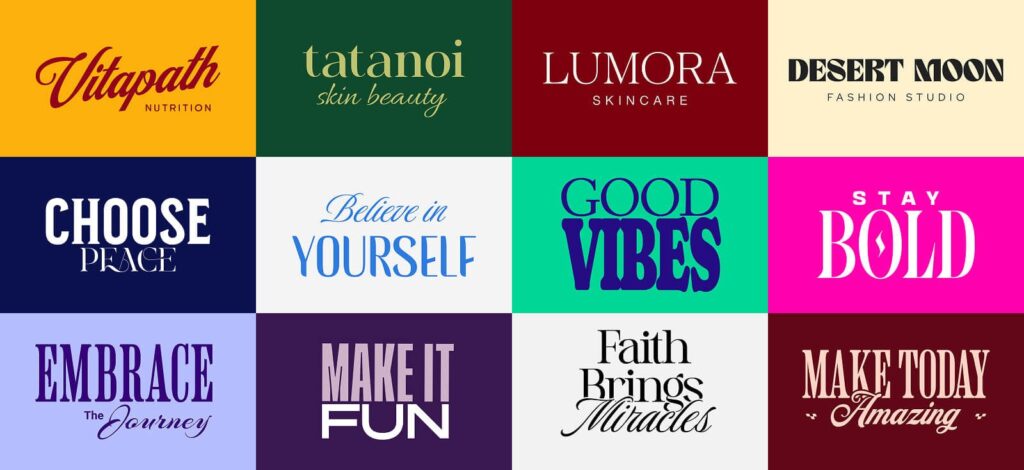
In the world of branding, what you say is often secondary to how it looks. Typography is the “visual voice” of a brand. It conveys personality, authority, and emotion before a single word is actually processed by the brain. In 2026, as digital noise reaches an all-time high, the ability to choose and pair fonts effectively has become a critical competitive advantage for businesses. In this article, we’ll explore some of the Best Font Combinations for Professional Branding to help your business stand out.
Professional branding design relies on the delicate balance between contrast and harmony. Selecting a single font is rarely enough to build a complex brand identity; instead, designers use font combinations—usually a pairing of two or three distinct typefaces—to create a visual hierarchy. This article provides a comprehensive guide to the best font pairings, the psychology behind typography, and the technical standards required to build a trustworthy and memorable brand.
Before diving into specific pairings, it is essential to understand the psychological weight of different font categories. Every typeface carries historical and cultural baggage. Serif fonts, characterized by the small lines at the ends of strokes, are associated with tradition, reliability, and institutional power. Sans-serif fonts, which lack these lines, are seen as modern, clean, and efficient.
When you pair two fonts, you are essentially creating a conversation. A bold Serif headline paired with a clean Sans-Serif body suggests a brand that is “classic yet contemporary.” Conversely, two fonts that are too similar can create “visual dissonance,” making the design look accidental or messy rather than intentional. Statistics from 2025 consumer behavior studies suggest that 60% of users are more likely to trust a brand if its typography feels consistent with its industry standards.
Certain pairings have stood the test of time because they provide perfect contrast while maintaining legibility. These combinations are safe bets for professional services, luxury brands, and high-end retail.
One of the most celebrated pairings in 2026 remains Playfair Display (Serif) with Source Sans Pro (Sans-Serif). Playfair Display, with its high-contrast strokes, provides a sense of luxury and editorial elegance, making it perfect for headlines. Source Sans Pro, designed for clarity in digital interfaces, acts as the perfect grounded partner for body text. This combination is a staple for boutique hotels, fashion houses, and high-end law firms that want to appear established yet modern.
For startups, SaaS companies, and digital agencies, the branding needs to feel “fast,” “clean,” and “scalable.” Geometric sans-serifs are the go-to choice here. These fonts are based on perfect circles and squares, giving them a mathematical, precise feeling.
A leading combination in this category is Montserrat and Lato. Montserrat is inspired by urban typography from Buenos Aires; its bold weights are incredibly impactful for headlines. Lato, which means “Summer” in Polish, is a warmer sans-serif with rounded curves that make long paragraphs easy to read. This pairing provides a “human-centric tech” vibe, which is crucial for AI companies in 2026 looking to appear approachable rather than cold or robotic.
Slab serifs are the “heavy lifters” of the typography world. They feature thick, block-like serifs that convey a sense of ruggedness, stability, and unshakeable authority. When paired with a light, modern sans-serif, they create a brand identity that feels both strong and sophisticated.
Consider the pairing of Roboto Slab and Open Sans. Roboto Slab has a mechanical skeleton but friendly curves, making it ideal for industrial, construction, or logistics brands. Open Sans is one of the most versatile fonts in existence, known for its neutral yet friendly appearance. This combination ensures that the brand feels powerful enough to handle large projects while remaining easy for customers to communicate with.
Sometimes, a brand wants to lean entirely into tradition and sophistication without using sans-serifs at all. This is common in the world of high-end jewelry, luxury travel, and literary publications. The key here is to mix two serifs that have different “x-heights” and weights.
A popular choice is Libre Baskerville (Headlines) and Lora (Body Text). Libre Baskerville is a classic web-optimized version of the 18th-century original, radiating “old money” and academic prestige. Lora has roots in calligraphy and is designed to flow beautifully in long-form content. Together, they create a “literary luxury” aesthetic that appeals to older, affluent demographics who value heritage and storytelling.
In 2025, a major European fintech startup struggled with a high “bounce rate” on its sign-up page. Their original branding used a rounded, playful font that made them look like a mobile game rather than a financial institution. Users reported feeling “uneasy” about putting their bank details into the app.
The agency rebranded them using a pairing of Fraunces (a soft, authoritative Serif) and Inter (the gold standard for UI Sans-Serif). Fraunces provided the “bank-like” stability and heritage feeling in the headlines, while Inter provided the “app-like” precision for the numbers and data. Within three months, the brand saw a 22% increase in user trust scores and a 15% increase in completed registrations. This case study proves that typography isn’t just about art; it’s about business results.
To create a professional look, designers follow a set of “Golden Rules” that ensure the typography functions well across different media, from a tiny business card to a massive billboard.
The first rule is Establish a Clear Hierarchy. Your headline font should be the most distinct, your sub-headline font should bridge the gap, and your body font should be invisible—meaning it is so easy to read that the user doesn’t even notice the font itself. Second, Limit the Palette. Using more than three fonts is the hallmark of an amateur. Most world-class brands stick to two: one for “Character” and one for “Utility.”
For creative industries like music, art, and high-concept fashion, “professionalism” doesn’t mean “standard.” These brands often use “Display Fonts”—highly stylized typefaces that wouldn’t work for a bank but are perfect for a creative statement.
A rising trend in 2026 is the Brutalist Sans paired with a delicate Script. This creates an “Industrial Romance” aesthetic. For example, using a heavy, blocky font like Impact or Bebas Neue for the main brand name, then overlaying a delicate, handwritten script for a secondary message. This creates a high-contrast, edgy look that appeals to Gen Z and Gen Alpha consumers who are tired of the “corporate minimalism” of the previous decade.
A font can look beautiful on a 27-inch iMac and be unreadable on a mobile phone screen. In 2026, branding is “Mobile-First.” This has led to the rise of “Sans-Serifs with high x-heights”—meaning the lowercase letters are relatively tall compared to the uppercase letters.
Fonts like Merriweather (Serif) and Open Sans are popular because Merriweather was designed specifically for screens. It has heavy serifs and large open spaces (counters), which prevent the letters from “blurring” together on low-resolution devices. When designing a professional brand, you must test your font combinations on different “Render Engines” to ensure the kerning (spacing between letters) and leading (spacing between lines) remain consistent.
As we look toward the end of the decade, the technology behind fonts is changing. Variable Fonts are now the industry standard. Instead of having separate files for “Bold,” “Italic,” and “Light,” a variable font is a single file that can be adjusted on a spectrum. This allows for “Responsive Typography”—where a brand’s font weight automatically gets thicker on a bright screen to improve contrast.
Furthermore, AI is now helping designers find the perfect pairings. Tools like Fontjoy and Adobe Sensei analyze millions of designs to suggest pairings based on visual mathematical similarities. However, the human designer’s role remains vital: AI can find a “match,” but it cannot understand if a font “feels” like the client’s brand values. The future of professional branding is a “Centaur” approach: using AI for technical matching and human intuition for emotional storytelling.
Choosing the right font combination is a blend of science and art. It requires a deep understanding of psychological triggers, technical constraints, and brand strategy.
In the end, the best font combination is the one that makes your brand feel “right” to your audience. When typography is done perfectly, the customer doesn’t notice the fonts—they simply feel the message.