

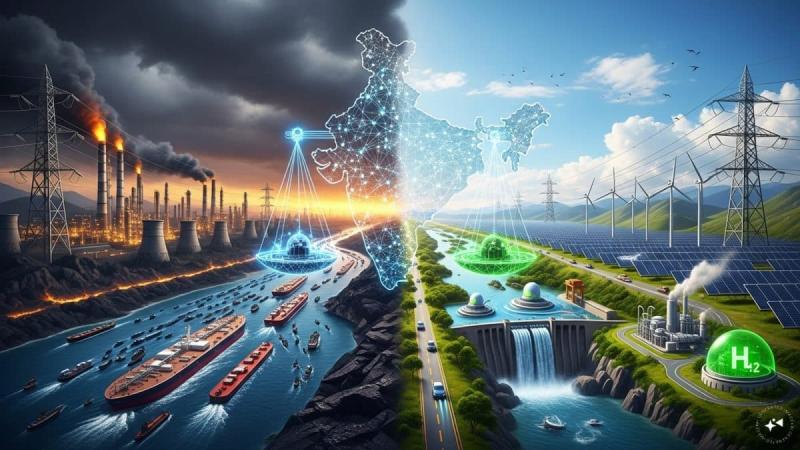
For over a century, the pursuit of energy security has been a primary driver of international relations and military strategy. However, as we stand in 2026, the definition of energy security has undergone a radical transformation. How war influences global energy security policies has become a critical question in this new era. Historically, it meant ensuring a steady flow of cheap oil and gas. Today, influenced by the brutal reality of recent conflicts, energy security is synonymous with national sovereignty, technological independence, and the acceleration of the green transition.
Wars have a unique way of exposing the “energy jugular” of a nation. When tanks cross borders, the invisible threads of pipelines and shipping lanes become the most targeted vulnerabilities. The invasion of Ukraine in 2022 served as the modern world’s greatest energy “stress test,” but it was merely the beginning of a global policy shift. This article explores how armed conflict forces nations to rewrite their energy playbooks. Instead of prioritizing economic efficiency, they move toward defensive resilience.
The most significant policy shift triggered by war is the realization that energy dependency is a strategic liability. For decades, European energy policy was built on the concept of “Wandel durch Handel” (Change through Trade)—the idea that economic interdependence would prevent conflict. The 2022 energy crisis shattered this illusion. It proved that an adversary can use energy exports as a “non-kinetic” weapon.
In response, global policies have pivoted toward “de-risking.” Nations are no longer looking for the cheapest calorie; they are looking for the safest. In 2026, we see the results of this shift in the “Energy Independence Acts” passed across the EU and North America. These policies prioritize domestic production and “friend-shoring”—sourcing energy only from trusted democratic allies. The economic cost of this shift is high. It abandons the efficiency of the globalized market, but policymakers now view this as a necessary “security tax” to prevent future blackmail.
Before 2022, the transition to renewable energy was primarily driven by climate goals. After the outbreak of major regional wars, the transition is now driven by military necessity. Unlike a centralized coal or nuclear plant, a decentralized network of solar panels and wind turbines is nearly impossible to “turn off” with a single missile strike or a cyberattack on a pipeline.
In 2026, “Renewables as Defense” is a core policy pillar. Governments are subsidizing domestic battery manufacturing and solar silicon production not just to save the planet, but to ensure that their military and civilian infrastructure can function if global supply chains are severed. This has led to the “Electrification of Everything” strategy. By moving transportation and heating away from imported oil and toward a domestic, renewable-powered grid, nations are effectively pulling their necks out of the geopolitical noose.
War has a tendency to make the “unthinkable” acceptable. Nuclear energy, which faced a slow decline after Fukushima, is experiencing a massive policy rebirth in 2026. Armed conflict in energy-producing regions has highlighted the vulnerability of solar and wind during “dark calms” or periods of high grid stress.
The latest policies focus on Small Modular Reactors (SMRs). These smaller, more flexible plants can be deployed near industrial hubs to provide constant, carbon-free baseload power. Poland, Romania, and Japan have all signed massive nuclear expansion bills in the last 24 months. For these nations, nuclear power represents “energy density.” This means the ability to generate massive amounts of power from a small, easily protected footprint that does not require constant, high-volume fuel shipments through dangerous waters.
The sabotage of the Nord Stream pipelines was a watershed moment for energy security policy. It proved that subsea infrastructure—the “nervous system” of the global economy—is highly vulnerable and difficult to defend. In 2026, energy policy has moved underwater.
We are seeing the creation of “Critical Underwater Infrastructure Protection” (CUIP) task forces within NATO and other regional alliances. Policies now mandate that all new energy cables and pipelines must include “digital twins” and fiber-optic acoustic sensors to detect intruders. Furthermore, policy is shifting toward “redundancy by design.” Instead of one massive pipe, nations are building multiple smaller, interconnected networks. This ensures that the loss of one node does not result in a total blackout. Energy security is no longer just about the fuel, it is about the protection of the delivery mechanism.
Ukraine provides the most vivid case study in modern energy security. Facing thousands of strikes on its power grid between 2022 and 2026, the country pioneered the “Energy Fortress” strategy. This involved physical hardening—building concrete sarcophagi around transformers—and rapid-response repair teams.
The Ukrainian model has been exported to Baltic and Nordic states. The policy shift involves “islanded microgrids.” In a traditional grid, a failure in one city can cascade into a national blackout. In Ukraine’s new model, every city and hospital can disconnect from the national grid and run on local solar, batteries, and backup generators. This “cellular” grid architecture is now being adopted by the U.S. Department of Defense and several EU nations as the ultimate defense against high-intensity warfare.
While the long-term goal is green, war often forces a “Pragmatism Gap”—a temporary return to the dirtiest fuels to survive the winter. In 2024 and 2025, several “green” nations, including Germany, were forced to restart mothballed coal plants.
This has led to a dual-track policy. While nations continue to invest in renewables, they are also passing “Emergency Fuel Acts.” These acts allow for the rapid reactivation of fossil fuel assets during a declared security crisis. This “Strategic Coal Reserve” policy ensures that a nation never has to choose between its climate goals and its survival. It is a sobering reminder that in the hierarchy of needs, physical warmth and industrial power will always sit below carbon reduction in the heat of a conflict.
The global oil supply chain is only as strong as its narrowest chokepoint. Conflicts in the Middle East and the Red Sea throughout 2025 have forced a total rethink of maritime energy security. When Houthi rebels or state actors target tankers, the “shipping premium” becomes a “tanker tax” on the global economy.
Energy policy is now merging with naval doctrine. Several Asian and European nations have passed “Flag Protection Acts,” which provide government-backed insurance for tankers in high-risk zones, provided they agree to sail in protected naval convoys. This is a return to the 1980s “Tanker War” tactics, but with a 21st-century twist: the use of electronic warfare to protect ships from drones. Therefore, energy security now requires a massive, ongoing military presence in the Strait of Hormuz and the Malacca Strait. This further increases the price of oil for the end consumer.
In the 20th century, energy security was about oil. In 2026, it is about Lithium, Cobalt, Copper, and Rare Earth Elements. War has taught policymakers that transitioning to solar and wind simply trades one dependency (Middle Eastern oil) for another (Chinese mineral processing).
The “Critical Raw Materials Acts” seen in the U.S. and EU are essentially energy security policies. They aim to break the monopoly of any single nation over the minerals needed for the energy transition. This involves “Resource Diplomacy”—signing exclusive trade deals with mineral-rich nations in Africa and South America—and subsidizing domestic mining that was previously banned for environmental reasons. In the 2026 landscape, a lithium mine in Nevada is seen as just as vital to national security as an oil well in Texas was in 1944.
Conflict-induced energy spikes don’t just affect the military; they affect the voter. High energy prices lead to “energy poverty,” which is a primary driver of social unrest and political radicalization. In 2026, governments are treating high energy prices as a domestic security threat.
We are seeing the rise of “Social Energy Buffers.” Policies now include mandatory price caps and direct energy subsidies during times of geopolitical tension. Governments have realized that if the population cannot afford to heat their homes or drive to work, the internal stability of the nation will collapse before the military is even defeated. This has led to the “Universal Energy Access” doctrine, where the state guarantees a basic level of energy as a fundamental right during times of war.
Finally, the influence of war has pushed the world toward “Circular Energy.” If a nation can recycle its batteries and solar panels, it reduces its need to import minerals or fuel from hostile regions. In 2026, recycling is no longer just for “green” points; it is a security mandate.
New policies require that 50% of the materials in any new energy project must come from recycled sources by 2030. This creates a “closed loop” energy system. A nation that can generate its own power from the sun, store it in recycled batteries, and distribute it through a hardened, decentralized grid is a nation that is “war-proof.” This is the ultimate goal of the 2026 energy security policy. It envisions a world where energy is no longer a reason to go to war, because it is no longer something that can be taken away.
The influence of war on global energy security policies has been profound and likely permanent. We have moved from a world of “just-in-time” energy to “just-in-case” energy.
The key takeaway is that energy is no longer viewed as a mere commodity to be traded; it is the fundamental infrastructure of national survival. In 2026, the strongest nations are not those with the most oil. Rather, they are those with the most resilient, diversified, and self-sustaining energy systems.