

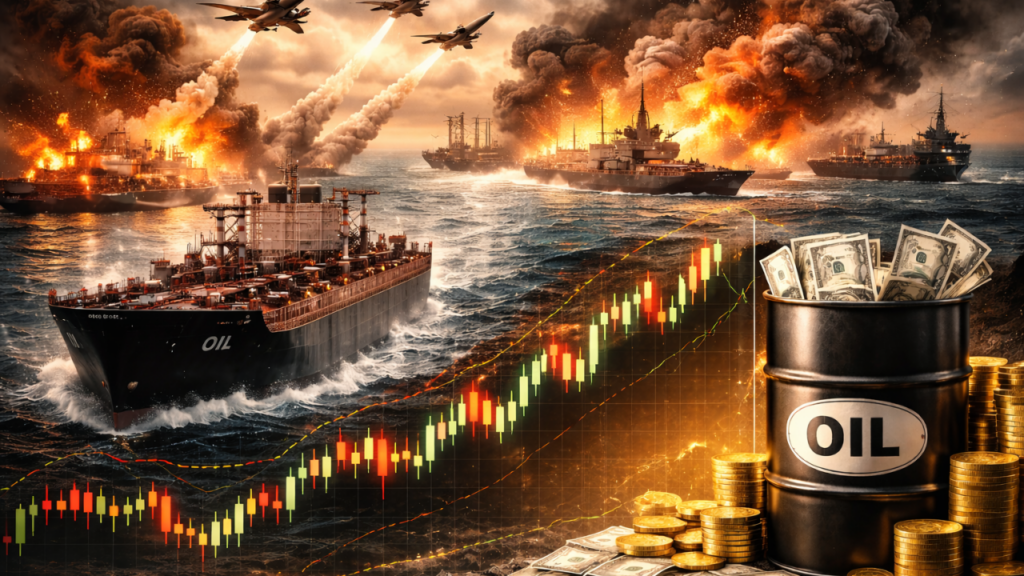
The modern world relies on a thin thread of energy. For over a century, oil and gas have been the lifeblood of our civilization. They heat our homes and power the ships that deliver our food. However, this reliance has a major weakness: much of the world’s oil is found in unstable places. Throughout history, the Energy Crisis Caused by War in Oil-Producing Regions has shown how conflict can lead to a global crisis. It hurts economies, changes politics, and alters the daily lives of billions.
By 2026, the link between war and energy has reached a breaking point. Recent conflicts, like the 2022 invasion of Ukraine and Middle Eastern unrest, show that energy is now a weapon of war. This article explains how fighting in oil regions triggers global crises and what nations must do to survive this new era of uncertainty.
When war hits an oil region, the supply fails in several ways. It is rarely just about turning off a tap; it is a total failure of the system.
The first impact is the physical destruction of gear. Modern armies now target the enemy’s economy. This means pipelines, refineries, and ports are top targets. Recently, we have seen drones used to strike storage tanks and processing units. These parts are hard to fix and can take years to replace. When these “soft spots” are hit, the whole energy network can grind to a halt.
To understand 2026, we must look back at the 1973 Yom Kippur War. At that time, Arab oil-producing nations stopped shipping oil to countries that supported Israel. This was the first time oil was used as a major weapon.
During that crisis, oil prices quadrupled in just a few months. In the U.S. and Europe, this led to long lines at gas stations and massive price hikes. This case proves that a crisis isn’t always about running out of oil. It is often about a country choosing to hold oil back to gain power. Today, we see similar moves as nations use their oil supply to influence the foreign policy of larger countries.
Most of the world’s oil—about 60%—moves by sea. Much of this traffic must pass through very narrow “chokepoints.” These areas are very easy to attack during a war.
The Strait of Hormuz is the most important of these spots. Over 20 million barrels of oil pass through it every day. If war breaks out nearby, these waters become “gray zones” filled with sea mines and missiles. This makes it too dangerous for tankers to pass. Even if the ships keep moving, the cost of insurance for these tankers skyrockets. This adds a “war tax” to the price of oil before it even reaches a refinery.
An energy crisis caused by war never stays in the energy sector. It acts as an “inflation multiplier.” When the price of a barrel of oil goes up, the price of almost everything else follows.
The biggest victim is often farming. Modern food relies on oil and gas. Gas is used to make fertilizer, and diesel runs the tractors and trucks. When energy prices spike, food prices go up even faster. In 2024 and 2025, we saw that high energy costs led to food shortages and protests in many developing nations. This creates a cycle where energy crises lead to local riots, which then cause more instability.
The 2022 invasion of Ukraine is a modern example of an energy war. Before the war, Russia was a top oil and gas seller, and Europe was its biggest buyer. The war forced them to split apart.
This crisis showed how pipelines can be used as weapons. When gas flows were cut, Europe had to find new energy sources fast. Governments spent billions to keep businesses from failing. This led to a major shift toward Liquefied Natural Gas (LNG). While LNG ships give Europe more freedom, they are much more expensive than old pipelines. This means Europeans now face a “security premium”—a permanently higher cost for their energy.
To protect against war, many nations keep “Strategic Petroleum Reserves.” These are massive stockpiles of oil kept in underground caves for emergencies.
In 2026, managing these reserves is a key part of national defense. However, these reserves are not endless. During the long wars of the early 2020s, many nations used up a large part of their stocks to keep prices steady. Now, refilling these tanks is very hard because prices remain high. This has left some nations vulnerable. If their reserves are low, enemies may feel it is a good time to attack the oil supply again.
In 2026, war in an oil region isn’t just about bombs. Cyber-attacks are now a major way to stop the flow of energy. An enemy can cause a crisis without ever crossing a border.
Oil and gas systems now run on computers. During a war, these systems are prime targets. A hack on a pipeline can cause it to burst, and a hack on a refinery can cause a fire. This means nations far from the battlefield are still at risk. We now see state-level hackers holding energy grids “hostage.” This digital threat is a new and dangerous part of modern energy warfare.
While war is devastating, it also speeds up the move to clean energy. High prices and supply fears are the best reasons for a nation to find new ways to power itself.
In 2026, the goal is “Energy Security.” Nations that used to be slow to use solar or wind now see them as vital for safety. Unlike oil, the sun and wind cannot be blocked by an enemy navy. We are also seeing a new interest in nuclear power. Small reactors can provide steady power that doesn’t depend on foreign oil. In a strange way, the oil crisis is helping to end the “Age of Oil” faster than climate laws ever could.
The poorest nations often suffer the most during an energy war. For billions of people, a small price hike in fuel is a life-changing disaster.
In 2026, many developing countries are facing a debt crisis because of energy costs. They must spend all their money just to keep the lights on. When war sends oil prices up, these countries are priced out. This leads to blackouts and the failure of hospitals. The energy crisis is widening the gap between rich and poor, as wealthy nations buy up the remaining oil, leaving none for the rest.
The final result of these wars is a new global power map. The “global” energy market is breaking into pieces based on who is friends with whom.
By 2026, we see two main groups. One is the “Western Energy Bloc” (U.S., Europe, and allies) focusing on LNG and green tech. The other is an “Eastern Energy Bloc” where Russia and some Middle Eastern states sell oil to China and India at a discount. This split makes the world less efficient, but it helps nations feel safer. Energy is no longer just a business; it is the main tool in a new global Cold War.
Energy crises caused by war are the biggest threat to world stability today. These problems are about more than just expensive gas. They hurt food supplies, businesses, and national safety.
To stay safe in 2026, nations must do more than just store oil. They must find many different energy sources and protect their computer systems. In a world at war, being energy independent is the best way to stay free.