

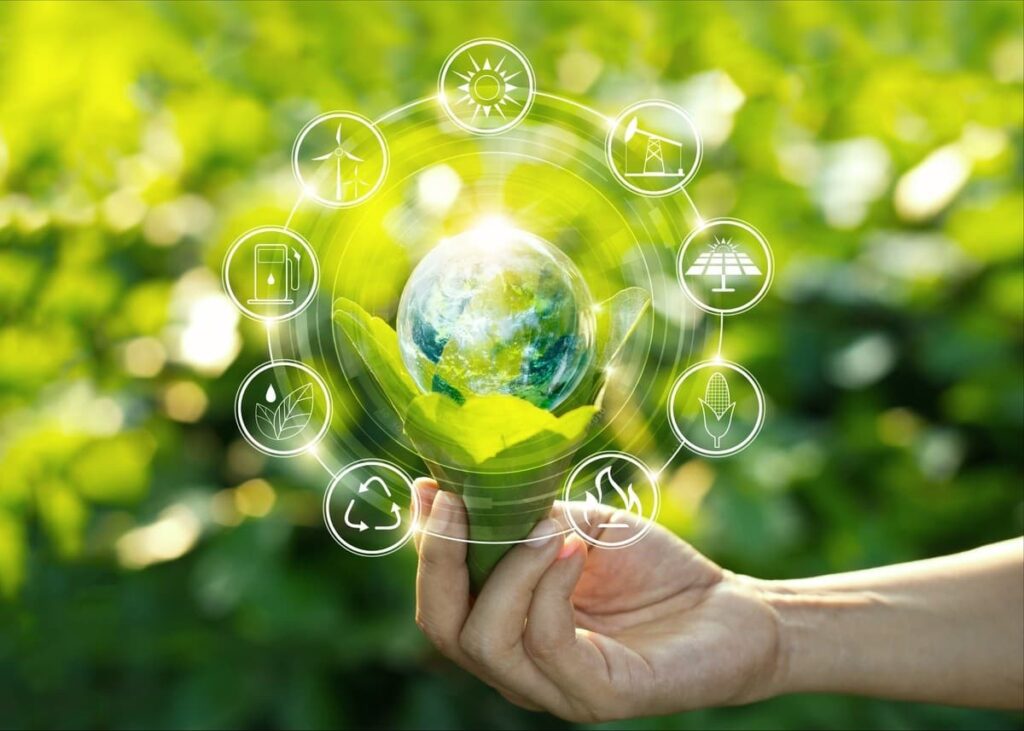
By early 2026, the world has stopped asking “why” we need green tech and started asking “how fast” we can get it. Sustainable technology is now the main engine of global growth. A key focus is on Future Trends in Sustainable Green Technology Developments, which are driving a massive burst of new ideas as clean energy is often cheaper than coal or oil.
The year 2026 is defined by a mix of AI, new materials, and biology. This blend creates “smart” systems where waste becomes a resource. From deep oceans to city skyscrapers, green tech is part of everything we build. This article looks at the ten biggest trends shaping our world today and for the next ten years.
Artificial Intelligence (AI) is now the brain of the green energy shift. The big problem with wind and solar has always been that nature is unpredictable. In 2026, AI “Smart Grids” solve this by predicting weather and power needs with 99% accuracy.
Recent data shows that AI has cut energy waste in data centers by 40%. By balancing power supply and demand in real-time, these systems act like a digital conductor. They make sure no clean energy goes to waste. This trend is leading to “Self-Healing Grids.” These grids can fix themselves during storms, keeping our power systems steady and strong.
Green hydrogen is made by using clean power to split water. In 2026, it has finally become a major tool. While electric cars win on the road, green hydrogen is taking over heavy shipping, trucking, and steel making.
The green hydrogen market is growing very fast. New tech has lowered the cost to under $2 per kilogram in many places. This makes it as cheap as “dirty” hydrogen made from gas. In places like the Port of Rotterdam, hydrogen now replaces coal in steel plants. This proves that even the heaviest industries can reach net-zero goals.
The era of just using lithium-ion batteries is changing. To meet the huge demand for power storage, 2026 has brought us Sodium-ion and Solid-state batteries. Sodium batteries use salt, which is cheap and easy to find. This makes them 30% cheaper and safer than lithium.
Solid-state batteries are the “dream” for electric cars. They hold twice as much energy and can charge in under 10 minutes. Car makers like Toyota are now testing cars that can travel 1,000 kilometers on one charge. This shift creates a fairer supply chain. It reduces our need for rare minerals that are often mined in poor conditions.
The old “buy, use, and toss” model is dying. In its place is a “Circular Economy” run by smart sorting tech. In 2026, we use Molecular Recycling. This process breaks plastic back down into its basic parts. This allows us to recycle it forever without losing quality.
New laws now require “Product Passports.” These are digital tags that track what a product is made of. This makes it easy to take things apart and reuse the pieces. In fashion, AI robots now sort old clothes by material faster than humans. They turn old polyester back into new gear without using any new plastic.
Carbon capture is no longer a dream; it is an active industry. By 2026, big plants in Texas are pulling one million tons of CO₂ directly from the sky each year.
The best part is how we use that carbon. Instead of just burying it, companies turn CO₂ into jet fuel or “Green Concrete.” This special concrete is actually stronger because of the injected CO₂. This turns the building industry—a huge polluter—into a “carbon sink.” It locks away harmful gases inside our buildings and bridges forever.
The way we grow food is changing. Regenerative Farming focuses on making the soil healthy again. Drones with special cameras can now see exactly which plants need water. This cuts fertilizer waste by half.
In food tech, 2026 is the year of Precision Fermentation. This uses tiny microbes to “brew” real milk and cheese without a cow. These products taste and act exactly like dairy but have a 90% lower carbon footprint. These items are now appearing in regular stores, offering a way to eat well without hurting the planet.
As we use more data, “Green Computing” has become vital. A big trend in 2026 is Liquid Cooling. Servers are dipped in special liquids that don’t conduct electricity. This removes the need for loud, power-hungry fans. It lets data centers use half the energy they did before.
Also, “Edge Computing” is helping. By processing data closer to the user, we save the energy needed to send it across the world. Developers are also using “Green Coding.” They write cleaner code that needs less power to run. This “slims down” the internet to save energy at every step.
With land running out, green tech is moving to the water. Floating Solar and Offshore Wind are huge in 2026. Solar panels on lakes generate power and stop water from drying up. This is a “double win” for dry areas.
The “Blue Economy” also uses the power of waves. New, tough turbines are being placed in the ocean to provide steady power. In tropical areas, we are testing “Ocean Thermal” power. This uses the temperature difference between deep and surface water to provide power 24/7. These ocean tools open up 70% of the earth for clean energy.
We are starting to use biology as a building tool. In 2026, we use Mushroom-based materials and Algae walls. Mushroom roots (mycelium) can be grown into shapes to replace plastic foam. It is fire-safe and can be composted when done.
Even better are “Living Buildings.” These use algae in their windows to catch CO₂ and make heat. These buildings don’t just “do less harm”—they actively help the air. By 2030, architects believe city towers will act like forests. they will clean the air and provide homes for birds while making their own solar power.
The final trend is how we pay for it all. In 2026, the market for carbon credits is clear and safe thanks to blockchain. We have moved to Biodiversity Credits. This is where companies are paid to protect or fix forests and oceans.
Investing in green projects will hit $1 trillion this year. Investors now use AI to see the real-world impact of their money. This makes it easy to spot “greenwashing.” It ensures that money goes to projects that truly help the earth. This link between profit and the planet is the most important trend of all.
The future of green tech is about “fixing” the earth, not just “using less.”
The “Green Horizon” is no longer a dream. It is happening right now. The ideas of 2026 are the maps for a world where people and nature can both thrive.