

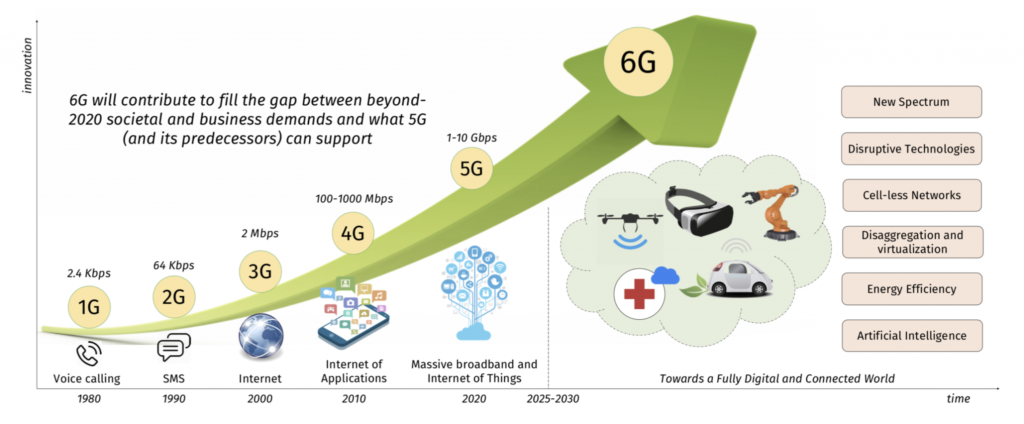
The evolution of wireless communication has consistently transformed the way people live, work, and interact. From the introduction of analog cellular networks in the 1980s to the deployment of high-speed 5G systems in the 2020s, each generation of mobile technology has delivered significant improvements in speed, capacity, reliability, and connectivity. Today, as 5G networks continue to expand worldwide, researchers, governments, telecommunications companies, and technology organizations are already looking ahead to the next revolutionary milestone: the Evolution of 6G Connectivity and Global Networking.
6G, or sixth-generation wireless technology, is expected to redefine global networking by enabling unprecedented data speeds, ultra-low latency, intelligent communication systems, and seamless integration between the physical and digital worlds. While commercial deployment is not expected until around 2030, ongoing research suggests that 6G could become the foundation for innovations such as holographic communications, digital twins, immersive extended reality, autonomous transportation networks, and AI-native connectivity.
This article explores the evolution of 6G connectivity, its technological foundations, global networking implications, potential applications, challenges, and the transformative impact it may have on society and the global economy.
To appreciate the significance of 6G, it is important to understand the progression of wireless technologies over the past four decades.
The first generation of mobile networks emerged in the 1980s and focused primarily on analog voice communication. Although revolutionary for its time, 1G offered limited coverage, poor security, and low call quality.
Introduced in the 1990s, 2G networks digitized voice communications and introduced text messaging. GSM technology enabled better security and more efficient spectrum utilization.
The early 2000s saw the arrival of 3G networks, enabling mobile internet access, video calling, and multimedia services. Data speeds improved dramatically compared to previous generations.
4G LTE networks transformed mobile connectivity by providing high-speed internet access capable of supporting video streaming, cloud applications, and mobile commerce.
5G introduced ultra-low latency, enhanced mobile broadband, massive machine-type communications, and support for the Internet of Things (IoT). It enabled smart cities, industrial automation, and advanced digital services.
6G aims to move beyond connectivity by integrating artificial intelligence directly into network architecture while delivering speeds and capabilities far exceeding current standards.
6G refers to the sixth generation of wireless communication technology expected to succeed 5G by the end of this decade. While official standards are still under development, researchers envision a network capable of supporting advanced applications that require near-instantaneous communication and massive computational resources.
Expected characteristics of 6G include:
These capabilities could fundamentally change how information is transmitted and processed worldwide.
The evolution of 6G relies on several emerging technologies that extend far beyond traditional telecommunications infrastructure.
Unlike previous generations, where AI serves as an add-on capability, 6G is expected to be AI-native. Artificial intelligence will be deeply integrated into network management, resource allocation, traffic optimization, and security systems.
Benefits include:
AI-driven networking will enable systems to adapt dynamically to changing user demands and environmental conditions.
One of the most discussed aspects of 6G is its potential use of terahertz (THz) frequencies. These frequencies lie above the millimeter-wave spectrum utilized in advanced 5G deployments.
Terahertz communication offers:
However, researchers must overcome challenges related to signal attenuation and limited transmission range.
Future 6G networks may combine communication and sensing capabilities into a single infrastructure.
This could enable devices to:
Such functionality would enhance applications ranging from smart transportation to healthcare monitoring.
Although still in its early stages, quantum communication research may contribute to future 6G security frameworks.
Quantum technologies have the potential to provide:
These capabilities could become increasingly important as cyber threats continue to evolve.
One of the primary objectives of 6G is achieving truly global connectivity.
While current mobile networks provide extensive coverage, significant portions of the world’s population still lack reliable internet access.
6G aims to bridge this gap through integrated networking ecosystems that combine:
The result could be continuous connectivity across remote regions, oceans, deserts, and mountainous areas.
Recent advancements in satellite internet services have demonstrated the potential of space-based networking. Modern satellite constellations already provide broadband connectivity to previously underserved regions.
In a 6G environment, satellites may become fully integrated components of wireless infrastructure rather than separate communication systems.
This integration could provide:
The convergence of terrestrial and non-terrestrial networks represents a major step toward global digital inclusion.
The impact of 6G will extend far beyond smartphones and consumer applications.
Healthcare systems stand to benefit enormously from ultra-fast, highly reliable communication networks.
Potential applications include:
Doctors may eventually perform complex procedures from thousands of miles away with virtually no communication delay.
Future transportation networks will depend heavily on continuous communication between vehicles, infrastructure, and cloud platforms.
6G could support:
Ultra-low latency communication is essential for ensuring safety and reliability in autonomous environments.
Manufacturing facilities are becoming increasingly automated through Industry 4.0 technologies.
6G could accelerate this trend by enabling:
These capabilities may significantly improve productivity and operational efficiency.
Digital twins are virtual representations of physical objects, systems, or environments.
As 6G networks mature, digital twins may become far more sophisticated and responsive.
Examples include:
Real-time synchronization between physical and virtual environments could revolutionize planning, maintenance, and decision-making processes.
Immersive digital experiences require enormous amounts of bandwidth and ultra-low latency communication.
6G is expected to support next-generation:
Future users may interact with realistic holographic representations of colleagues, friends, and family members regardless of geographic location.
The economic implications of 6G are expected to be substantial.
Historically, each generation of wireless technology has created new industries, jobs, and business models.
Potential economic benefits include:
Analysts anticipate that 6G could contribute trillions of dollars to the global economy over its lifecycle.
Countries worldwide are investing heavily in 6G research and development.
Major players include:
Governments recognize that leadership in next-generation connectivity can provide significant economic and strategic advantages.
Finland has emerged as one of the global leaders in 6G research through extensive collaboration among universities, technology companies, and government agencies.
Research programs focus on:
These initiatives highlight the international nature of 6G development efforts.
As data consumption continues to rise, energy efficiency has become a critical concern.
6G developers are focusing on reducing the environmental impact of communication infrastructure.
Potential sustainability improvements include:
Sustainable networking will play an important role in supporting global climate objectives.
Despite its promise, 6G faces numerous technical, economic, and regulatory challenges.
Deploying next-generation communication systems requires significant investment in hardware, software, and network infrastructure.
Regulators must identify and allocate suitable frequency bands for future communications.
As networks become more intelligent and interconnected, cybersecurity risks may increase.
Global cooperation is necessary to establish interoperable standards and ensure seamless international connectivity.
Policymakers must ensure that technological advances benefit all populations rather than widening existing inequalities.
Industry experts generally expect the first commercial 6G deployments to emerge around 2030.
By the mid-2030s, 6G may support entirely new categories of applications that are difficult to imagine today.
Potential developments include:
The convergence of AI, cloud computing, edge computing, and advanced wireless technologies could create a highly interconnected digital ecosystem.
6G is the sixth generation of wireless communication technology expected to succeed 5G around 2030, offering significantly faster speeds, lower latency, and AI-native networking capabilities.
Researchers anticipate peak speeds approaching 1 terabit per second, which is substantially faster than current 5G capabilities.
Most industry forecasts suggest initial commercial deployments around 2030, with broader adoption occurring throughout the following decade.
Yes, but the transition will occur gradually. 5G and 6G networks are expected to coexist for many years during deployment and adoption phases.
AI will enable intelligent network management, automated optimization, enhanced security, and dynamic resource allocation, making networks more efficient and responsive.
The evolution of 6G connectivity represents the next major chapter in the history of global communications. Building upon the foundations established by previous wireless generations, 6G aims to deliver extraordinary speed, near-instantaneous responsiveness, AI-native intelligence, and seamless integration between terrestrial and space-based networks. Its potential applications extend far beyond mobile devices, influencing healthcare, transportation, manufacturing, education, entertainment, and countless other sectors.
While significant technical and regulatory challenges remain, ongoing research and international collaboration are steadily advancing the vision of a hyperconnected world. By enabling universal connectivity, intelligent networking, immersive digital experiences, and sustainable communication systems, 6G has the potential to transform how societies operate and interact. As the world moves toward the 2030s, 6G is poised to become a foundational technology that shapes the future of global networking and digital innovation for decades to come.