

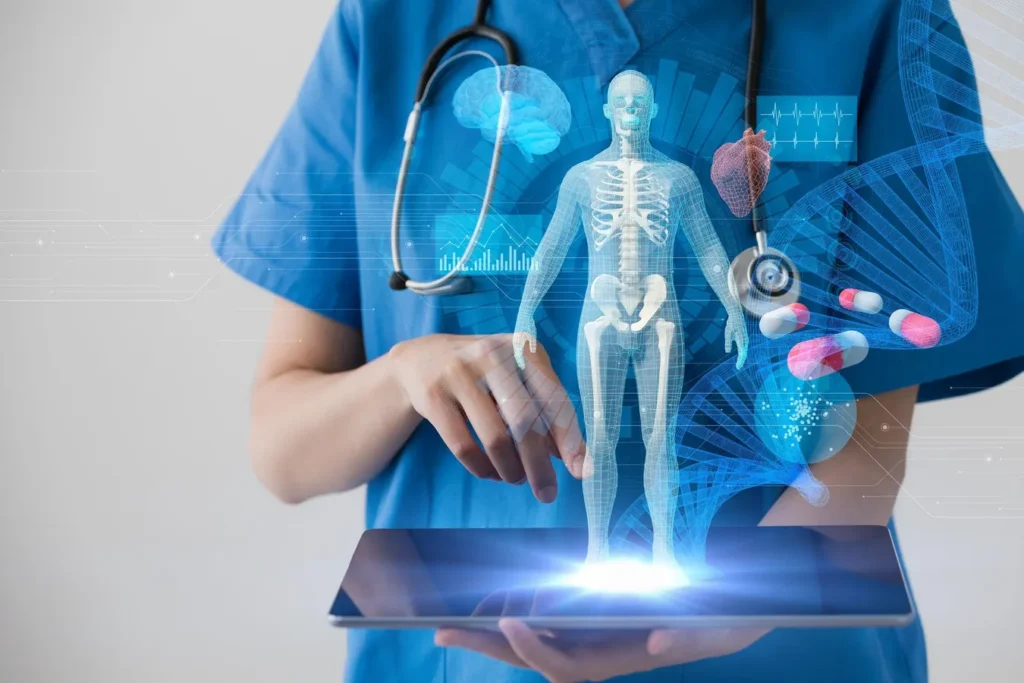
Machine Learning Innovations Transforming Healthcare & Medicine… Machine learning (ML), a specialized branch of artificial intelligence (AI), is rapidly transforming healthcare and medicine by enabling computers to learn from data, recognize patterns, and make predictions with minimal human intervention. From diagnosing diseases earlier to accelerating drug discovery and personalizing patient treatments, machine learning is reshaping nearly every aspect of the healthcare ecosystem. As hospitals, research institutions, pharmaceutical companies, and healthcare providers continue to adopt data-driven technologies, machine learning is becoming an indispensable tool for improving patient outcomes, reducing costs, and increasing operational efficiency.
The healthcare industry generates enormous volumes of data every day through electronic health records (EHRs), medical imaging, wearable devices, laboratory tests, genomic sequencing, and clinical trials. Traditionally, analyzing such vast datasets was time-consuming and prone to human limitations. Machine learning algorithms can process millions of data points within seconds, uncover hidden relationships, and provide actionable insights that assist clinicians in making more accurate decisions.
According to industry estimates, the global AI in healthcare market is expected to experience substantial growth over the coming decade, driven largely by machine learning applications. Increasing investments from governments, technology companies, and healthcare organizations continue to accelerate innovation while improving access to advanced medical technologies worldwide.
Machine learning refers to algorithms that improve their performance by learning from data instead of relying solely on explicitly programmed instructions. In healthcare, these algorithms analyze historical and real-time information to identify trends, predict outcomes, classify diseases, recommend treatments, and automate repetitive clinical tasks.
Machine learning models generally fall into several categories:
These techniques enable healthcare professionals to make better-informed decisions while supporting preventive medicine, personalized care, and improved clinical workflows.
Healthcare has evolved significantly over the past few decades. Early computer systems primarily stored patient records and managed administrative functions. Advances in computing power, cloud infrastructure, medical imaging, and data availability paved the way for sophisticated machine learning models capable of solving increasingly complex medical problems.
Today, hospitals integrate machine learning into clinical decision support systems, diagnostic imaging platforms, robotic surgery, predictive analytics, remote patient monitoring, and pharmaceutical research. The increasing digitization of healthcare records has further accelerated the adoption of intelligent healthcare technologies.
One of the most impactful applications of machine learning is the early detection of diseases. Early diagnosis significantly improves treatment success rates while reducing healthcare costs.
Machine learning algorithms analyze multiple data sources, including:
These systems identify subtle abnormalities that may be difficult for humans to detect consistently, helping clinicians diagnose diseases earlier and with greater confidence.
Deep learning models trained on mammography images have demonstrated performance comparable to experienced radiologists in detecting breast cancer. By identifying tiny abnormalities that might otherwise be overlooked, machine learning assists physicians in reducing false negatives and improving diagnostic accuracy.
Hospitals using AI-assisted mammography systems have reported improvements in screening efficiency while reducing unnecessary follow-up procedures for patients.
Diabetic retinopathy is one of the leading causes of blindness worldwide. Machine learning systems can analyze retinal images and detect early signs of retinal damage, enabling timely intervention before irreversible vision loss occurs.
Automated screening programs are particularly valuable in underserved regions where access to ophthalmologists is limited.
Medical imaging is among the fastest-growing areas benefiting from machine learning innovations. Radiologists must interpret thousands of X-rays, CT scans, MRIs, ultrasounds, and PET scans daily. Machine learning enhances both speed and accuracy.
Applications include:
Rather than replacing radiologists, machine learning functions as an intelligent assistant that highlights suspicious findings, allowing specialists to focus on complex clinical decisions.
Traditional medicine often follows standardized treatment protocols. Machine learning enables personalized medicine by analyzing individual patient characteristics, including genetics, medical history, lifestyle, environmental factors, and treatment responses.
Personalized healthcare allows physicians to:
This individualized approach is especially valuable in oncology, where cancer treatments increasingly depend on specific genetic mutations rather than tumor location alone.
Developing a new drug traditionally requires years of laboratory research, clinical testing, regulatory review, and significant financial investment. Machine learning dramatically accelerates various stages of pharmaceutical development.
Algorithms assist researchers by:
Drug repurposing has become particularly valuable because approved medications already have established safety profiles, reducing both development costs and approval timelines.
During the COVID-19 pandemic, machine learning helped researchers analyze viral genomes, predict protein structures, identify potential therapeutic compounds, and accelerate vaccine development. Computational models significantly shortened research timelines by rapidly evaluating thousands of candidate molecules before laboratory testing.
Machine learning enables healthcare providers to predict adverse events before they occur, allowing proactive intervention rather than reactive treatment.
Predictive models help forecast:
Early warning systems continuously monitor patient data and alert healthcare teams when intervention may be necessary, improving survival rates and reducing hospital stays.
Wearable devices and connected medical sensors generate continuous streams of health data. Machine learning algorithms analyze these data to detect abnormal physiological patterns and notify healthcare providers.
Common monitoring applications include:
Remote monitoring supports chronic disease management while reducing unnecessary hospital visits and improving patient engagement.
Robotic-assisted surgical systems increasingly integrate machine learning to improve precision, planning, and intraoperative decision support.
Machine learning contributes by:
Although surgeons remain fully responsible for patient care, intelligent systems enhance consistency and support minimally invasive procedures.
Natural Language Processing (NLP), a specialized machine learning technology, extracts meaningful information from unstructured clinical documents.
Healthcare providers use NLP to analyze:
Automating documentation reduces administrative burden while improving data accessibility for clinical decision-making and research.
Machine learning extends beyond clinical care into healthcare administration.
Hospitals apply predictive analytics to optimize:
Operational efficiency enables healthcare systems to serve more patients while controlling costs and improving quality of care.
Advances in genome sequencing have generated massive biological datasets that require sophisticated analytical tools.
Machine learning helps researchers:
These innovations contribute to personalized medicine by tailoring treatments according to each patient’s unique genetic profile.
Sepsis is a life-threatening condition requiring immediate intervention. Machine learning models analyze vital signs, laboratory values, medication histories, and electronic health records to detect subtle warning signs hours before traditional diagnosis.
Hospitals implementing predictive sepsis algorithms have reported earlier interventions, improved survival rates, and reduced intensive care admissions.
Machine learning increasingly supports mental healthcare through early detection, monitoring, and personalized interventions.
Applications include:
While machine learning cannot replace mental health professionals, it provides valuable tools for identifying patients who may benefit from early clinical evaluation.
The growing adoption of machine learning provides numerous advantages for healthcare systems worldwide.
Together, these benefits contribute to safer, more efficient, and more patient-centered healthcare delivery.
Machine learning models depend on high-quality, representative data. Incomplete, inaccurate, or biased datasets can reduce model performance and potentially lead to incorrect clinical recommendations.
Healthcare organizations must protect sensitive patient information while complying with applicable privacy regulations. Strong cybersecurity practices, encryption, access controls, and secure data-sharing frameworks are essential.
If training data underrepresent certain populations, machine learning models may produce unequal performance across demographic groups. Developers and healthcare providers must continuously evaluate algorithms to promote fairness and equity.
Medical machine learning systems require rigorous validation before clinical deployment. Regulatory agencies evaluate safety, effectiveness, reliability, and ongoing performance to ensure patient protection.
Healthcare professionals must trust machine learning recommendations before integrating them into routine practice. Transparent models, explainable AI techniques, and comprehensive clinical validation help build confidence.
Machine learning continues to evolve rapidly alongside advances in computing power, biomedical research, and healthcare digitization.
Emerging trends include:
These innovations promise to make healthcare more predictive, preventive, personalized, and participatory.
Responsible implementation of machine learning requires careful attention to ethics. Healthcare decisions affect human lives, making transparency, accountability, fairness, and patient autonomy essential principles.
Healthcare organizations should prioritize:
Machine learning should augment—not replace—the expertise, judgment, and compassion of healthcare professionals.
Successful adoption of machine learning depends not only on technological innovation but also on workforce readiness. Physicians, nurses, pharmacists, researchers, and administrators increasingly require foundational knowledge of data science and AI-supported clinical tools.
Medical schools and healthcare institutions are incorporating digital health education into training programs, emphasizing interdisciplinary collaboration between clinicians, engineers, computer scientists, and data analysts. Continuous professional development ensures healthcare workers can effectively interpret algorithmic outputs while maintaining patient-centered care.
Machine learning is transforming healthcare and medicine at an unprecedented pace. Its ability to analyze enormous datasets, recognize complex patterns, and generate accurate predictions has revolutionized disease diagnosis, medical imaging, personalized treatment, drug discovery, hospital operations, genomics, remote monitoring, and preventive care. Rather than replacing healthcare professionals, machine learning serves as a powerful decision-support tool that enhances clinical expertise and improves patient outcomes.
Despite challenges related to data privacy, algorithmic bias, regulatory oversight, and ethical governance, continued advancements in machine learning promise a future in which healthcare becomes increasingly intelligent, efficient, and personalized. Organizations that invest in high-quality data, transparent AI systems, workforce education, and responsible innovation will be better positioned to deliver safer, more accessible, and more effective healthcare. As research progresses and technologies mature, machine learning will remain one of the most influential drivers of modern medicine, helping shape a healthier future for individuals and populations worldwide.