

The FIFA World Cup 2026 is expected to be the biggest tournament in football history, featuring an expanded format with 48 participating nations and more matches than any previous edition. Hosted jointly by the United States, Canada, and Mexico, the tournament represents a major milestone for international football. In this article, we’ll cover FIFA World Cup 2026 Prize Money Distribution Details as FIFA has announced a record-breaking financial package that will reward participating teams with the highest prize money ever distributed in a FIFA World Cup.
Prize money has become an increasingly important aspect of the World Cup because it supports national football associations, rewards sporting success, and helps finance long-term football development. While fans focus on the excitement on the pitch, the tournament also generates billions of dollars through broadcasting rights, sponsorships, licensing, hospitality, and ticket sales. A significant portion of this revenue is redistributed to participating nations, making the World Cup one of the most financially rewarding sporting events in the world.
Every four years, the FIFA World Cup captures the attention of billions of football fans across the globe. Beyond the sporting spectacle, the tournament has evolved into one of the largest commercial events worldwide. Television audiences reach billions of viewers, sponsorship agreements continue to grow in value, and host nations invest heavily in infrastructure to support the competition.
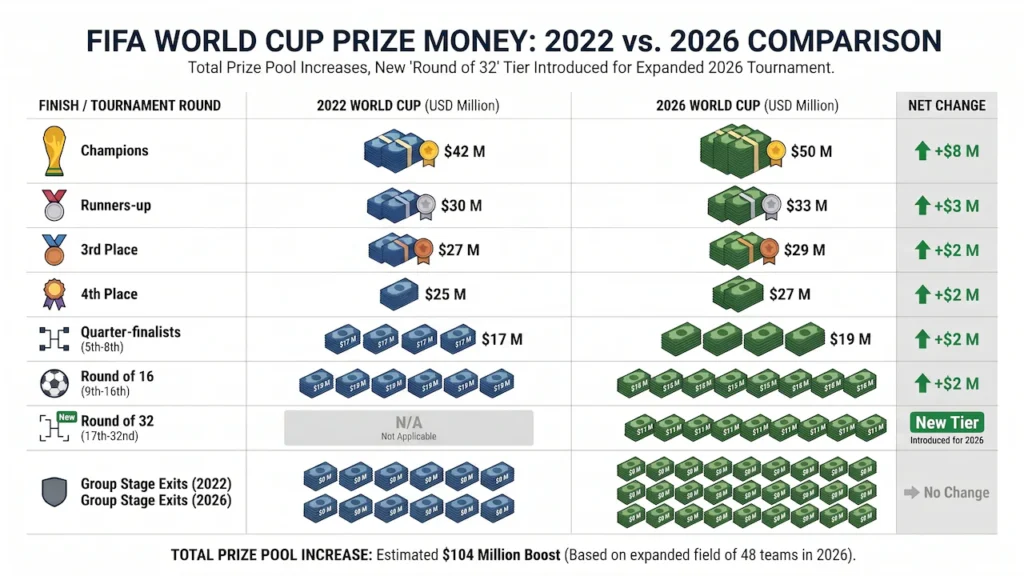
For the 2026 edition, FIFA has approved a record financial contribution totaling USD 727 million. According to FIFA, USD 655 million will be distributed as tournament prize money, while additional funding will be provided to each participating football association to assist with tournament preparation. The expanded prize fund reflects the increase from 32 to 48 competing nations and FIFA’s commitment to supporting football development across its member associations.
The 2026 FIFA World Cup introduces several historic changes. It will be the first tournament featuring 48 national teams instead of 32, increasing participation opportunities for countries from every confederation.
The expansion allows more nations to compete while increasing the overall commercial value of the tournament through additional matches, television broadcasts, sponsorship opportunities, and ticket sales.
FIFA has approved a total financial contribution of approximately USD 727 million for the 2026 FIFA World Cup.
This means every nation that qualifies for the tournament is guaranteed financial support even before playing its first match. The guaranteed funding helps associations cover travel, accommodation, training camps, coaching staff, logistics, and operational expenses.
FIFA has announced the official prize distribution for participating teams based on their final tournament performance.
These amounts are separate from the preparation funding provided before the tournament, meaning every qualified nation receives additional financial assistance regardless of its results.
The financial rewards for the 2026 tournament represent a significant increase compared with the 2022 FIFA World Cup. The overall financial contribution has grown by roughly 50%, reflecting higher commercial revenues and the expanded tournament format.
The increase demonstrates FIFA’s intention to distribute tournament revenue more broadly while encouraging football development across all member associations.
Several factors contributed to FIFA’s decision to increase prize money for the 2026 tournament.
The expanded tournament generates additional commercial opportunities, enabling FIFA to return a larger share of revenue to participating football associations.
World Cup prize money does not go directly to players alone. Instead, it is paid to each country’s football association, which then allocates funds according to its own policies and agreements.
Many football associations invest tournament earnings in grassroots football, youth academies, coaching education, women’s football, referee development, infrastructure improvements, and national team programs. Successful World Cup campaigns often strengthen long-term football development within participating countries.
Although FIFA distributes prize money to football associations, many national federations establish bonus agreements with players before the tournament begins. These agreements often reward players for qualifying, advancing through knockout rounds, and winning the championship.
The exact amounts vary significantly between countries and depend on agreements negotiated by each football association.
Participation in the FIFA World Cup generates financial benefits beyond direct prize money. Successful teams often experience increased sponsorship opportunities, merchandise sales, tourism promotion, and greater commercial interest in domestic football leagues.
Host countries also benefit from increased international tourism, infrastructure investment, hospitality spending, and global media exposure.
Following France’s World Cup victory in 2018, the French Football Federation received significant financial rewards that supported continued investment in player development and football infrastructure. The tournament also strengthened commercial partnerships and increased public interest in football throughout the country.
Morocco became the first African nation to reach a FIFA World Cup semi-final in 2022. Beyond the historic sporting achievement, the team’s success generated increased sponsorship opportunities, greater international recognition, and additional investment in football development programs.
For emerging football nations, qualifying for the World Cup can transform their football programs. Prize money may exceed annual federation budgets, allowing investments in facilities, coaching, youth development, and national competitions that might otherwise be financially challenging.
The guaranteed preparation funding also helps smaller federations compete more effectively on the global stage.
Although FIFA provides substantial financial support, football associations face important decisions regarding how funds should be allocated. Balancing player bonuses with long-term development projects requires careful financial planning and transparent governance.
As football continues to grow commercially, future FIFA World Cups may feature even larger financial distributions. Expanding media rights, digital broadcasting, sponsorship growth, and increasing global fan engagement are expected to generate additional revenue in future tournaments.
FIFA is also expected to continue investing in football development through financial assistance programs that benefit member associations worldwide.
The FIFA World Cup 2026 represents a new era for international football. With 48 participating teams, an expanded tournament format, and a record financial contribution of USD 727 million, it sets a new benchmark for both sporting competition and economic impact. The increased prize money rewards on-field success while providing valuable financial support to football associations around the world.
Beyond rewarding the tournament’s champions, the expanded prize structure helps strengthen football development at every level by supporting infrastructure, coaching, youth programs, and grassroots initiatives. As global interest in football continues to grow, the 2026 FIFA World Cup is expected to leave a lasting legacy not only through memorable matches but also through its significant investment in the future of the sport.