

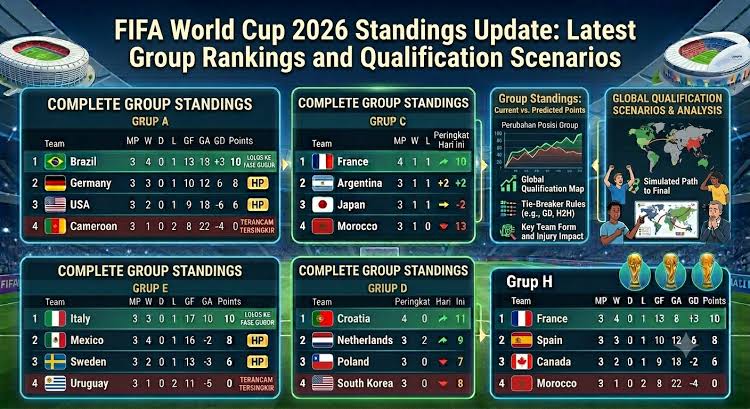
The FIFA World Cup 2026 is shaping up to be the most competitive edition in the tournament’s history. With the expansion from 32 to 48 teams, the competition will feature a broader mix of traditional football powerhouses, emerging national teams, and rising football nations. This expansion significantly changes how FIFA World Cup 2026 Team Rankings and Performance Analysis are interpreted, as rankings, performance expectations, and tactical analyses take on even greater importance.
Unlike previous tournaments, where a smaller group of elite teams consistently dominated, the 2026 World Cup introduces more variability, unpredictability, and opportunities for underdog breakthroughs. As a result, analysts, coaches, and fans are closely examining team performance trends, FIFA rankings, recent tournament results, and tactical evolution to predict potential outcomes.
The 2026 FIFA World Cup, hosted by the United States, Canada, and Mexico, marks a turning point in international football. The increase to 48 teams not only expands representation but also reshapes qualification dynamics and competitive balance.
According to FIFA’s global ranking methodology, team strength is evaluated based on match results, opponent strength, competition importance, and regional performance trends. However, rankings alone do not fully capture current form, tactical depth, or squad evolution—factors that are critical in tournament settings.
This analysis explores projected team rankings, performance indicators, tactical strengths, and potential breakout teams heading into the 2026 tournament.
Several national teams consistently rank among the world’s best due to their squad depth, tactical stability, and international experience. These teams are considered strong favorites for deep runs in the tournament.
These teams typically maintain high FIFA rankings due to consistent performance in international competitions and strong player development systems.
Each elite team brings a unique tactical identity that influences its World Cup performance. Understanding these styles is key to predicting outcomes in high-pressure matches.
Argentina combines disciplined defensive organization with creative attacking play. Their success in recent international tournaments has been driven by tactical cohesion, experienced leadership, and efficient finishing in key moments.
France remains one of the most complete teams in world football. With elite players in every position, their strength lies in squad depth and tactical flexibility. They can switch between defensive solidity and high-tempo attacking football seamlessly.
Brazil continues to rely on technical brilliance and attacking creativity. Their ability to produce unpredictable attacking movements makes them dangerous against any opponent, although defensive consistency remains a key area of focus.
England benefits from one of the strongest domestic leagues in the world. Their tactical approach emphasizes structured buildup, high pressing, and versatile attacking options.
Germany and Spain both rely heavily on tactical systems, Germany focuses on efficiency and transitional play, while Spain emphasizes possession control and midfield dominance.
Beyond the traditional giants, several mid-tier teams have shown significant improvement and could deliver strong performances in 2026.
These teams may not always rank in the top tier, but they possess the tactical structure and individual talent capable of producing upset victories.
The expanded 48-team format opens the door for emerging football nations to make a stronger impact. Several teams outside traditional power rankings are improving rapidly.
Examples include teams such as Senegal, Japan, South Korea, and Morocco, all of which have demonstrated strong performances in recent global tournaments.
Morocco’s historic run in the 2022 FIFA World Cup demonstrated how tactical discipline and defensive organization can challenge elite teams. Reaching the semi-finals, Morocco became the first African nation to achieve this milestone.
Their success was built on:
This performance reshaped expectations for African teams heading into 2026.
The United States has significantly improved its football infrastructure, youth development systems, and international competitiveness. Hosting the 2026 World Cup provides additional motivation and exposure.
Key improvements include:
These developments position the USA as a potential knockout-stage contender.
Modern football analysis relies heavily on data-driven metrics to evaluate team strength beyond traditional rankings.
Teams that consistently perform well across these metrics are more likely to succeed in tournament environments where margins are extremely narrow.
Modern international football continues to evolve, with several tactical trends expected to influence the 2026 tournament.
The expansion to 48 teams significantly changes tournament dynamics. More matches and additional knockout rounds increase unpredictability and reduce the dominance of traditional favorites in early stages.
Benefits of expansion include:
However, it also introduces challenges such as scheduling complexity and potential quality gaps in early matches.
Based on current form, squad depth, and tactical stability, analysts expect strong performances from traditional powerhouses such as France, Brazil, Argentina, and England. However, the gap between elite and mid-tier teams is narrowing.
This means that teams like Portugal, the Netherlands, and the United States may play a more significant role in shaping knockout-stage outcomes.
The FIFA World Cup 2026 represents a major evolution in international football. With an expanded format, improved global competitiveness, and rising tactical sophistication, the tournament is expected to be one of the most unpredictable in history.
While traditional football giants remain strong contenders, the gap between elite and emerging teams continues to shrink. Tactical innovation, data-driven analysis, and player development systems will play a decisive role in determining success.
Ultimately, the 2026 World Cup will not only crown a champion but also highlight the global growth of football as a truly international sport shaped by diversity, strategy, and evolving performance standards.