

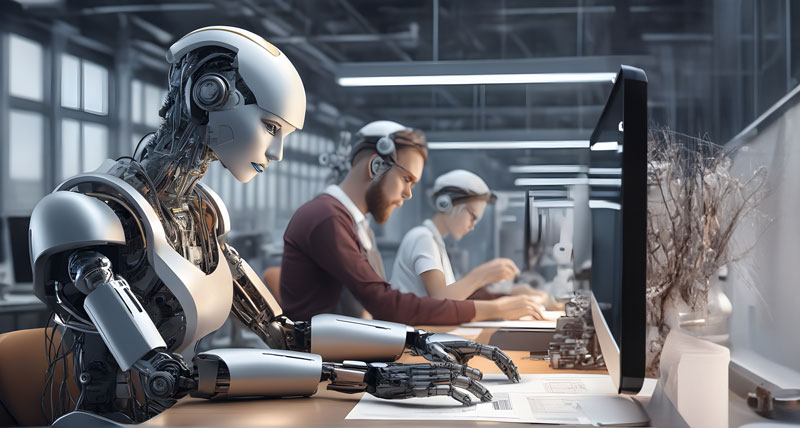
Artificial intelligence (AI) is rapidly transforming the modern workplace, reshaping industries, redefining job roles, and altering how businesses operate on a global scale. The future of Artificial Intelligence in the workplace is being shaped by these advances, leading to profound changes across various sectors. What was once considered futuristic technology is now deeply integrated into everyday professional environments. From intelligent automation and predictive analytics to generative AI assistants and autonomous systems, AI is becoming a central driver of productivity, innovation, and competitive advantage.
The future of artificial intelligence in the workplace is one of the most significant economic and social developments of the 21st century. Businesses across sectors including healthcare, finance, manufacturing, retail, logistics, education, and customer service are investing billions of dollars into AI technologies to streamline operations, reduce costs, and improve decision-making.
At the same time, AI’s rapid advancement has sparked debates about job displacement, ethical concerns, workforce adaptation, and the future relationship between humans and machines. While some fear widespread automation may eliminate millions of jobs, others argue that AI will create entirely new categories of employment while enhancing human creativity and productivity.
The reality will likely involve a combination of disruption, transformation, and opportunity. Understanding how AI is shaping the future workplace is essential for businesses, employees, policymakers, and educational institutions preparing for the next era of work.
This article explores the future of artificial intelligence in the workplace, including emerging trends, benefits, risks, industry case studies, workforce implications, ethical challenges, and the evolving relationship between human workers and intelligent machines.
Artificial intelligence has evolved dramatically over the past several decades.
Early workplace automation focused primarily on repetitive mechanical tasks in manufacturing environments. Over time, advances in computing power, machine learning, big data, and cloud infrastructure enabled AI systems to perform increasingly complex cognitive tasks.
Today’s workplace AI includes:
Unlike traditional software, modern AI systems can learn, adapt, analyze patterns, and improve over time.
Several factors are driving rapid AI adoption across industries.
Organizations now generate enormous amounts of data every day.
AI systems can process and analyze this information far more efficiently than humans.
Cloud computing and specialized AI chips have dramatically increased computational capabilities.
This allows businesses to deploy AI systems at scale.
Companies increasingly view AI as essential for maintaining competitiveness.
Businesses using AI often gain advantages in:
The rise of generative AI tools capable of producing text, images, code, and analysis has accelerated workplace AI adoption even further.
Employees across industries are now using AI assistants for daily tasks.
One of the most immediate impacts of AI is productivity enhancement.
AI excels at automating repetitive and rule-based tasks.
Examples include:
This allows employees to focus on higher-value activities.
Modern AI assistants can:
These tools can significantly reduce administrative workload.
AI can analyze vast datasets to provide insights and recommendations.
This improves:
Contrary to fears that AI will completely replace workers, many experts believe the future workplace will emphasize collaboration between humans and AI systems.
Rather than replacing employees, AI often enhances human capabilities.
Examples include:
In these cases, humans remain central decision-makers while AI improves efficiency and insight.
As AI handles more routine tasks, uniquely human abilities may become even more valuable.
These include:
AI is revolutionizing healthcare through:
AI systems can detect patterns in medical data that may be difficult for humans to identify quickly.
The financial industry uses AI for:
AI enables faster analysis of market data and financial behavior.
Smart factories increasingly rely on AI-powered automation.
Applications include:
Retailers use AI to improve:
AI is transforming education through:
Customer service represents one of the most visible examples of workplace AI transformation.
AI-powered chatbots and virtual assistants now handle millions of customer interactions daily.
Benefits include:
However, companies have learned that fully automated customer service often creates frustration when empathy or complex problem-solving is required.
As a result, many organizations now use hybrid models combining AI efficiency with human support agents.
The question of job displacement remains one of the most debated aspects of AI adoption.
Routine and repetitive jobs are generally more vulnerable to automation.
Examples include:
At the same time, AI is expected to create new roles.
Emerging career opportunities include:
Previous technological revolutions also disrupted labor markets.
The Industrial Revolution automated many manual tasks but ultimately created entirely new industries and employment opportunities.
Many economists believe AI may follow a similar pattern, though the transition could be challenging.
As AI transforms workplaces, workers will need new skills to remain competitive.
Demand for technical expertise will continue growing.
Important areas include:
Human strengths will remain essential.
Employers increasingly value:
Continuous education may become necessary throughout professional careers.
Workers will likely need ongoing reskilling as technologies evolve.
The rise of remote and hybrid work has accelerated AI adoption.
AI tools now support distributed teams through:
AI also enables better collaboration across languages and time zones.
AI systems can reflect biases present in training data.
This creates risks in areas such as:
Organizations must carefully monitor AI systems to ensure fairness.
Some companies use AI-powered monitoring systems to track worker productivity.
Critics argue excessive surveillance can:
Employees and customers increasingly demand transparency regarding AI decision-making.
“Black box” AI systems can create accountability concerns.
Generative AI has sparked debate about creativity and intellectual work.
Writers, marketers, designers, and musicians increasingly use AI for:
Many professionals view AI as a collaborative assistant rather than a replacement.
Some critics worry overreliance on AI-generated content could reduce originality and diversity of thought.
Maintaining human creativity and unique perspectives will remain important.
Many companies now use AI-driven recruitment tools.
These systems can:
Benefits include faster hiring processes and reduced administrative burden.
However, biased algorithms have also generated controversy, highlighting the importance of ethical AI governance.
Governments worldwide are beginning to develop AI regulations.
Key policy concerns include:
Balancing innovation with responsible oversight will become increasingly important.
AI may also reshape economic inequality.
Highly skilled workers may benefit disproportionately from AI adoption.
Workers lacking access to education and reskilling opportunities could face greater displacement risks.
Countries and communities with limited technological infrastructure may struggle to compete in AI-driven economies.
This could widen existing economic disparities.
Future workplaces may look dramatically different from today’s offices.
AI could become integrated into nearly every business process.
Employees may work alongside:
AI systems may adapt workflows to individual employee preferences and productivity patterns.
This could improve:
Organizations preparing for AI transformation should focus on:
Successful AI adoption requires both technological capability and organizational adaptability.
The future of artificial intelligence in the workplace is not simply a story of machines replacing humans. Instead, it represents a profound transformation in how work is organized, how decisions are made, and how humans interact with technology.
AI is already improving productivity, automating repetitive tasks, enhancing decision-making, and enabling entirely new forms of creativity and collaboration. Industries across the global economy are experiencing rapid change as intelligent systems become embedded into daily operations.
At the same time, AI introduces major challenges involving job displacement, ethical governance, privacy, workforce inequality, and the need for continuous education. Successfully navigating these challenges will require cooperation among businesses, governments, educational institutions, and workers themselves.
The most successful workplaces of the future will likely combine the strengths of AI with uniquely human capabilities such as empathy, creativity, ethical reasoning, leadership, and innovation.
Rather than eliminating human work entirely, artificial intelligence is poised to redefine it. Employees who adapt, learn new skills, and embrace collaboration with intelligent technologies may find unprecedented opportunities in the evolving AI-powered economy.
As the next decade unfolds, the relationship between humans and AI will become one of the defining forces shaping the future of work, business, and society itself.