

Quantum computing has evolved from a theoretical idea into one of the most exciting technologies shaping the future of business. When considering the Future of Quantum Computing for Enterprise Applications, it’s clear that the field holds unique potential for organisations seeking solutions to complex challenges. While classical computers continue to power today’s digital world, they struggle with certain highly complex problems such as optimization, molecular modeling, cryptography, and advanced machine learning. Quantum computers use the principles of quantum mechanics to process information in fundamentally different ways, allowing them to tackle problems that would take traditional computers an impractical amount of time to solve.
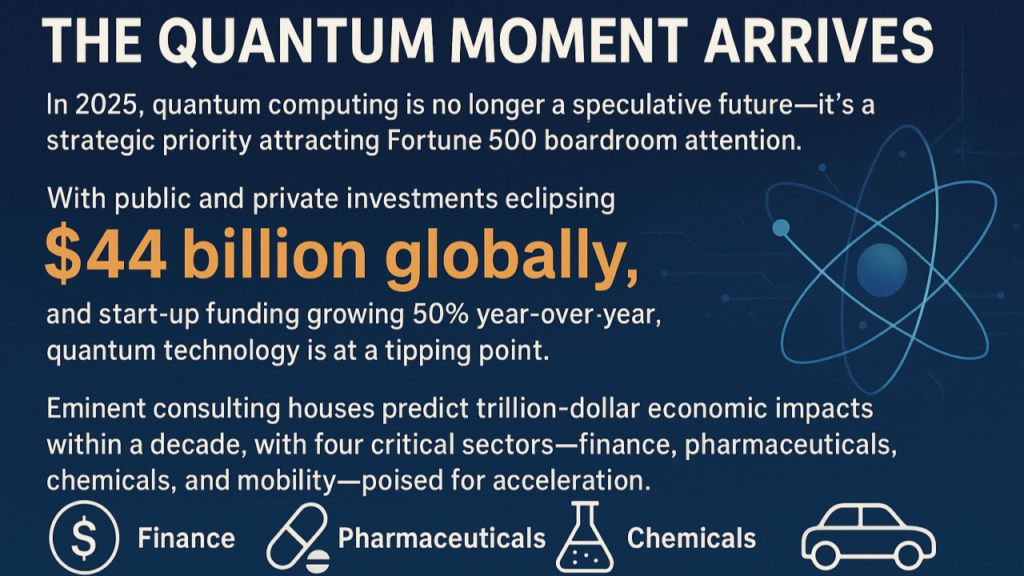
For businesses, quantum computing represents far more than a scientific breakthrough. Companies across industries—including finance, healthcare, manufacturing, logistics, telecommunications, energy, and pharmaceuticals—are investing heavily in quantum technology to gain a competitive edge. Governments and leading technology companies have also committed billions of dollars to quantum research, driving rapid innovation and bringing commercial applications closer to reality.
Although fully fault-tolerant quantum computers capable of solving large-scale business problems are still under development, organizations are already preparing for the quantum era. Early experimentation helps companies understand quantum algorithms, build internal expertise, and identify business opportunities that could deliver significant value in the years ahead.
Quantum computing works very differently from classical computing. Traditional computers use bits that can represent either a 0 or a 1. Quantum computers use quantum bits, or qubits, which can exist in multiple states at the same time through a property called superposition.
Another key concept is entanglement, where two or more qubits become linked so that the state of one directly relates to another. Combined with quantum interference, these properties allow quantum computers to solve specific computational problems much more efficiently than classical machines.
Modern businesses generate enormous amounts of data every day. As organizations become increasingly data-driven, solving complex optimization problems becomes more challenging. Many of these problems involve billions—or even trillions—of possible combinations, making them extremely difficult for conventional computers to solve efficiently.
Quantum computing has the potential to reduce processing times from years to hours or even minutes for specific workloads. This capability could unlock new levels of efficiency, innovation, and strategic decision-making.
Financial institutions are among the earliest adopters of quantum computing research. Banks, insurance companies, and investment firms deal with highly complex calculations involving portfolio optimization, risk management, derivatives pricing, fraud detection, and market forecasting.
Quantum algorithms could evaluate thousands of financial variables simultaneously, enabling more accurate investment decisions and improved risk analysis.
Potential applications include:
For example, a global investment firm managing thousands of financial assets could use quantum optimization to maximize returns while minimizing investment risk under multiple market conditions.
Healthcare is expected to be one of the biggest beneficiaries of quantum computing. Developing new medicines requires simulating molecular interactions, an extremely complex task that quickly exceeds the capabilities of classical computers.
Because molecules naturally follow quantum mechanics, quantum computers are particularly well suited for molecular simulation.
Potential applications include:
Reducing drug development timelines from years to months could lower research costs while bringing life-saving treatments to patients much faster.
Global supply chains involve millions of interconnected variables, including transportation routes, warehouse locations, inventory levels, weather conditions, fuel prices, labor availability, and customer demand.
Quantum optimization could improve:
For instance, a logistics company operating thousands of delivery vehicles could reduce fuel consumption, transportation costs, and delivery times using quantum-powered route optimization.
Modern manufacturing relies on automation, predictive maintenance, digital twins, and advanced analytics. Quantum computing can enhance these technologies by solving highly complex optimization problems more efficiently.
Future applications include:
Energy companies manage highly interconnected systems that include electricity generation, transmission, storage, and distribution.
Quantum computing could help optimize:
Telecommunications companies process billions of network requests every day while striving to maintain fast and reliable service.
Quantum computing could improve:
Artificial intelligence and quantum computing complement one another. AI excels at recognizing patterns and making predictions, while quantum computing can dramatically improve optimization and mathematical calculations.
Quantum machine learning may allow businesses to train AI models faster, process larger datasets, and develop more accurate predictive systems.
Quantum computing creates both opportunities and challenges for cybersecurity. Powerful quantum algorithms may eventually be capable of breaking many public-key encryption systems that protect today’s digital communications.
As a result, organizations should begin preparing for post-quantum cryptography by identifying vulnerable systems and planning a gradual transition to quantum-resistant encryption standards.
At the same time, quantum technologies may also improve cybersecurity through innovations such as quantum key distribution, stronger random number generation, and more secure communication protocols.
Today, many leading technology companies provide cloud-based quantum computing services, allowing organizations to explore quantum applications without purchasing expensive hardware.
Current enterprise initiatives focus on:
Although practical quantum advantage for large commercial applications is still emerging, companies recognize that early preparation will provide long-term benefits.
Qubits are extremely sensitive to environmental disturbances. Even tiny temperature changes or electromagnetic interference can introduce errors.
Reliable quantum computing requires advanced error-correction techniques, often using many physical qubits to create one stable logical qubit.
Building large-scale quantum computers with thousands or millions of stable qubits remains one of the industry’s greatest engineering challenges.
There is currently a shortage of professionals with expertise in quantum computing, physics, mathematics, and quantum software engineering.
Quantum computers require specialized cooling systems and sophisticated hardware, making them expensive to build and operate.
Rather than replacing classical computers, quantum computers will most likely work alongside them. In hybrid computing systems, classical computers manage everyday tasks while quantum processors handle highly specialized computational problems.
This approach is expected to become the standard enterprise model during the next decade because it offers the best balance between performance, cost, and practicality.
A global financial institution explored quantum optimization for managing investment portfolios containing thousands of assets. Researchers found that quantum-inspired optimization techniques showed promising improvements over traditional methods in certain scenarios.
A pharmaceutical company partnered with quantum researchers to simulate complex protein interactions. Early studies suggest that future quantum computers could significantly shorten drug discovery and development cycles.
An international logistics company tested quantum optimization for delivery route planning. Simulations indicated potential reductions in travel distance, fuel usage, and operating costs compared with conventional optimization techniques.
Industry experts believe quantum computing could generate trillions of dollars in economic value over the coming decades by transforming industries and enabling entirely new technological breakthroughs.
Expected business benefits include:
Businesses should begin preparing now rather than waiting for quantum technology to fully mature. Organizations that invest early will be better positioned to capitalize on future breakthroughs.
The quantum computing ecosystem continues to evolve rapidly. Several developments are expected to shape enterprise adoption over the next decade:
Quantum computing has the potential to become one of the most transformative technologies of the 21st century. Although large-scale commercial quantum computers are still being developed, businesses are already investing in research, partnerships, and pilot projects to prepare for the future.
Industries such as finance, healthcare, logistics, manufacturing, telecommunications, and energy could benefit from dramatically faster problem-solving capabilities, enabling new discoveries, greater operational efficiency, and innovative business models.
While challenges such as hardware reliability, scalability, cost, and cybersecurity remain, progress continues at an impressive pace. Organizations that begin building quantum expertise today will be well positioned to take advantage of future breakthroughs and gain a lasting competitive advantage in the quantum era.