

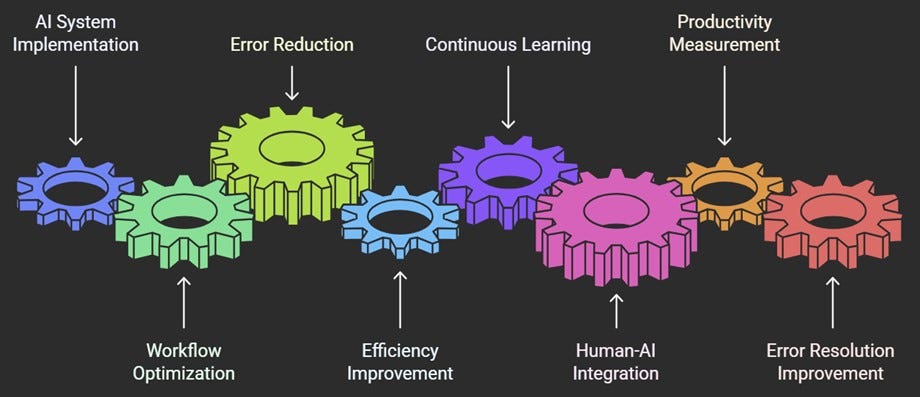
Artificial intelligence has evolved rapidly over the past decade, moving beyond simple automation and predictive analytics to systems capable of planning, reasoning, and completing complex tasks with minimal human intervention. One of the most exciting developments in this evolution is agentic AI. In fact, How Agentic AI Is Transforming Workplace Productivity is a topic that is capturing attention across industries. Unlike traditional AI tools that respond only to direct prompts, agentic AI systems can independently pursue goals, make decisions within defined boundaries, coordinate multiple tasks, and adapt their actions based on changing conditions.
Businesses across industries are beginning to integrate agentic AI into daily operations to improve efficiency, reduce repetitive work, enhance decision-making, and increase employee productivity. Rather than replacing human workers, these intelligent agents act as digital collaborators that assist teams by handling time-consuming tasks, analyzing information, and executing multi-step workflows.
This article explores how agentic AI is transforming workplace productivity, examines its real-world applications, discusses its benefits and challenges, and explains why many experts consider it the next major milestone in enterprise automation.
Agentic AI refers to artificial intelligence systems that can pursue objectives with a high degree of autonomy. Instead of responding to one instruction at a time, these systems can break large goals into smaller tasks, prioritize activities, gather information, use external tools, and modify their plans when circumstances change.
For example, instead of asking an AI assistant to write a single email, a user might instruct an agentic AI system to organize an entire product launch. The AI could research competitors, prepare marketing content, schedule meetings, analyze customer feedback, generate reports, and notify team members when milestones are completed.
This ability to execute connected workflows makes agentic AI significantly more powerful than conventional chatbots or rule-based automation software.
Traditional AI typically performs isolated tasks after receiving explicit instructions. Agentic AI, on the other hand, is designed to manage longer processes with limited supervision.
These capabilities enable organizations to automate not only repetitive work but also complex business workflows that previously required significant human coordination.
Improving productivity is a priority for organizations of every size. Employees often spend a significant portion of their workday on administrative tasks, repetitive data entry, meeting coordination, report preparation, and information searches. These activities consume valuable time that could otherwise be spent on strategic planning, innovation, or customer engagement.
Agentic AI helps reduce these inefficiencies by automating routine work while allowing employees to focus on higher-value responsibilities.
Agentic AI can coordinate projects by creating timelines, assigning tasks, monitoring deadlines, tracking progress, and identifying potential risks before they affect delivery schedules.
Modern AI agents can resolve customer inquiries, process refunds, schedule appointments, escalate complex issues, and maintain personalized conversations across multiple communication channels.
Instead of handling only simple questions, agentic systems can complete entire service workflows while keeping human representatives informed.
Software engineers increasingly use AI agents to generate code, review pull requests, identify bugs, write documentation, execute tests, and monitor application performance.
Rather than replacing developers, these systems reduce repetitive coding tasks and accelerate software delivery.
HR departments benefit from agentic AI through automated resume screening, interview scheduling, employee onboarding, policy management, and workforce analytics.
Finance teams use AI agents to process invoices, reconcile accounts, prepare financial reports, monitor expenses, and identify unusual transactions that may require investigation.
This reduces manual effort while improving reporting accuracy.
A mid-sized e-commerce company deployed an agentic AI platform to support its marketing department. Instead of manually managing campaigns, the AI monitored customer behavior, generated personalized email campaigns, scheduled social media posts, analyzed advertising performance, and recommended budget adjustments.
Marketing specialists focused on strategy and creative direction while the AI handled routine execution. The company experienced faster campaign deployment, improved customer engagement, and more efficient resource allocation.
An enterprise IT department implemented an AI agent capable of resolving common technical issues without human intervention. Employees submitted support requests through a conversational interface, and the AI diagnosed problems, reset passwords, installed approved software, created support tickets, and escalated unresolved cases.
The result was shorter response times, reduced support workloads, and improved employee satisfaction.
The adoption of agentic AI offers numerous advantages for organizations seeking to improve operational efficiency.
By automating repetitive activities, employees gain more time for innovation, collaboration, and strategic initiatives.
Despite its significant potential, agentic AI introduces several technical and organizational challenges.
Organizations should establish governance frameworks that define clear responsibilities, approval processes, and monitoring procedures for AI-driven decisions.
Agentic AI is designed to augment rather than replace human expertise. Employees continue to provide creativity, ethical judgment, emotional intelligence, and strategic thinking—qualities that remain difficult to automate.
The most successful workplaces combine AI efficiency with human insight. While AI manages repetitive workflows, people focus on leadership, relationship building, innovation, and complex decision-making.
Organizations should approach agentic AI implementation through a structured and responsible strategy.
Following these practices helps organizations maximize benefits while reducing operational risks.
Agentic AI is expected to become a standard component of digital workplaces over the next several years. Future systems will coordinate increasingly sophisticated workflows, collaborate across departments, and integrate seamlessly with enterprise software platforms.
Advances in reasoning, memory, multimodal capabilities, and workflow orchestration will allow AI agents to manage larger projects while adapting to changing business priorities.
Organizations that invest early in AI literacy, governance, and infrastructure will be better positioned to benefit from these innovations.
Agentic AI represents a significant step forward in the evolution of workplace automation. Unlike traditional AI systems that perform isolated tasks, agentic AI can plan, reason, execute multi-step workflows, and adapt its actions to achieve defined objectives. These capabilities enable organizations to streamline operations, improve productivity, reduce repetitive work, and support better decision-making across departments.
Although challenges such as data security, governance, workforce training, and ethical oversight remain important, the potential benefits are substantial. Businesses that combine agentic AI with skilled employees and responsible implementation strategies can unlock new levels of efficiency, innovation, and competitiveness. As the technology continues to mature, agentic AI is likely to become an essential digital collaborator that empowers people to focus on creative, strategic, and high-value work while intelligent systems manage routine operational tasks.