

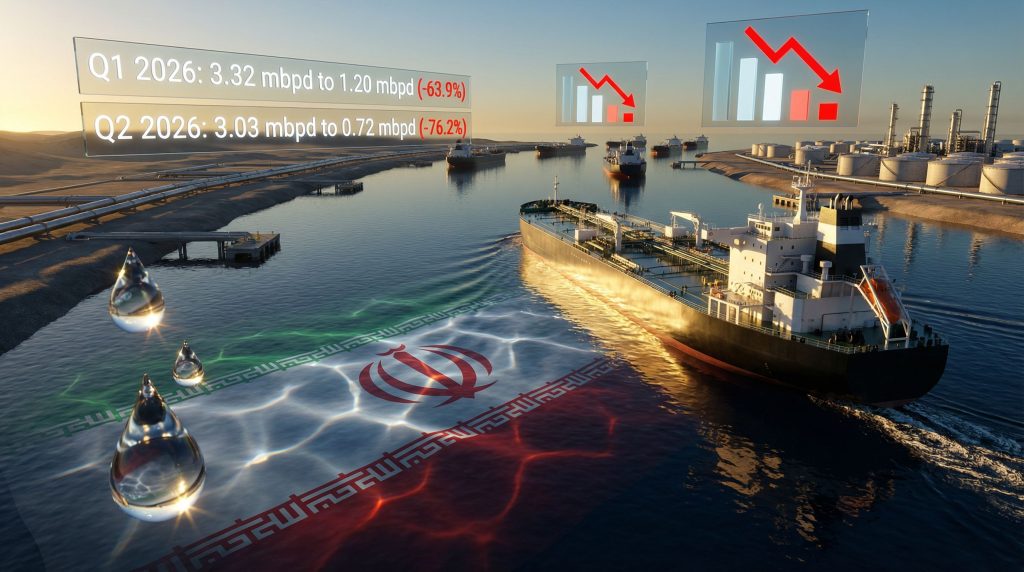
As of April 2026, the global energy scene is a high-stakes arena where geography and military strategy meet. Global oil supply disruption due to war conflicts has become a significant concern in this environment. Oil is more than just a product; it is the lifeblood of our modern world. When war breaks out in oil-rich regions or near shipping routes, the impact is felt instantly—at gas stations in Los Angeles, factories in Germany, and homes in Tokyo. Oil often pays for the machinery of war, while war threatens the very oil we rely on.
In this decade, we have moved from small fights to major conflicts that threaten the entire global trade system. From the long battles in Eastern Europe to the naval tensions in the Middle East, the fragility of our “just-in-time” energy supply is now clear to everyone. This article looks at how war stops the flow of oil and what countries are doing to stay safe in an unstable world.
The main reason war disrupts oil is that most reserves are clumped together in a few places. Nearly half of the world’s oil is in the Middle East—a region that has faced political unrest for a century. When conflict hits, the supply usually stops in three ways: physical damage, economic sanctions, or blocked sea paths.
Physical damage is the most direct hit. During the Gulf War in the early 90s, retreating forces set fire to over 600 oil wells, causing a massive loss of oil and a disaster for the environment. In 2026, we see “surgical” strikes. Using drones and precision missiles, forces can hit specific pumping stations or refineries. These targeted attacks cause huge economic pain but take a very long time to fix because the equipment is so specialized.
Even after oil is pumped out of the ground, it has to get to the buyer. About 60% of the world’s oil travels by sea. This creates a weakness called “chokepoints”—narrow channels that are easy to block during a war. The most important is the Strait of Hormuz, where 21 million barrels of oil pass through every single day.
In 2025 and 2026, the “Shadow War” in the Red Sea has shown how drones can threaten massive tankers. When a waterway becomes a war zone, insurance costs for ships skyrocket. Sometimes, insurers won’t cover ships at all, which effectively closes the route. This forces tankers to take longer, more expensive paths around Africa. This adds weeks to delivery times and drives up prices for everyone.
In modern war, the pen can be as powerful as the sword. Sanctions have become a top tool for world powers to punish aggression without fighting a direct war. By stopping a country from selling its oil, the world can “drain the bank” of the aggressor. But this is a double-edged sword.
Sanctions on Russia after 2022 forced a massive shift in how oil flows. While the West tried to limit Russia’s profits, Moscow began selling to China and India instead. This created a “two-tier” market. It didn’t stop the oil from moving, but it made it much less efficient. Oil that once moved through pipes now moves on “shadow fleet” tankers—older, poorly insured ships that ignore rules. This increases the risk of oil spills and accidents.
To understand how bad things can get, we look back at the 1973 Oil Embargo. In response to Western support for Israel during a war, several Arab nations stopped selling oil to the West. The price of oil quadrupled almost overnight. It was the first time oil was used clearly as a “weapon of war” on a global scale.
The 1973 crisis changed how nations look at energy. It led to the creation of the International Energy Agency (IEA) and emergency oil stockpiles. In 2026, we see similarities, but the world is more complex. While the U.S. now produces its own shale oil as a “buffer,” it still can’t escape price hikes. Because oil prices are set on a global market, a war halfway across the world still hits your wallet at home.
The way wars are fought has changed. In 2019, a drone attack in Saudi Arabia knocked out 5% of the world’s oil supply in a single day. It showed that even a powerful oil nation could be stopped by cheap, smart technology.
By 2026, sabotage is a standard part of war. It’s no longer just about taking over an oil field; it’s about making it useless. Cyber-attacks are the new frontier. A hacker can shut down a pipeline with malware more easily than a soldier can with a bomb. This “invisible war” means that energy safety is now about cybersecurity as much as it is about tanks and missiles.
When war hits the oil supply, the news often focuses on big economies. But the real damage is often in the “Global South.” Developing countries spend a huge part of their money on energy imports. When prices spike, these nations have to choose between buying fuel or buying food.
In 2026, many countries in Africa and Asia have faced riots due to high fuel prices caused by distant wars. High oil prices also make fertilizer more expensive, which leads to food shortages. This creates a chain reaction. A war in one part of the world can start a revolution in another country simply because people can no longer afford to eat or drive.
To survive oil shocks, nations keep “Strategic Petroleum Reserves” (SPR). These are massive underground piles of oil used only during emergencies. The U.S. has the largest reserve in the world, stored in deep salt caverns.
Recently, using these reserves has become a political debate. While they were meant for war disruptions, some leaders use them to lower daily gas prices. Critics say this leaves the “insurance policy” empty. As of mid-2026, these reserves are at a 20-year low. This means if a larger war starts, the world has very little “extra” oil left to use.
The threat of oil stopping due to war has speeded up the move to clean energy. For a long time, this was about the environment. In 2026, it is about national safety. Every electric car and solar panel means one less bit of energy that can be “held hostage” by a war in another country.
But this new path has its own risks. The minerals needed for batteries—like lithium and cobalt—are also found in only a few places. We are moving from “Oil Politics” to “Mineral Politics.” While the wind and sun cannot be blocked by an army, the technology to use them can be. The world needs a new plan to keep these materials safe so we don’t repeat the mistakes of the oil age.
The disruption of oil by war is a major theme of the 2020s. We have seen how damage, blocked seas, and sanctions create a risky energy system.
In short, as long as we need oil, war will continue to threaten our economy. The “Oil Weapon” is still powerful in 2026, but today it is fired by computer code and drones as much as by traditional armies.