

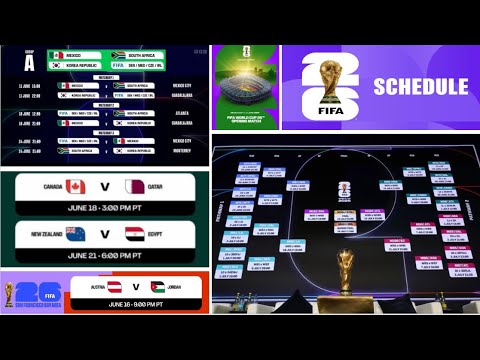
The FIFA World Cup 2026 is set to become one of the most historic sporting events ever organized. If you are looking for the FIFA World Cup 2026 June – July Schedule, this tournament is scheduled across June and July 2026 and will unite fans from every corner of the world as 48 national teams compete for football’s most prestigious trophy. Hosted jointly by the United States, Canada, and Mexico, the 2026 edition marks a groundbreaking moment in FIFA history, introducing a new tournament format, expanded participation, and a record-breaking number of matches.
The World Cup schedule is one of the most discussed topics among football fans, broadcasters, sponsors, tourism authorities, and national teams. The June–July calendar is carefully designed to balance competitive fairness, player recovery, global television audiences, travel logistics, and stadium operations across North America.
With 104 matches planned over more than a month, the FIFA World Cup 2026 promises a football festival unlike any previous edition. From the opening match in Mexico City on June 11 to the final in July, millions of supporters are expected to travel between cities while billions watch from around the globe.
This article provides a detailed and comprehensive overview of the FIFA World Cup 2026 June–July schedule, tournament format, host cities, match structure, knockout stages, logistical planning, economic impact, fan expectations, broadcasting innovations, and the overall significance of the tournament calendar.
The FIFA World Cup schedule is much more than a list of match dates. It serves as the organizational foundation of the entire tournament.
Scheduling decisions influence:
For FIFA World Cup 2026, scheduling became even more complex due to the tournament’s expansion from 32 to 48 teams and the involvement of three host nations.
The FIFA World Cup 2026 officially begins on June 11, 2026, and concludes with the final on July 19, 2026.
The expanded competition length reflects the addition of more teams and matches.
The tournament opener is scheduled to take place at the legendary Estadio Azteca in Mexico City.
This stadium holds enormous historical significance in world football.
With the 2026 opener, Estadio Azteca becomes the first stadium to host World Cup matches in three separate tournaments.
The FIFA World Cup 2026 introduces the largest expansion in tournament history.
This expansion increases opportunities for nations from every continent to participate.
The tournament will feature:
The format significantly increases the number of matches played during June and July.
FIFA designed the schedule carefully to manage player fatigue, travel distances, and stadium usage.
During the group stage:
The knockout rounds are spread across July to maximize:
The final weeks of the tournament are expected to generate massive international attention.
The United States will host the majority of matches, including later knockout rounds and the final.
Key American host cities include:
Canada will host matches in:
These cities are preparing extensive transportation and tourism upgrades.
Mexico’s host cities include:
Mexico’s football culture is expected to create one of the most energetic atmospheres of the tournament.
The group stage will dominate the first half of the tournament schedule.
The larger format means more nations will experience World Cup participation, creating additional excitement globally.
The 48-team structure benefits developing football nations from:
This creates a more inclusive tournament and increases worldwide engagement.
The knockout rounds are expected to become the centerpiece of global sports coverage in July 2026.
The newly introduced Round of 32 adds additional drama and unpredictability.
Teams advancing from the group stage will compete in direct elimination matches.
The Round of 16 often features clashes between football superpowers and emerging underdogs.
Historically, this stage has produced many iconic World Cup moments.
The quarterfinals represent the final stage before the tournament’s elite contenders emerge.
Global television audiences typically increase dramatically during this phase.
The semifinals and final are expected to become some of the most-watched sporting events in history.
The final scheduled for July 19, 2026, will crown the next world champion.
The geographic size of North America creates unique scheduling and travel challenges.
Teams and fans may travel thousands of kilometers between matches.
This affects:
Host nations are investing heavily in:
Efficient transportation will be essential for tournament success.
Summer weather conditions in North America may influence match scheduling.
Host cities experience different summer conditions:
FIFA may schedule certain matches during evening hours to reduce heat-related concerns.
Organizers are expected to implement:
The extended June–July tournament is expected to generate enormous economic benefits.
Millions of visitors are expected across North America.
Key sectors benefiting include:
The tournament will create temporary and permanent employment opportunities in:
The FIFA World Cup remains one of the most valuable broadcasting properties globally.
The expanded schedule means:
The 1994 FIFA World Cup provides valuable insights into the potential impact of the 2026 tournament.
The success of the 1994 tournament helped establish Major League Soccer (MLS).
The 2026 World Cup is expected to surpass 1994 due to:
Fans are central to the World Cup atmosphere.
Host cities will organize large-scale public celebrations including:
Technology will enhance fan participation through:
Social media is expected to play a major role in tournament engagement.
The FIFA World Cup is one of the most-watched events on Earth.
Billions of viewers are expected across television and streaming platforms.
Broadcast innovation may include:
The June–July schedule must accommodate audiences worldwide.
Match kickoff times are likely designed to maximize viewership across:
The 2026 schedule will feature football’s strongest national teams competing across North America.
The larger tournament format increases the potential for surprises and underdog stories.
The expanded June–July schedule raises concerns regarding player workload.
Clubs and national teams are increasingly focused on sports science and player recovery strategies.
The FIFA World Cup 2026 requires one of the largest sports security operations ever organized.
The three host nations are expected to coordinate closely on security planning.
Environmental sustainability is increasingly important in modern sporting events.
FIFA faces pressure to ensure the tournament aligns with climate and sustainability goals.
The World Cup is more than a sporting event—it is a global cultural celebration.
Fans from around the world gather to celebrate football, culture, and national pride.
The tournament promotes:
The 2026 World Cup may permanently reshape football’s role in North American sports culture.
The June–July tournament may leave a lasting legacy across multiple sectors.
The tournament could inspire future generations of players and fans throughout North America.
Long-term tourism and business investment may continue benefiting host cities after the tournament ends.
The success of the 2026 June–July schedule could influence future FIFA tournament planning.
FIFA may use lessons from 2026 to shape future global competitions.
The FIFA World Cup 2026 June–July schedule represents one of the most ambitious sporting calendars ever created. With 48 teams, 104 matches, and three host nations, the tournament promises a month of extraordinary football, global celebration, and historic moments.
Beginning on June 11, 2026, and concluding with the final on July 19, the tournament will showcase the world’s best players, passionate fan cultures, and advanced sports infrastructure across North America.
While logistical, environmental, and scheduling challenges remain important considerations, the World Cup also presents enormous opportunities for economic growth, tourism, cultural exchange, and football development.
The 2026 FIFA World Cup is expected to redefine the scale and global influence of international football tournaments. As anticipation continues to build, fans around the world are preparing for what may become one of the greatest World Cups in history.