

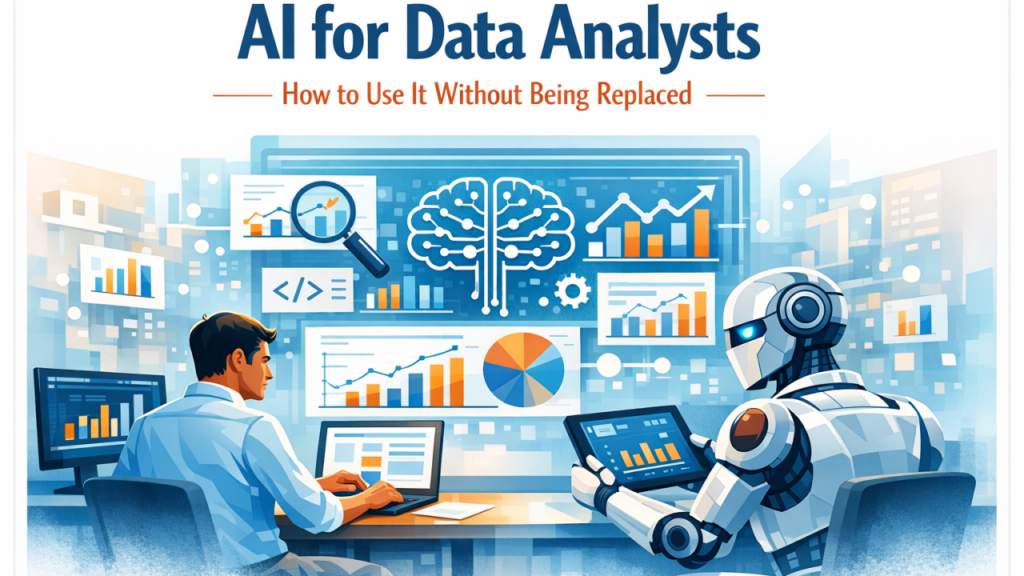
Artificial Intelligence (AI) has transformed the way organizations collect, process, analyze, and interpret data. Understanding how to use AI for data analysis and insights is now critical for staying competitive. From startups to multinational corporations, businesses are increasingly relying on AI-powered analytics to uncover patterns, automate repetitive tasks, predict outcomes, and gain strategic insights faster than ever before.
Traditional data analysis methods often require significant manual effort, advanced statistical expertise, and long processing times. AI changes this by enabling systems to learn from data, identify relationships, and generate recommendations with minimal human intervention. Whether you are a marketer, financial analyst, healthcare professional, entrepreneur, or student, understanding how to use AI for data analysis can provide a major competitive advantage.
In this article, you will learn how AI is used in data analysis, the tools and technologies involved, practical applications across industries, implementation strategies, challenges, best practices, and future trends shaping intelligent analytics.
AI-powered data analysis refers to the use of artificial intelligence technologies such as machine learning, natural language processing (NLP), computer vision, and deep learning to process and analyze large datasets. These technologies help automate data-related tasks and uncover insights that may be difficult for humans to identify manually.
Unlike traditional analytics, AI systems continuously improve their performance by learning from new data. This enables businesses to create more accurate forecasts, detect anomalies, personalize customer experiences, and make better decisions in real time.
The modern business environment generates enormous amounts of data every day. Social media interactions, customer transactions, IoT devices, online searches, and operational systems all contribute to massive datasets that are impossible to process manually at scale.
AI helps organizations convert raw information into actionable intelligence quickly and efficiently.
Research from multiple market studies indicates that organizations implementing AI analytics often achieve improved operational efficiency, increased revenue opportunities, and stronger customer engagement compared to companies relying solely on traditional reporting systems.
AI-driven data analysis typically follows a structured workflow. Understanding each stage helps businesses implement AI solutions more effectively.
AI systems gather data from multiple sources, including:
The more relevant and high-quality the data, the more accurate the insights generated by AI models.
Raw data often contains missing values, duplicates, inconsistencies, and formatting issues. AI tools can automate much of the data-cleaning process.
For example, machine learning algorithms can identify outliers, standardize inconsistent entries, and fill missing values using predictive methods.
After cleaning, AI systems process the information using algorithms designed to identify trends and relationships.
This stage may involve:
Machine learning models are trained using historical data. The system learns patterns and relationships between variables.
For example, a retail company may train a model using past sales data to predict future customer purchasing behavior.
Once trained, AI models generate insights, forecasts, recommendations, and alerts.
These insights can help organizations:
AI-powered dashboards transform complex findings into easy-to-understand visualizations.
Interactive charts and automated reports make it easier for decision-makers to act quickly.
Numerous AI-powered tools are available for organizations and individuals seeking advanced analytical capabilities.
These platforms combine visualization with AI-driven insights and predictive analytics.
These tools enable developers and data scientists to build custom AI models.
These platforms automate model building and provide user-friendly interfaces for advanced analytics.
No-code solutions make AI accessible to non-technical users.
Companies use AI to understand customer preferences, buying patterns, and engagement behaviors.
E-commerce platforms analyze browsing history, clicks, and purchase data to deliver personalized recommendations.
Streaming services use AI recommendation systems to increase viewer engagement and retention.
An online retailer may use AI to identify customers likely to abandon their shopping carts. The system can automatically trigger personalized discounts or reminder emails, improving conversion rates.
Financial institutions use AI to predict market trends, assess credit risks, and detect fraud.
Machine learning models can analyze historical transactions and flag suspicious activities in real time.
Healthcare organizations use AI to analyze patient data, improve diagnostics, and optimize treatment plans.
AI can identify disease patterns from medical imaging, electronic health records, and genetic data.
Hospitals using AI-assisted imaging systems have improved early detection rates for diseases such as cancer by identifying abnormalities that may be difficult for human radiologists to detect consistently.
AI helps marketers measure campaign performance and identify the most effective channels.
AI-driven analytics can:
AI enhances supply chain efficiency by forecasting demand, optimizing logistics, and reducing inventory waste.
Predictive analytics allows businesses to anticipate disruptions and adjust operations proactively.
HR departments use AI to analyze employee performance, predict turnover, and improve recruitment processes.
AI-powered recruitment tools can screen resumes and identify the most qualified candidates faster than traditional methods.
Predictive analytics is one of the most powerful applications of AI in data analysis.
By analyzing historical data, AI models can forecast future events and trends.
Telecommunications companies often use AI models to identify customers likely to cancel subscriptions.
The system analyzes variables such as:
Businesses can then proactively offer retention incentives to high-risk customers.
AI and big data work together to unlock deeper insights from massive datasets.
Big data refers to datasets so large and complex that traditional processing tools struggle to handle them efficiently.
AI makes big data analysis practical by automating pattern recognition and identifying meaningful relationships across billions of data points.
AI systems are particularly effective in managing all three dimensions simultaneously.
Natural Language Processing (NLP) enables AI systems to understand and analyze human language.
NLP is widely used for:
Brands use NLP to analyze customer reviews and social media comments.
AI categorizes feedback as positive, negative, or neutral, helping businesses understand public perception and improve products or services.
Data visualization plays a critical role in transforming analytical findings into understandable insights.
AI-powered visualization tools can automatically:
Modern BI platforms use AI to suggest the most effective visual representations for different types of data.
Despite its advantages, AI-driven analytics comes with several challenges organizations must address.
AI models are only as good as the data they receive. Poor-quality data can lead to inaccurate predictions and misleading insights.
Organizations handling sensitive information must ensure compliance with privacy regulations and cybersecurity standards.
Biases in training data can result in unfair or inaccurate outcomes.
For example, biased hiring datasets may lead to discriminatory recruitment recommendations.
Developing advanced AI systems may require substantial investments in infrastructure, software, and skilled professionals.
Many organizations struggle to find experienced data scientists, machine learning engineers, and AI specialists.
Some AI models operate as “black boxes,” making it difficult to understand how decisions are made.
To maximize the value of AI analytics, organizations should follow strategic best practices.
Ensure datasets are clean, consistent, complete, and up to date.
Define measurable goals before implementing AI solutions.
Examples include:
Select AI platforms that align with organizational needs, technical capabilities, and budget constraints.
Implement fairness, transparency, and accountability measures in AI systems.
Provide data literacy and AI training programs to help teams understand and leverage analytical insights effectively.
AI models should be continuously evaluated and updated to maintain accuracy over time.
Determine which business challenges could benefit from AI-driven insights.
Collect structured and unstructured data from reliable sources.
Select appropriate analytics platforms and machine learning frameworks.
Remove inconsistencies and ensure high data quality.
Use machine learning algorithms to analyze historical data and identify patterns.
Test model accuracy and refine algorithms when necessary.
Integrate AI systems into business workflows and continuously monitor performance.
Retailers use AI for personalized shopping experiences, inventory management, and demand forecasting.
Banks use AI for fraud prevention, credit scoring, and customer support automation.
Manufacturers rely on predictive maintenance and quality control analytics.
Hospitals and research institutions use AI for diagnostics and treatment optimization.
Educational institutions use AI to analyze student performance and personalize learning experiences.
Logistics companies use AI to optimize delivery routes and reduce operational costs.
The future of AI-driven analytics is highly promising. As computing power increases and machine learning algorithms become more advanced, organizations will gain even deeper insights from data.
Businesses that embrace these innovations early are likely to gain substantial competitive advantages.
A global retail company implemented AI-powered analytics to improve inventory management and customer targeting.
The company used machine learning models to analyze:
Results included:
By integrating AI into decision-making processes, the retailer significantly improved profitability and responsiveness to market trends.
Poor governance can lead to inconsistent datasets and unreliable outcomes.
Complex AI systems are not always better. Simpler models may provide more interpretable and practical insights.
AI implementation requires ongoing refinement, monitoring, and optimization.
Human expertise remains essential for interpreting insights and making strategic decisions.
Small or unrepresentative datasets reduce model effectiveness and reliability.
AI analytics is no longer limited to large enterprises. Affordable cloud-based solutions have made advanced analytics accessible to small businesses.
Many small businesses start with low-cost AI-powered dashboards and gradually expand into predictive analytics as their needs grow.
As AI becomes more integrated into business operations, ethical considerations become increasingly important.
Organizations should establish ethical AI policies and regularly audit systems for fairness and compliance.
AI has fundamentally changed the landscape of data analysis and business intelligence. By automating data processing, identifying hidden patterns, and generating predictive insights, AI empowers organizations to make smarter and faster decisions.
From healthcare and finance to retail and marketing, AI-driven analytics is helping industries improve efficiency, reduce costs, personalize experiences, and uncover new opportunities for growth.
However, successful implementation requires more than simply adopting technology. Organizations must focus on data quality, ethical practices, employee training, and continuous model improvement to unlock the full potential of AI analytics.
As AI technologies continue to evolve, businesses and professionals who develop strong data analysis capabilities will be better positioned to compete in an increasingly data-driven world. Learning how to use AI for data analysis today is not just a technological advantage—it is becoming a critical skill for future success.