

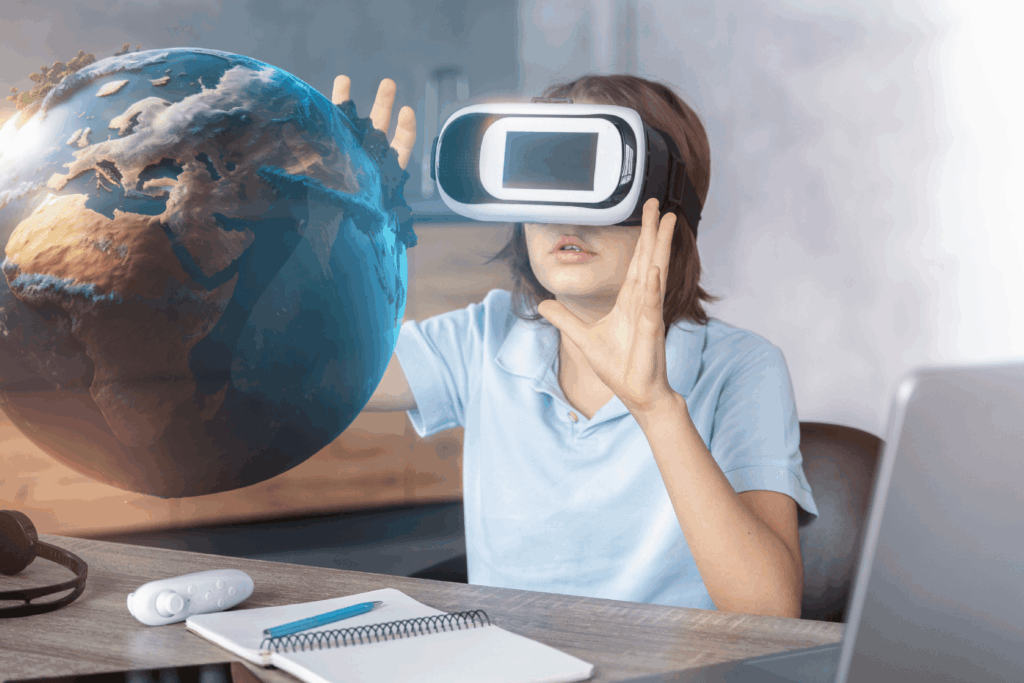
Education has undergone remarkable transformations throughout history, from traditional classroom instruction and printed textbooks to online learning platforms and artificial intelligence-powered tutoring systems. Among the most revolutionary innovations shaping the future of education is Virtual Reality (VR), particularly as immersive virtual reality experiences for education become more widespread. By creating immersive, interactive, and highly engaging learning environments, VR has the potential to redefine how students acquire knowledge, develop skills, and interact with educational content.
Immersive virtual reality experiences enable learners to step inside historical events, explore distant planets, conduct complex scientific experiments, practice surgical procedures, and engage in realistic simulations that would otherwise be impossible, dangerous, or prohibitively expensive. Unlike conventional learning methods, VR places students at the center of the educational experience, transforming passive observation into active participation.
As educational institutions, businesses, and governments invest in immersive technologies, virtual reality is increasingly being recognized as a powerful tool for enhancing learning outcomes, improving engagement, and preparing students for the challenges of the modern world. This article explores the rise of VR in education, its benefits, applications, challenges, and future potential.
Virtual Reality is a computer-generated environment that allows users to interact with digital spaces using specialized equipment such as VR headsets, motion controllers, and tracking systems.
In educational settings, VR creates immersive experiences that simulate real-world environments or entirely fictional scenarios designed to facilitate learning.
Key characteristics of educational VR include:
By engaging multiple senses simultaneously, VR can help learners better understand complex concepts and retain information more effectively.
The integration of technology into education has progressed through several stages over the past few decades.
Major milestones include:
Virtual reality represents the next major step in this evolution by moving beyond screen-based learning toward fully immersive educational experiences.
Research in cognitive science suggests that people often learn more effectively when they actively participate in experiences rather than simply reading or listening to information.
Immersive learning environments can improve:
By creating realistic scenarios, VR allows learners to practice concepts in context, making abstract ideas more concrete and understandable.
Experiential learning theory emphasizes learning through direct experience, reflection, and application.
Virtual reality aligns closely with this educational approach by allowing students to:
These experiences help bridge the gap between theoretical knowledge and practical understanding.
Virtual reality is increasingly being adopted in primary and secondary education.
Teachers use VR to make lessons more engaging and memorable.
Students can visit locations that would otherwise be inaccessible due to distance, cost, or logistical constraints.
Examples include:
These experiences provide contextual learning opportunities that traditional textbooks cannot replicate.
Rather than merely reading about historical events, students can virtually explore reconstructed environments and gain a deeper appreciation of historical contexts.
Immersive history lessons often increase student interest and engagement.
Universities are among the earliest adopters of educational VR technologies.
Higher education institutions use VR across numerous disciplines.
Medical schools increasingly employ VR simulations to teach anatomy, surgery, and patient care.
Students can:
VR allows repeated practice without risking patient safety.
Engineering students use virtual environments to design, test, and evaluate complex systems.
Benefits include:
Medical simulation is one of the most successful applications of educational VR.
Traditional medical training often relies on textbooks, lectures, cadavers, and supervised clinical experiences.
VR adds a powerful new dimension by allowing students to perform procedures in realistic virtual environments.
Research has shown that simulation-based learning can improve confidence, procedural accuracy, and skill retention among healthcare professionals.
Students can practice complex procedures multiple times before working with real patients.
Science, technology, engineering, and mathematics (STEM) education benefits significantly from immersive simulations.
Virtual laboratories enable students to conduct experiments that may be:
Examples include:
Virtual labs provide hands-on experiences while minimizing safety risks and operational costs.
Language acquisition often requires immersion and frequent practice.
VR can simulate authentic environments where learners interact with native speakers and real-world situations.
Potential applications include:
These immersive interactions help students develop practical communication skills more effectively than traditional classroom exercises alone.
Virtual reality also offers promising opportunities for students with diverse learning needs.
Potential benefits include:
Researchers continue to explore how VR can support students with autism spectrum disorders, learning disabilities, and other educational challenges.
Several educational programs have used VR to help students with autism practice social interactions in safe and controlled environments.
Scenarios may include:
These simulations allow learners to build confidence and practice skills without real-world pressures.
Beyond traditional education, VR has become an important tool for workforce training.
Organizations use immersive simulations for:
Employees can gain practical experience in realistic environments before facing real-world situations.
Educational institutions are increasingly adopting VR because of its numerous advantages.
Interactive environments often capture student attention more effectively than traditional teaching methods.
Experiential learning can help students remember information for longer periods.
Learners can make mistakes and learn from them without real-world consequences.
VR experiences can be adapted to individual learning needs and pacing.
Virtual environments can provide access to educational opportunities regardless of geographic location.
Numerous studies have highlighted the effectiveness of immersive learning technologies.
Although results vary depending on implementation and subject matter, evidence increasingly supports the educational value of immersive experiences.
Despite its potential, virtual reality faces several obstacles to widespread adoption.
VR hardware, software, and content development can require significant investment.
Some educational institutions lack the infrastructure necessary to support large-scale VR deployment.
High-quality educational VR content remains limited in certain subject areas.
Educators need professional development to effectively integrate VR into their teaching practices.
Some users experience motion sickness or discomfort during extended VR sessions.
Artificial intelligence is increasingly being integrated into virtual learning environments.
AI can enhance VR education through:
The combination of AI and VR has the potential to create highly individualized educational experiences.
Several emerging trends are expected to shape the future of VR in education.
As technology becomes more accessible, immersive learning experiences are likely to become increasingly common across educational levels.
The classroom of the future may blend physical and virtual learning spaces.
Students could:
Rather than replacing teachers, VR is likely to serve as a powerful tool that enhances instruction and expands educational possibilities.
As immersive technologies become more prevalent, educational institutions must address important ethical issues.
These include:
Responsible implementation requires careful planning and ongoing evaluation to ensure that benefits outweigh potential risks.
Immersive virtual reality experiences are transforming education by making learning more interactive, engaging, and experiential. From virtual field trips and historical recreations to medical simulations and corporate training programs, VR offers opportunities that traditional teaching methods often cannot provide. By placing learners directly within educational environments, virtual reality helps bridge the gap between theory and practice, improving engagement, understanding, and skill development.
Although challenges such as cost, infrastructure requirements, and content availability remain, ongoing technological advancements are steadily making VR more accessible and effective. The integration of artificial intelligence, collaborative virtual spaces, and increasingly sophisticated simulation tools promises to further enhance the educational potential of immersive learning environments.
As schools, universities, and organizations continue to explore innovative approaches to teaching and training, virtual reality is positioned to become a cornerstone of modern education. Its ability to create meaningful, memorable, and personalized learning experiences represents a significant step toward a future where education is not only more accessible but also more engaging and impactful for learners around the world.